
Last Updated: June 28, 2026
SBI PO Mains Syllabus 2025-26: Complete Topic-wise Syllabus, Weightage, Exam Pattern & Preparation Strategy
Before you start preparing for SBI PO Mains 2025-26, you need to know exactly what to study and where to focus. This guide breaks down the complete Mains syllabus — section by section, topic by topic, with weightage analysis and preparation strategy — so you can plan your preparation intelligently.
The SBI Probationary Officer Mains Examination is the most critical stage of the selection process, carrying 75% weightage in the final merit calculation. As per the official SBI PO notification, candidates who qualify the Prelims are called for the Mains exam, which consists of both Objective and Descriptive tests.
Unlike many other banking exams where Mains is similar to Prelims with additional sections, SBI PO Mains represents a significant leap in both difficulty level and scope. It’s designed to test analytical abilities, decision-making skills, and comprehensive knowledge required for a Probationary Officer role in India’s largest public sector bank.
The SBI PO Mains syllabus is comprehensive, testing five core competency areas: Reasoning & Computer Aptitude — Analytical thinking and technical awareness, Data Analysis & Interpretation — Quantitative and analytical skills, General/Economy/Banking Awareness — Current affairs and banking knowledge, English Language — Communication and comprehension abilities, and Descriptive Writing — Formal writing skills for banking correspondence.
This comprehensive guide provides the complete SBI PO Mains Syllabus based on official notifications, previous year question papers, and analysis from successful candidates who have cleared this challenging stage.
📘 Table of Contents
- Introduction: Why Mains is the Decisive Stage
- SBI PO Mains Exam Overview
- SBI PO Mains Exam Pattern 2025-26
- SBI PO Mains Syllabus – Topic-wise & Section-wise
- Reasoning & Computer Aptitude
- Data Analysis & Interpretation
- General/Economy/Banking Awareness
- English Language
- Descriptive Test
- Topic-wise Weightage Analysis
- Difficulty Level & PYQ Trends
- High-Weight & Scoring Topics
- Section-wise Preparation Strategy
- Descriptive Test: Letter & Essay Writing
- Common Mistakes to Avoid
- Frequently Asked Questions
- Suggested Next Reads
- Conclusion
⚡ Quick Summary – SBI PO Mains Syllabus 2025-26
- Total Questions: 155 Objective + 2 Descriptive
- Total Marks: 200 (Objective) + 50 (Descriptive) = 250
- Duration: 3 hours (Objective) + 30 minutes (Descriptive)
- Sections: 4 Objective sections + Descriptive Test
- Negative Marking: 0.25 per wrong answer
- Final Weightage: 75% of written test marks
- Key Focus Areas: Data Interpretation, Puzzles, Banking Awareness, Essay Writing
Introduction: Why Mains is the Decisive Stage of Your SBI PO Journey
The SBI PO Mains examination is not just another test — it’s the stage that determines your entire banking career. Unlike Prelims which is purely qualifying, your Mains score carries 75% weightage in the final selection process. The interview carries the remaining 25%, making Mains the most important written examination you’ll face.
Every year, thousands of candidates who clear Prelims with ease find themselves struggling in Mains because they underestimate the jump in difficulty and syllabus breadth. The Mains exam tests deeper conceptual understanding, broader knowledge areas, and better time management skills.
This comprehensive guide covers the complete SBI PO Mains syllabus for 2025-26, including section-wise topic breakdown, weightage analysis, difficulty trends, descriptive test details, and strategic preparation tips to help you maximize your score and secure a top rank.
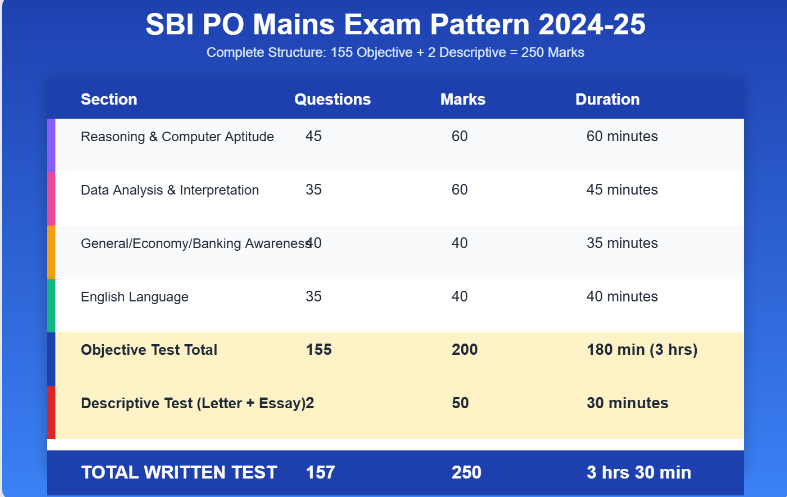
Complete Exam Pattern Overview: SBI PO Mains Structure
SBI PO Mains Exam Overview
Before diving into the detailed syllabus, let’s understand the fundamental characteristics of the SBI PO Mains examination:
Key Examination Characteristics
| Aspect | Details |
|---|---|
| Exam Mode | Online Computer-Based Test (CBT) for both Objective & Descriptive |
| Question Types | Objective MCQs + Descriptive Typing Test |
| Timing System | Sectional timing for Objective Test (strict enforcement) |
| Language Options | English and Hindi (except English Language section) |
| Selection Impact | 75% weightage in final merit (with 25% for Interview) |
| Descriptive Test | 50 marks, qualifying in nature, evaluated only for Mains qualifiers |
| Overall Selection | Mains + Group Exercise & Interview + Psychometric Test |
Why SBI PO Mains is More Challenging Than Prelims
| Factor | SBI PO Prelims | SBI PO Mains |
|---|---|---|
| Sections Tested | 3 sections | 5 components (4 objective + descriptive) |
| Syllabus Depth | Basic concepts | Advanced applications & analytical thinking |
| Data Interpretation | Basic charts & tables | Complex DI, Caselets, Advanced calculations |
| Reasoning Puzzles | Moderate complexity | High complexity with multiple variables |
| Computer Aptitude | Not tested | 8-10 questions with practical banking focus |
| General Awareness | Not tested | 40 questions with banking/economy emphasis |
| Descriptive Test | Not applicable | Letter & Essay writing (50 marks) |
| Time Pressure | High (60 mins for 100 Qs) | Very High (180 mins for 157 Qs) |
- Data Interpretation mastery – Most challenging section with highest time consumption
- Puzzle-solving efficiency – Complex puzzles can make or break your Reasoning score
- Descriptive writing practice – 50 marks that many candidates underestimate
- Current affairs depth – Not just facts but understanding implications for banking
- Time management across sections – Strict sectional timing requires discipline
SBI PO Mains Exam Pattern 2025-26
Understanding the exam pattern is crucial for developing an effective preparation strategy. The SBI PO Mains follows a structured pattern with clear sectional divisions and timing.
Complete Exam Pattern Structure
| Test Component | No. of Questions | Maximum Marks | Duration |
|---|---|---|---|
| Objective Test (Total) | 155 | 200 | 3 hours |
| • Reasoning & Computer Aptitude | 45 | 60 | 60 minutes |
| • Data Analysis & Interpretation | 35 | 60 | 45 minutes |
| • General/Economy/Banking Awareness | 40 | 40 | 35 minutes |
| • English Language | 35 | 40 | 40 minutes |
| Descriptive Test | 2 | 50 | 30 minutes |
| Total (Written Test) | 157 | 250 | 3 hours 30 minutes |
Marking Scheme Details
| Response Type | Objective Test | Descriptive Test |
|---|---|---|
| Correct Answer | +1 mark per question | 25 marks per question (evaluated) |
| Wrong Answer | -0.25 marks deduction | No penalty (evaluation based) |
| Unattempted | 0 marks | 0 marks |
- Reasoning (60 mins for 45 Qs): 1.33 minutes per question – Puzzles need 5-7 minutes each
- DI (45 mins for 35 Qs): 1.29 minutes per question – DI sets need 15-20 minutes for 5 questions
- General Awareness (35 mins for 40 Qs): 52 seconds per question – Fastest if well-prepared
- English (40 mins for 35 Qs): 68 seconds per question – Comfortable pace
- Descriptive (30 mins for 2): 12 mins for letter, 15 mins for essay, 3 mins review
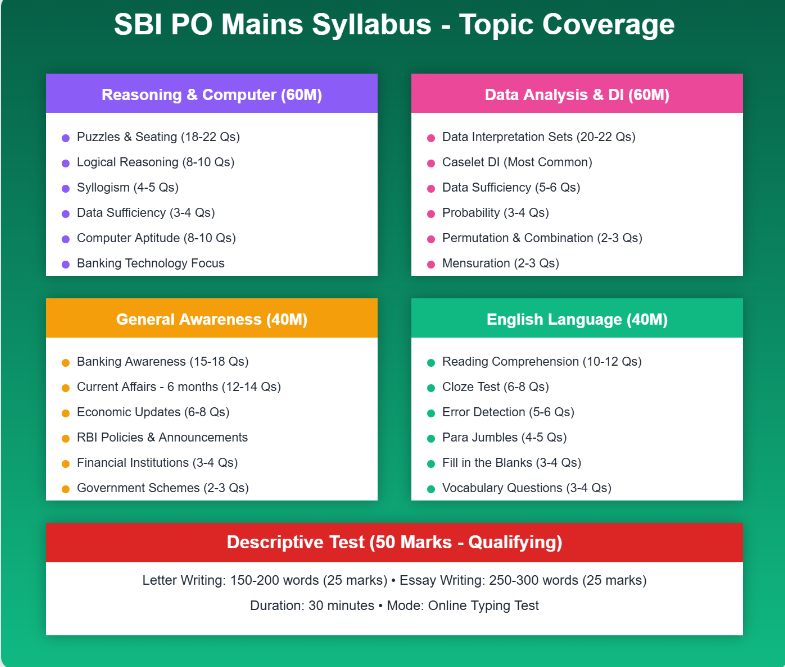
SBI PO Mains Exam Pattern Structure
SBI PO Mains Syllabus – Topic-wise & Section-wise
Now let’s dive deep into each section’s syllabus with comprehensive topic coverage, expected weightage, and preparation priorities.
1. Reasoning & Computer Aptitude (45 Questions | 60 Marks)
Difficulty Level: Moderate to Difficult
Time Allocated: 60 minutes
Focus Areas: Complex puzzles + Computer fundamentals + Banking technology
Marks Weightage: Highest per section (60 marks)
This section combines logical reasoning with computer knowledge, testing analytical thinking and technical awareness simultaneously. The puzzles in SBI PO Mains are significantly more complex than in Prelims.
Complete Reasoning Topics Syllabus
| Topic | Sub-topics / Question Types | Expected Questions | Difficulty |
|---|---|---|---|
| Puzzles & Seating Arrangement | Linear arrangement (single/double row), Circular arrangement, Floor-based puzzles, Box-based puzzles, Scheduling puzzles, Category-based puzzles, Comparison-based puzzles | 18–22 | Difficult |
| Logical Reasoning | Statement-Assumptions, Statement-Conclusions, Statement-Arguments, Statement-Courses of Action, Cause-Effect relationships, Strengthening/Weakening arguments | 8–10 | Moderate |
| Syllogism | Direct conclusions, Possibility cases, Either-or cases, Coded syllogism | 4–5 | Easy-Moderate |
| Data Sufficiency | Two-statement problems, Logical data sufficiency, Quantitative data sufficiency | 3–4 | Moderate |
| Input-Output | Machine input-output, Word/number rearrangement, Step-based operations | 2–3 | Moderate |
| Blood Relations | Coded relationships, Family tree problems, Generation-based questions | 2–3 | Easy-Moderate |
| Direction Sense | Complex direction problems, Shadow-based directions, Distance calculations | 2–3 | Easy-Moderate |
| Inequality | Coded inequality, Direct inequality, Combined statements | 1–2 | Easy |
Complete Computer Aptitude Topics Syllabus
| Computer Topic | Coverage Areas | Expected Questions |
|---|---|---|
| Computer Fundamentals | Input/output devices, Memory types (RAM, ROM, Cache), Storage devices, Computer generations, Basic architecture | 1–2 |
| Operating Systems | Windows basics, Linux fundamentals, File management, System utilities | 1 |
| MS Office Suite | MS Word features, MS Excel formulas & functions, MS PowerPoint basics, Keyboard shortcuts | 1–2 |
| Internet & Networking | Internet protocols (HTTP, HTTPS, FTP), Email protocols (SMTP, POP3), Network types (LAN, WAN, MAN), IP addressing basics, Cloud computing concepts | 2 |
| Cyber Security | Malware types (virus, worm, trojan), Phishing & hacking, Encryption methods, Digital signatures, Two-factor authentication | 1–2 |
| Banking Technology | Core Banking Solutions (CBS), ATM technology, Mobile banking security, UPI, NEFT, RTGS, IMPS, Blockchain basics, Fintech innovations | 2–3 |
- Start with Computer Aptitude (5-7 mins): Factual, quick scoring
- Solve Syllogism & Inequality (4-5 mins): Formula-based, high accuracy
- Attempt Logical Reasoning (8-10 mins): Moderate difficulty, good marks
- Puzzle Selection (2 mins scanning): Identify easiest-looking sets
- Solve 2-3 puzzle sets (25-30 mins): Complete easier ones first
- Data Sufficiency & others (8-10 mins): Remaining questions
- Target 30-35 correct attempts: Don’t chase all 45 questions
2. Data Analysis & Interpretation (35 Questions | 60 Marks)
Difficulty Level: Difficult
Time Allocated: 45 minutes
Focus Areas: Complex DI sets + Advanced arithmetic + Data sufficiency
Marks Weightage: Highest marks per question (~1.71 marks)
This is often considered the most challenging section of SBI PO Mains. The DI sets are calculation-intensive, and questions test both quantitative skills and analytical thinking.
Complete Topic-wise Syllabus
| Topic | Sub-topics / Question Types | Expected Questions | Difficulty |
|---|---|---|---|
| Data Interpretation | Table DI (multiple tables), Bar Graph (grouped, stacked), Line Chart (trend analysis), Pie Chart (angular degree calculations), Caselet DI (paragraph-based), Mixed Graphs (combination), Missing Data DI, Radar/Web Charts | 20–22 | Difficult |
| Data Sufficiency | Quantitative data sufficiency, Logical data sufficiency, Two-statement problems, Yes/No type questions | 5–6 | Moderate-Difficult |
| Probability | Basic probability calculations, Conditional probability, Cards/dice/coins problems, Probability with combinations | 3–4 | Moderate |
| Permutation & Combination | Arrangement problems, Selection problems, Circular permutations, Application-based questions | 2–3 | Moderate-Difficult |
| Mensuration | Area/volume calculations, Surface area problems, Geometry applications, 3D shapes problems | 2–3 | Moderate |
| Miscellaneous | Quadratic equations, Number series, Simplification | 1–2 | Easy-Moderate |
- Start with Data Sufficiency (6-8 mins): Logical approach, less calculation
- Attempt Probability/P&C (6-7 mins): Formula-based, moderate difficulty
- Scan all DI sets quickly (2 mins): Identify easiest-looking sets
- Solve 2 DI sets completely (20-25 mins): Choose wisely, focus on accuracy
- Mensuration/Miscellaneous (4-5 mins): Quick questions if time permits
- Target 20-25 correct attempts: Quality over quantity due to high marks
- Use approximation aggressively: Exact calculations waste time
3. General/Economy/Banking Awareness (40 Questions | 40 Marks)
Difficulty Level: Moderate
Time Allocated: 35 minutes
Focus Areas: Banking awareness + Current economic affairs + Financial terms
Preparation Window: Last 6-8 months current affairs
This section tests your awareness of current events, banking developments, economic policies, and financial terms. Well-prepared candidates can score very high in this section as it’s based on factual knowledge.
Complete Topic-wise Syllabus
| Topic Category | Specific Coverage | Expected Questions |
|---|---|---|
| Banking Awareness | RBI policies and announcements, Monetary Policy Committee decisions, Banking regulations and reforms, Digital banking initiatives, Payment systems (UPI, RTGS, NEFT, IMPS), Banking terms and abbreviations, Types of bank accounts, Loan products and schemes, Merger and acquisition news, Non-Performing Assets (NPAs), Priority sector lending | 15–18 |
| Current Affairs | National news and events, International developments, Sports achievements, Awards and honors, Books and authors, Appointments and resignations, Important days and themes, Government policies and initiatives, Summits and conferences | 12–14 |
| Economic Awareness | Union Budget highlights, Economic Survey key findings, GDP growth estimates, Inflation trends (CPI, WPI), Fiscal deficit targets, Foreign trade and exchange rates, Stock market indices (Sensex, Nifty), Economic reforms and policies, International economic organizations | 6–8 |
| Financial Institutions | Functions of RBI, SEBI, IRDAI, PFRDA, NABARD and rural credit, SIDBI and small industries, EXIM Bank and foreign trade, Credit rating agencies (CRISIL, CARE, ICRA), International financial institutions (IMF, World Bank) | 3–4 |
| Government Schemes | Financial inclusion schemes, Social welfare programs, Agricultural schemes, Skill development initiatives, Digital India programs, Startup and entrepreneurship schemes | 2–3 |
- Daily reading habit: 30-40 minutes of financial newspapers (Economic Times, Business Standard)
- RBI focus: Subscribe to RBI’s press releases and monetary policy statements
- Monthly consolidation: Use monthly current affairs compilations
- Static GK integration: Link current events with static facts
- Weekly quizzes: Test retention through practice tests
- Target 32-36 correct attempts: High accuracy achievable with preparation
- Time allocation: Complete section in 25-30 minutes, keep buffer for review
4. English Language (35 Questions | 40 Marks)
Difficulty Level: Moderate
Time Allocated: 40 minutes
Focus Areas: Reading comprehension + Grammar + Vocabulary in context
Special Note: Available only in English
The English Language section in SBI PO Mains tests comprehensive language skills through various question types. The reading passages are longer and more complex than in Prelims.
Complete Topic-wise Syllabus
| Topic | Question Types | Expected Questions | Difficulty |
|---|---|---|---|
| Reading Comprehension | Main idea/theme identification, Inference and deduction questions, Author’s tone and purpose, Vocabulary in context, Fact-based questions, Title selection, Paragraph summary | 10–12 | Moderate |
| Cloze Test | Context-based word selection, Grammar-appropriate fills, Logical flow maintenance, Theme-based passages (banking/economy) | 6–8 | Moderate |
| Error Detection / Sentence Correction | Subject-verb agreement, Tense consistency, Preposition errors, Article usage, Pronoun errors, Modifier placement, Parallel structure | 5–6 | Easy-Moderate |
| Para Jumbles / Sentence Rearrangement | Logical sequence identification, Connector word recognition, Opening and concluding sentences, Coherent paragraph formation | 4–5 | Moderate |
| Fill in the Blanks | Single blank (grammar/vocabulary), Double blanks (context + grammar), Phrase replacement | 3–4 | Easy-Moderate |
| Vocabulary-based Questions | Synonyms, Antonyms, Idioms and phrases, One-word substitution, Spelling corrections | 3–4 | Easy-Moderate |
- Start with Error Detection (4-5 mins): Quick scoring, builds confidence
- Attempt Cloze Test next (5-6 mins): Context-based, manageable
- Solve Para Jumbles (4-5 mins): Identify opening/closing sentences
- Tackle Reading Comprehension (12-15 mins): When most focused
- Fill in the Blanks (3-4 mins): Quick questions
- Vocabulary questions (3-4 mins): Skip if completely unfamiliar
- Target 28-32 correct attempts: 80-90% accuracy achievable
- Keep 3-4 minutes buffer: Final review and marking
5. Descriptive Test (2 Questions | 50 Marks)
Duration: 30 minutes
Components: Letter Writing + Essay Writing
Mode: Online typing test
Nature: Qualifying (must secure passing marks)
Descriptive Test Format
| Component | Word Limit | Marks | Time Recommended |
|---|---|---|---|
| Letter Writing | 150-200 words | 25 | 12 minutes |
| Essay Writing | 250-300 words | 25 | 15 minutes |
| Proofreading | – | – | 3 minutes |
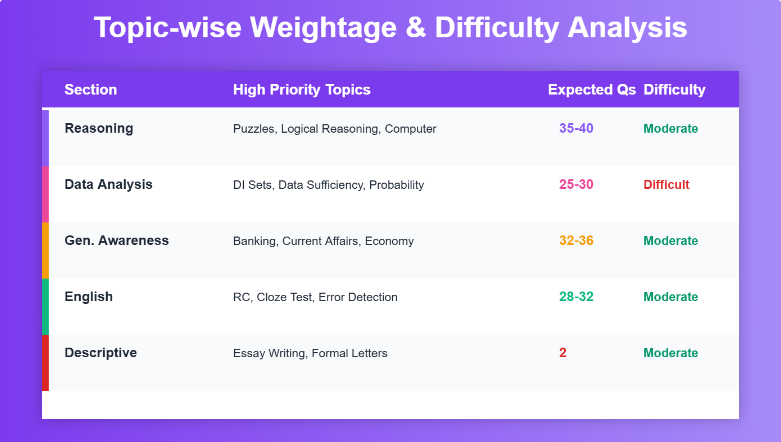
Topic Weightage & Difficulty Analysis: Priority Areas for SBI PO Mains
Topic-wise Weightage Summary
Here’s a consolidated view of high-weightage topics across all sections that should be your preparation priorities:
| Section | High-Weight Topics (Priority 1) | Medium-Weight Topics (Priority 2) |
|---|---|---|
| Reasoning & Computer | Puzzles & Seating Arrangement, Logical Reasoning, Computer Aptitude (Banking Tech) | Syllogism & Data Sufficiency, Input-Output, Blood Relations & Direction |
| Data Analysis & DI | Data Interpretation Sets, Data Sufficiency, Probability | Permutation & Combination, Mensuration, Miscellaneous Quant |
| General Awareness | Banking Awareness, Current Affairs (6 months), Economic Updates | Financial Institutions, Government Schemes, Static Banking GK |
| English Language | Reading Comprehension, Cloze Test, Error Detection | Para Jumbles, Fill in the Blanks, Vocabulary |
| Descriptive Test | Essay Writing (Banking/Economy), Formal Letter Writing | Vocabulary & Grammar, Typing Speed Practice |
Difficulty Level & PYQ Trends
Analyzing previous year question papers helps understand the evolving difficulty pattern and prepare accordingly.
| Section | 2023-24 Difficulty | Trend Observed | Preparation Focus |
|---|---|---|---|
| Reasoning & Computer | Moderate-Difficult | Puzzles more complex, Computer more banking-focused | Practice complex puzzles, study banking technology |
| Data Analysis & DI | Difficult | Caselet DI dominant, calculation-intensive | Focus on caselets, improve calculation speed |
| General Awareness | Moderate | Banking-heavy, current economic affairs | Daily banking news, RBI updates |
| English Language | Moderate | RC passages longer, vocabulary contextual | Read editorials, practice comprehension |
| Descriptive Test | Moderate | Banking/economic topics preferred | Practice banking essays, formal letters |
High-Weight & Scoring Topics
Focusing on these high-weight topics can significantly improve your SBI PO Mains score:
| Section | Most Scoring Topics | Potential Marks |
|---|---|---|
| Reasoning & Computer | Computer Aptitude, Syllogism, Inequality | 15-20 marks |
| Data Analysis | Data Sufficiency, Probability, Mensuration | 15-20 marks |
| General Awareness | Banking Awareness, Current Affairs | 30-35 marks |
| English Language | Error Detection, Fill in the Blanks | 8-10 marks |
| Descriptive Test | Letter Writing, Essay Structure | 40-45 marks |
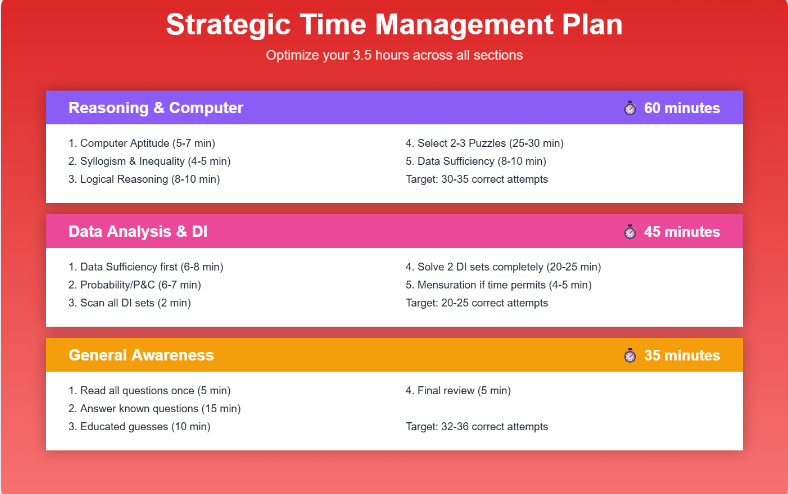
Strategic Time Management Plan: Section-wise Allocation for SBI PO Mains
Section-wise Preparation Strategy
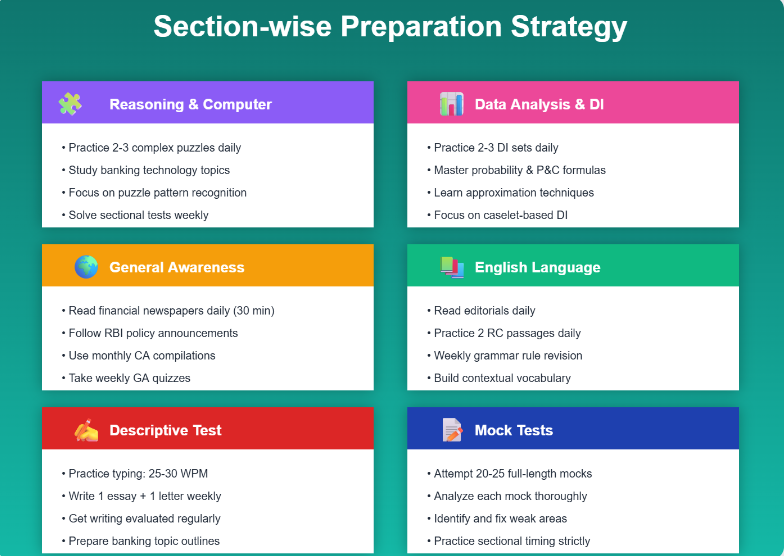
Reasoning & Computer Aptitude
- Daily puzzle practice: 2-3 complex puzzles daily
- Computer study: Focus on banking technology, cyber security
- Logical reasoning: Practice statement-based questions
- Time management: Practice with 60-minute sectional tests
Data Analysis & Interpretation
- DI practice: 2-3 DI sets daily under timed conditions
- Concept clarity: Master probability, P&C formulas
- Approximation skills: Learn quick calculation methods
- Caselet focus: Practice paragraph-based DI extensively
General Awareness
- Daily reading: 30 minutes financial newspapers
- RBI updates: Follow monetary policy statements
- Monthly revision: Use current affairs compilations
- Weekly tests: Practice GA quizzes
English Language
- Daily reading: Editorials from economic newspapers
- RC practice: 2 passages daily with timed solving
- Grammar revision: Weekly grammar rule review
- Vocabulary building: Contextual learning from reading
Descriptive Test
- Typing practice: Target 25-30 wpm typing speed
- Weekly writing: 1 essay + 1 letter weekly
- Feedback: Get writing evaluated by mentors/peers
- Topic preparation: Prepare outlines for common banking topics
Descriptive Test: Letter & Essay Writing
Evaluation Criteria
- Content (40%): Relevance, depth, coverage
- Structure (30%): Organization, logical flow
- Language (20%): Grammar, vocabulary, expression
- Presentation (10%): Format, neatness, word limit adherence
Common Mistakes in Descriptive Test
- Exceeding word limit significantly
- Poor structure and organization
- Grammatical and spelling errors
- Irrelevant content or deviation from topic
- Informal language in formal letters
- Incomplete or abrupt ending
Preparation Strategy Roadmap: 90-Day Plan for SBI PO Mains Success
Common Mistakes to Avoid
- Underestimating Descriptive Test: 50 marks can make significant difference
- Over-attempting puzzles: Complex puzzles consume disproportionate time
- Neglecting Computer Aptitude: Easy marks lost due to lack of preparation
- Poor time allocation in DI: Spending too much time on one DI set
- Last-minute GA preparation: Current affairs requires consistent daily reading
- Ignoring mock test analysis: Practice without analysis yields limited improvement
- Not practicing typing: Slow typing affects descriptive test performance
Frequently Asked Questions (FAQs) – SBI PO Mains Syllabus 2025-26
SBI PO Mains carries 75% weightage in the written test component. The final merit is calculated as: (Mains Score ÷ 250 × 75) + (Interview Score ÷ 50 × 25).
Descriptive Test is qualifying in nature (must secure passing marks) but the marks are added to Objective Test marks for preparing the final merit list for interview shortlisting.
Both Reasoning & Computer Aptitude and Data Analysis & Interpretation sections carry 60 marks each, making them the highest-scoring sections.
Prepare at least 6-8 months of current affairs before the exam date, with special focus on banking, economy, RBI policies, and significant national/international events.
Yes, SBI PO Mains has both sectional and overall cut-offs. You must clear minimum qualifying marks in each section as well as the total score cut-off.
Computer questions focus on banking technology, cyber security, digital banking, internet basics, MS Office, and practical computer applications relevant to banking.
Suggested Next Reads
Conclusion
The SBI PO Mains Examination is a comprehensive test designed to select future banking leaders for India’s largest public sector bank. With its challenging objective test, descriptive writing component, and high competition level, it tests candidates across multiple dimensions of knowledge, skills, and analytical abilities.
Success in SBI PO Mains requires strategic preparation focusing on high-weightage topics, effective time management across all sections, consistent practice with mock tests and analysis, balanced approach to clear sectional cut-offs, and descriptive writing proficiency with good typing speed.
Remember, SBI PO Mains is not just about knowledge—it’s about applying knowledge under pressure with strategic precision. Thousands of candidates clear this stage every year, and with the right preparation and mindset, you can be one of them.
- Week 1-2: Focus on weak areas identified through mock tests
- Week 3: Take 2-3 full-length mocks with descriptive test
- Week 4: Revise formulas, banking awareness, practice essay writing
- Last week: Light revision, current affairs update, rest and mental preparation
📌 For the latest updates and official notification, visit SBI Careers — sbi.co.in/careers