
Last Updated: June 28, 2026
SBI PO Selection Process 2026: Complete Stage-by-Stage Breakdown
Understanding the SBI PO selection process is the first step toward cracking this prestigious exam. This comprehensive guide breaks down every stage – Prelims, Mains, Interview, and Group Exercises – with detailed patterns, marking schemes, and strategies to help you navigate each phase successfully.
The State Bank of India Probationary Officer exam is one of India’s most competitive banking recruitment processes. Unlike clerical-level exams, SBI PO follows a rigorous three-stage selection framework designed to identify candidates with both academic excellence and leadership potential. The competition is intense – with 15-20 lakh applicants competing for roughly 2,000-2,500 seats annually.
This guide gives you a complete, stage-by-stage breakdown of the SBI PO selection process. From the Prelims screening to the final interview and document verification, you’ll understand exactly what each stage entails, how marks are calculated, and what you need to do to succeed at every step.
📘 Table of Contents
- Introduction: What Makes SBI PO Selection Unique
- Selection at a Glance
- Stage 1: Prelims Exam (Qualifying)
- Exam Pattern & Marking Scheme
- Qualification Criteria
- Stage 2: Mains Exam (75% Weightage)
- Objective Test Pattern
- Descriptive Test Details
- Qualifying Marks
- Stage 3: Interview & Group Exercises (25% Weightage)
- Personal Interview Assessment
- Group Exercises Format
- Interview Cut-off
- Final Merit Calculation
- Normalisation Explained
- Document Verification Checklist
- Probation Period & Training
- Frequently Asked Questions
- Suggested Next Reads
- Conclusion
⚡ Quick Summary – SBI PO Selection Process 2026
- Three Stages: Prelims → Mains → Interview & Group Exercises
- Prelims: Qualifying only (0% weightage in final selection)
- Mains: 75% weightage (200 marks objective + 50 descriptive)
- Interview & GE: 25% weightage (50 marks)
- Descriptive Test: Mandatory and qualifying (Letter + Essay)
- Final Score: (Mains Score ÷ 200) × 75 + (Interview Score ÷ 50) × 25
- Normalisation: Applied only for Prelims (multiple shifts)
- Probation: 2 years with intensive management training
Introduction: What Makes SBI PO Selection Different
The SBI Probationary Officer exam isn’t your typical banking test – it’s a management trainee selection process designed to identify future leaders for India’s largest public sector bank. The three-stage filter tests not just your academic knowledge but also your personality, communication skills, and leadership potential.
Unlike clerical exams that stop at written tests, SBI PO includes a descriptive writing component, a personal interview, and group exercises. This comprehensive approach ensures that selected candidates possess not only strong technical skills but also the interpersonal abilities required to thrive in a demanding banking environment.
Understanding this process in detail is the first step toward strategic preparation. When you know exactly what each stage demands, you can allocate your time and effort more effectively, focusing on areas that carry the most weight in final selection.
- Prelims – Screening only. Marks don’t count in the final list.
- Mains – 75% weightage. This is where the real battle begins.
- Interview + Group Exercises – 25% weightage. Can make or break your rank.
Selection at a Glance
Here’s the complete journey from application to appointment – a step-by-step breakdown of what happens at each stage.
| Stage | Purpose | Weightage |
|---|---|---|
| Prelims | Shortlists candidates for Mains | 0% (Qualifying only) |
| Mains | Tests knowledge & writing ability | 75% |
| Interview & GE | Assesses personality & leadership | 25% |
| Final Selection | Combined score determines merit | 100% |
Prelims marks do not carry forward to the final selection. Your final rank depends entirely on Mains (75%) + Interview (25%). Even if you scrape through Prelims, you can still top the final list by acing the next two stages.
Complete Selection Timeline
- Apply Online – Fill application form, pay fees, upload documents
- Appear for Prelims – Clear sectional and overall cut-offs
- Shortlisted for Mains – Based on Prelims performance (10-20 times vacancies)
- Appear for Mains – Objective test + Descriptive test (letter & essay)
- Shortlisted for Interview – Based on Mains performance (3-4 times vacancies)
- Appear for Interview & Group Exercises – Personal assessment round
- Final Merit List – Prepared using Mains (75%) + Interview (25%)
- Provisional Allotment – Based on merit & preferences
- Document Verification – Original certificates checked
- Training & Probation – 2-year management trainee program
Stage 1: Prelims Exam (Qualifying)
The Prelims exam serves as a gatekeeper – it’s designed to filter out the majority of applicants quickly. Three sections, 60 minutes, and every second counts.
Exam Pattern
| Section | Questions | Marks | Time |
|---|---|---|---|
| English Language | 30 | 30 | 20 minutes |
| Quantitative Aptitude | 35 | 35 | 20 minutes |
| Reasoning Ability | 35 | 35 | 20 minutes |
| Total | 100 | 100 | 60 minutes |
You cannot switch between sections before the 20 minutes are up. Each section has a fixed time slot – use it wisely and don’t waste time hoping to make up in another section.
Marking Scheme
- ✔ +1 for correct answer
- ❒ –0.25 for wrong answer
- âž– No penalty for leaving questions unanswered
In Prelims, a candidate with 70 correct out of 90 attempts (77.7% accuracy) often beats someone with 80 correct out of 110 attempts (72.7% accuracy). Negative marking is brutal – focus on accuracy, not just attempts.
Qualification Criteria
To make it to Mains, you need to clear both:
- Sectional Cut-off – minimum marks in each of the three sections
- Overall Cut-off – minimum total marks across all sections
Cut-offs vary by category – SC/ST/OBC/PwBD candidates get lower thresholds compared to General/EWS candidates.
How many get through? SBI typically shortlists candidates for Mains in the ratio of 10-20 times the number of vacancies. For approximately 2,500 vacancies, around 25,000-50,000 candidates are called for Mains.
Stage 2: Mains Exam (75% Weightage)
This is where the real battle happens. The Mains exam carries 75% weightage in your final score – performing well here is non-negotiable for final selection.
Objective Test Pattern
| Section | Questions | Marks | Time |
|---|---|---|---|
| Reasoning & Computer Aptitude | 45 | 60 | 60 minutes |
| Data Analysis & Interpretation | 35 | 60 | 45 minutes |
| General/Economy/Banking Awareness | 40 | 40 | 35 minutes |
| English Language | 35 | 40 | 40 minutes |
| Total | 155 | 200 | 180 minutes |
Descriptive Test Details
| Task | Word Limit | Marks | Time |
|---|---|---|---|
| Letter Writing | 150-200 words | 25 | 30 minutes |
| Essay Writing | 250-300 words | 25 |
The descriptive test is qualifying – your marks here don’t get added to your Mains score. However, if you score below the minimum (8/50 for General/OBC, 6/50 for SC/ST/PwBD), you’re disqualified. Even if you aced the objective section.
Marking Scheme (Mains)
- ✔ +1 for correct answer in objective test
- ❒ –0.25 for wrong answer in objective test
- ✔ Descriptive test – qualifying only (marks not added to objective score)
Mains is conducted in a single shift, so there’s no normalisation here. Everyone gets the same paper, and cut-offs are straightforward.
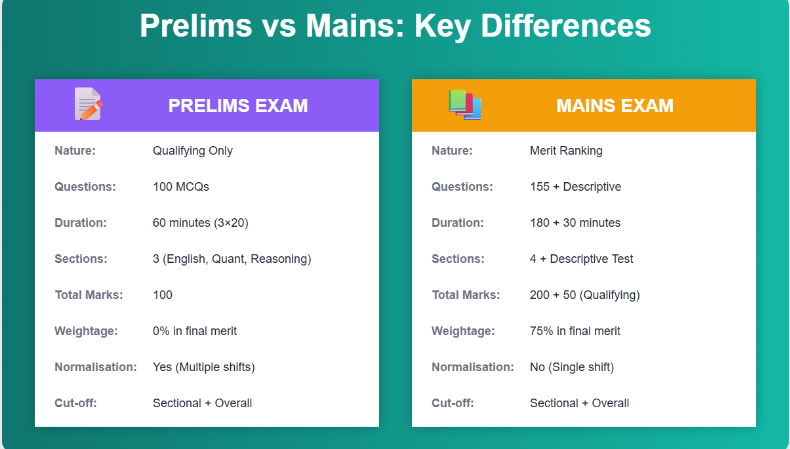
Prelims vs Mains – Key Differences in SBI PO Selection
Stage 3: Interview & Group Exercises (25% Weightage)
The final frontier. This stage carries 25% weightage and tests things no written exam can – your communication, confidence, leadership, and ability to work in a team.
| Component | Duration | Marks | Focus Areas |
|---|---|---|---|
| Personal Interview | 20-30 minutes | 30 | Banking awareness, current affairs, academics, personality |
| Group Exercises | 20-30 minutes | 20 | Leadership, communication, teamwork, problem-solving |
| Total | 40-60 minutes | 50 | Overall personality assessment |
Personal Interview Assessment
The panel (usually 3-4 senior SBI officials) evaluates you on:
- Banking Awareness (30%) – RBI functions, banking terminology, recent developments
- Current Affairs (25%) – National/international events, economic policies
- Academic Background (20%) – Your graduation subjects, projects, achievements
- Personality Traits (15%) – Communication, confidence, attitude, ethics
- General Awareness (10%) – Logical thinking, basic knowledge
Group Exercises Format
You’ll be placed in a group of 6-10 candidates and asked to participate in one or more of these:
- Group Discussion – 15-20 minutes on a topical issue
- Case Study Discussion – 20-25 minutes, solving a business problem
- Group Task – 20-30 minutes, a hands-on activity requiring coordination
- Are you a good listener? Do you let others speak?
- Do you lead without being bossy?
- Can you structure your thoughts clearly?
- Do you handle disagreement gracefully?
Interview Cut-off
- General/OBC: Minimum 40% (20 marks out of 50)
- SC/ST/PwBD: Minimum 35% (17.5 marks out of 50)
A killer interview performance (say, 45/50) can give you a 5-6% boost in your final score. That’s enough to overtake someone who scored higher in Mains but fumbled in the interview. The interview can truly make or break your selection.
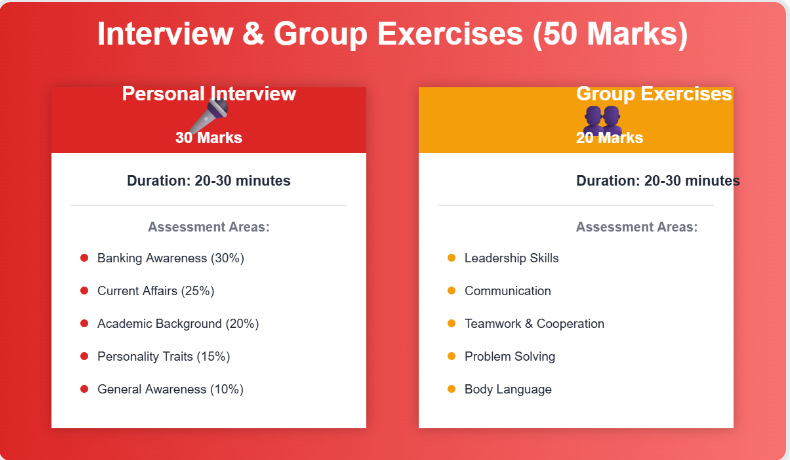
Interview & Group Exercises – Assessment Parameters
Final Merit Calculation
Here’s the formula that decides your rank – understanding this helps you strategize your preparation.
| Component | Max Marks | Weightage | Conversion Formula |
|---|---|---|---|
| Mains | 200 | 75% | (Mains Score ÷ 200) × 75 |
| Interview & GE | 50 | 25% | (Interview Score ÷ 50) × 25 |
| Final Score | 100 | 100% | Sum of both converted scores |
Example Calculation
| Candidate | Mains Score | Interview Score | Calculation | Final % |
|---|---|---|---|---|
| Rahul | 145/200 | 40/50 | (145÷200)×75 + (40÷50)×25 = 54.38 + 20 | 74.38% |
| Priya | 155/200 | 30/50 | (155÷200)×75 + (30÷50)×25 = 58.13 + 15 | 73.13% |
Rahul scored 10 marks less in Mains but still beat Priya because he aced the interview. This demonstrates why interview preparation is equally as important as written exam preparation – don’t treat it as an afterthought.
Normalisation – What It Is and Why It Matters
Since the Prelims exam is conducted in multiple shifts across several days, the difficulty level can vary slightly. Normalisation is SBI’s method of ensuring fairness – no candidate gets an unfair advantage (or disadvantage) because of their shift allocation.
- Normalisation is only for Prelims – Mains is a single-shift exam
- SBI uses the Equi-percentile method – a standard statistical approach
- Your scorecard shows both raw and normalised scores
- Cut-offs are based on normalised scores
- Shift allocation is random – candidates cannot choose
How Normalisation Works (In Plain English)
- SBI calculates raw scores for everyone in each shift
- They determine the percentile rank of each candidate within their shift
- These percentiles are mapped to a common reference scale
- Your normalised score is derived from that mapping
If you score 70/100 in a tough shift (where the average is 45), your normalised score might go up to 75. But if you score 70/100 in an easy shift (average 60), it might come down to 68. Fair, right?
Document Verification Checklist
If you make it to the final list, you’ll need to present original documents for verification. Any mismatch can disqualify you – even if you’ve cleared everything else.
Essential Documents for All Candidates
- SBI Call Letter for document verification
- Online Application Form printout (with photograph)
- Date of Birth Proof – Class 10 certificate or birth certificate
- Educational Certificates
- Graduation degree / provisional certificate
- All semester/year mark sheets
- Class 10 and 12 certificates & mark sheets
- Photo ID – Aadhaar, PAN, Passport, Voter ID, or Driving License
- Recent Passport-size Photographs (same as application)
- Signature on white paper
Category-Specific Documents
| Category | Certificate Required | Validity Requirements |
|---|---|---|
| SC/ST | Caste Certificate | Issued by competent authority in prescribed format |
| OBC | Non-Creamy Layer Certificate | Current financial year |
| EWS | Income & Asset Certificate | Current financial year |
| PwBD | Disability Certificate | Medical Board, minimum 40% disability |
| Ex-Servicemen | Discharge Certificate | With service period details |
- Your name must match across all documents
- Carry originals + photocopies (self-attested)
- Category certificates must be in the correct format
- Deadlines are strict – don’t be late
Probation Period & Training
Once selected, your real journey begins. You’ll undergo a 2-year probation period that combines classroom training with on-the-job experience.
| Phase | Duration | Focus | Location |
|---|---|---|---|
| Induction Training | 6 months | Classroom learning, banking fundamentals | SBI Training Academies |
| On-the-Job Training | 18 months | Practical experience, branch operations | Assigned branches |
| Total Probation | 24 months | Comprehensive development | Multiple locations |
What You’ll Learn During Probation
- Banking Operations – Core banking, customer service, accounting
- Credit Appraisal – Loan processing, risk assessment, documentation
- Digital Banking – Internet banking, mobile apps, cybersecurity
- Soft Skills – Communication, leadership, team management
- Regulatory Compliance – RBI guidelines, banking laws, KYC norms
Confirmation Criteria
- Successful completion of all training modules
- Satisfactory performance in branch assignments
- Clearing probation examinations conducted by SBI
- Positive feedback from reporting officers
- Medical fitness certificate
After confirmation as Assistant Manager (JMGS-I), you can appear for internal promotions to Scale-II (Deputy Manager) within 2-3 years, and climb the ladder to General Manager and beyond based on performance and experience.
Frequently Asked Questions (FAQs)
Three – Prelims, Mains (Objective + Descriptive), and Interview with Group Exercises. You need to clear all three stages.
No. Prelims is purely qualifying. Only Mains (75%) and Interview (25%) count toward the final merit list.
Yes. It’s mandatory and qualifying. If you don’t clear the minimum marks (8/50 for General/OBC, 6/50 for SC/ST/PwBD), you’re disqualified – regardless of your objective score.
25%. That’s 50 marks out of the total 250 (200 from Mains + 50 from Interview).
Final Score = (Mains Score ÷ 200) × 75 + (Interview Score ÷ 50) × 25. The result is a percentage out of 100.
Yes, but only for Prelims (since it’s held in multiple shifts). Mains is a single-shift exam, so no normalisation there.
They include Group Discussion, Case Study Analysis, and Group Tasks. They test leadership, communication, teamwork, and problem-solving skills – and carry 20 marks out of the 50 total interview marks.
Usually 3-4 times the number of vacancies. For ~2,500 seats, about 7,500-10,000 candidates are called based on Mains performance.
2 years – 6 months of classroom training + 18 months of on-the-job training at assigned branches.
Yes, if they meet the age and educational criteria. They’ll need to provide experience certificates and may require a No Objection Certificate from their current employer if selected.
Suggested Next Reads
Conclusion
The SBI Probationary Officer Selection Process 2026 is one of the most thorough recruitment systems in India’s banking sector. It’s designed to find candidates who aren’t just good at solving questions but also possess the communication, leadership, and presence to represent India’s largest public sector bank.
Here’s what to keep in mind as you prepare:
- ✅ Prelims – Quick and sharp. Focus on accuracy, not just attempts.
- ✅ Mains – Deep knowledge + strong writing skills. This is your biggest opportunity to score.
- ✅ Interview & GE – Personality and communication matter enormously. Be authentic and prepared.
- ✅ Final Merit – Remember the 75:25 ratio. Both Mains and Interview deserve equal attention.
- Treat Prelims as the entry point – the real journey begins with Mains
- Don’t neglect the Descriptive Test – it’s qualifying but mandatory
- Take the Interview seriously – it can be your game-changer
- Stay consistent, stay informed, and trust the process
📌 For the latest updates and official notification, visit SBI Careers — sbi.co.in/careers