
Last Updated: June 28, 2026
SBI PO Prelims Syllabus 2026 — Complete Topic-wise Syllabus for English Language, Quantitative Aptitude & Reasoning Ability
Before you start preparing for SBI PO Prelims 2026, you need to know exactly what to study and what to skip. This guide breaks down the complete syllabus — topic by topic, with weightage and difficulty analysis — so you can plan your preparation strategically.
The SBI PO Prelims exam is the first stage of the prestigious State Bank of India Probationary Officer recruitment process. As per the official SBI notification, the Preliminary Examination serves as a screening test where marks are not counted for the final merit list but clearing it is mandatory to qualify for the Main Examination.
According to SBI’s official exam pattern, the Prelims syllabus tests three core competencies essential for banking professionals: Analytical Abilities — Logical reasoning and data interpretation skills, Quantitative Skills — Numerical and mathematical problem-solving, and Language Proficiency — English comprehension and grammatical accuracy.
With SBI PO being one of the most competitive banking exams in India (with over 20 lakh applicants annually for approximately 2000 vacancies), a strategic, topic-wise preparation approach becomes crucial. The cut-off marks have consistently risen, making focused preparation based on weightage analysis essential for success.
This comprehensive guide provides a complete, updated, and exam-oriented syllabus breakdown based on official SBI patterns, Previous Year Question trends, difficulty analysis, and strategic preparation tips to help you maximize your Prelims score.
📘 Table of Contents
- Introduction: Why SBI PO Syllabus is Different
- SBI PO Prelims Syllabus 2026 – Overview
- Topic-Wise Syllabus
- English Language
- Quantitative Aptitude
- Reasoning Ability
- Weightage: Topic-Wise Marks Distribution
- Most Important Topics (High-Weight Areas)
- Difficulty Level Overview (Recent Trend)
- What to Prioritize for SBI PO Prelims 2026
- Common Mistakes to Avoid
- Frequently Asked Questions
- Suggested Next Reads
- Conclusion
⚡ Quick Summary – SBI PO Prelims Syllabus 2026
- Sections: English Language, Quantitative Aptitude, Reasoning Ability
- Total: 100 Questions | 100 Marks | 60 Minutes
- Sectional Timing: 20 minutes each (strict — cannot switch)
- High-weight topics: Reading Comprehension, Data Interpretation, Puzzles & Seating Arrangement
- Difficulty Level: English (Easy to Moderate), Quant (Moderate to Difficult), Reasoning (Moderate to Difficult)
- Best scoring areas: Simplification, Syllogism, Error Detection, Cloze Test
- Strategy: Topic-wise mastery + speed building + mock test analysis
- Negative Marking: 0.25 marks deducted for each wrong answer
Introduction: Why SBI PO Syllabus is Unique from Other Bank PO Exams
Before we dive into the detailed syllabus, let’s understand what makes SBI PO Prelims unique. State Bank of India is not just any bank — it’s the country’s largest public sector bank with over 22,000 branches. The Prelims syllabus reflects this prestige by being slightly more challenging and competitive than other bank PO exams.
The SBI PO Prelims syllabus follows a similar structure to IBPS PO but with key differences — the competition is more intense (SBI is the most sought-after bank), the difficulty level is generally higher, and SBI emphasizes application-based questions more than rote learning. SBI also introduces new question patterns more frequently than other banks.
This guide covers everything you need to know about the SBI PO Prelims syllabus for 2026, with practical examples and strategic insights to help you maximize your score within the 60-minute window.
SBI PO Prelims Syllabus 2026 Overview
SBI PO Prelims Syllabus 2026 – Overview
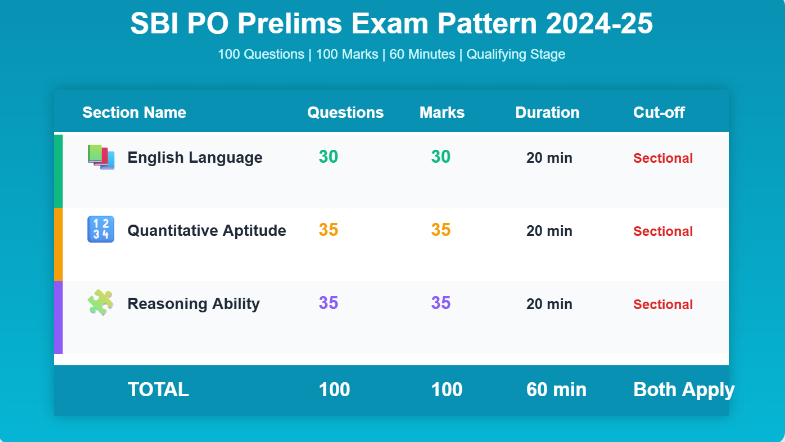
As per SBI’s official examination pattern, the PO Prelims exam follows a structured format with strict sectional timing. Understanding this pattern is crucial for effective time management during the exam.
| Section | No. of Questions | Marks | Time Allocated |
|---|---|---|---|
| English Language | 30 | 30 | 20 minutes |
| Quantitative Aptitude | 35 | 35 | 20 minutes |
| Reasoning Ability | 35 | 35 | 20 minutes |
| Total | 100 | 100 | 60 minutes |
- Sectional timing is strict – Cannot switch between sections during exam
- Objective-type online exam – All questions are Multiple Choice Questions (MCQs)
- Negative marking: –0.25 marks for each wrong answer
- No penalty for unattempted questions – Strategic skipping is important
- Sectional + overall cut-off applicable – Must clear both to qualify
- Qualifying nature – Marks NOT counted in final merit (Mains decides final selection)
- Language options: English & Hindi (except English Language section)
Topic-Wise Syllabus
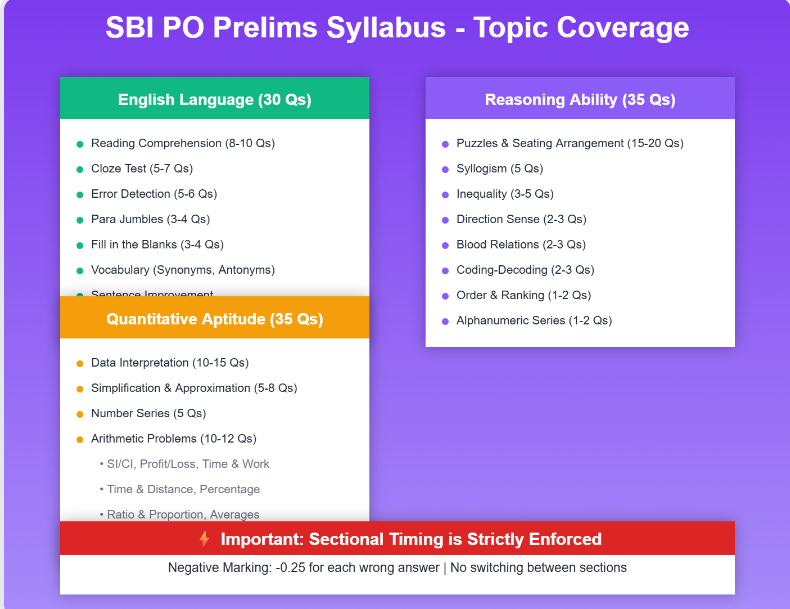
Based on analysis of previous SBI PO exams and official patterns, here’s the detailed topic-wise breakdown for each section.
1. English Language Syllabus (30 Questions)
Difficulty Level: Easy to Moderate
Exam Focus: Reading comprehension, grammar accuracy, vocabulary in context
The English Language section tests candidates’ proficiency in English through various question types. According to SBI’s previous year papers, this section emphasizes practical language usage rather than theoretical knowledge.
| Topic Area | Sub-Topics | Expected Questions | PYQ Trend |
|---|---|---|---|
| Reading Comprehension | Passages from business, economy, social issues; Inference, Vocabulary-in-context, Main idea | 10–12 | Always appears (high weightage) |
| Cloze Test | Grammar + contextual understanding, Fill in blanks with options | 5–6 | Frequent |
| Error Detection | Spotting errors in sentences, Sentence improvement | 4–5 | Regular |
| Para Jumbles / Sentence Rearrangement | Logical flow, coherence, sentence connectors | 4–5 | Consistent |
| Phrase Replacement / Sentence Correction | Grammar-based corrections, contextual appropriateness | 3–4 | Increasing trend |
| Vocabulary | Synonyms, Antonyms, Word usage, Spelling errors | 2–3 | Occasional |
High-Weight Topics in English Language
Based on SBI’s recent exam patterns:
- Reading Comprehension – 10-12 questions (33-40% weightage)
- Cloze Test – 5-6 questions
- Error Detection & Sentence Correction – 7-9 questions combined
These topics together account for approximately 22-27 questions out of 30, making them critical for your preparation strategy.
Section-wise Detailed Syllabus: Complete Topic Breakdown for All Sections
2. Quantitative Aptitude Syllabus (35 Questions)
Difficulty Level: Moderate to Difficult
Exam Focus: Calculation speed + arithmetic concepts + Data Interpretation
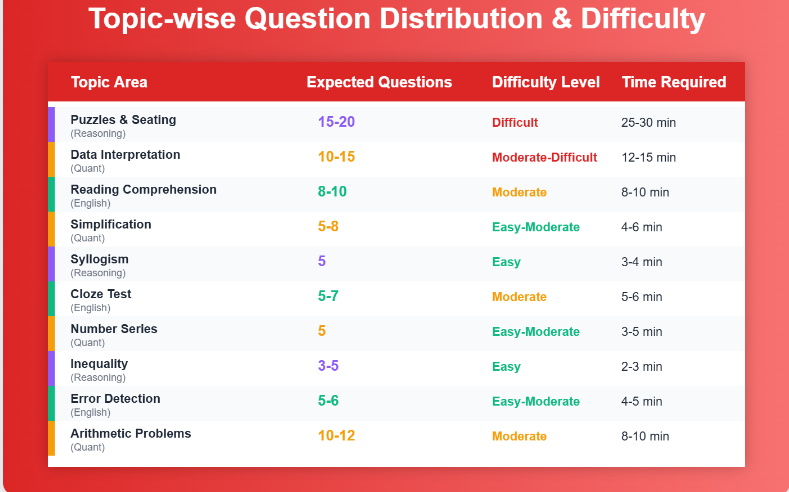
Quantitative Aptitude is considered challenging in SBI PO Prelims due to time constraints and the level of calculations involved. However, with strategic preparation, it can be a scoring section.
| Topic | Sub-Topics Included | Expected Weightage | PYQ Trend |
|---|---|---|---|
| Data Interpretation (DI) | Table, Bar Graph, Line Graph, Pie Chart, Caselet, Mixed DI | 10–15 | Very High (Core of Quant section) |
| Arithmetic | Percentage, Ratio, SI-CI, Time-Speed-Distance, Time & Work, P&L, Averages, Mixtures, Ages, Partnerships | 10–12 | High |
| Number Series | Missing number, Wrong number, Double pattern series | 5–6 | Consistent |
| Simplification & Approximation | BODMAS, Decimals, Fractions, Surds & Indices, Square roots | 4–5 | Regular |
| Quadratic Equations | Comparing roots, Finding roots, New pattern quadratic | 3–4 | Regular |
| Data Sufficiency | Quantitative data sufficiency (2 statements) | 0–2 | Occasional |
High-Weight Topics in Quantitative Aptitude
- Data Interpretation (DI) – 10-15 questions (30-43% of section)
- Arithmetic – 10-12 questions
Together they account for 20–27 questions out of 35! Focusing on DI and Arithmetic can secure you 60-75% marks in this section.
Detailed Arithmetic Sub-Topics
The Arithmetic section in SBI PO covers multiple fundamental topics:
- Percentage: Basic calculations, percentage change, successive percentage
- Ratio & Proportion: Simple ratios, compound ratios, partnership ratios
- Simple & Compound Interest: Basic formulas, difference between SI & CI, installments
- Time, Speed & Distance: Relative speed, average speed, trains, boats & streams
- Time & Work: Work efficiency, pipes & cisterns, wages based on work
- Profit & Loss: Cost price, selling price, discount, marked price, successive discounts
- Averages & Mixtures: Simple average, weighted average, alligation rule
- Ages, Partnerships: Basic age problems, partnership profit sharing
Quantitative Aptitude Topic Weightage Distribution
3. Reasoning Ability Syllabus (35 Questions)
Difficulty Level: Moderate to Difficult
Exam Focus: Puzzles, seating arrangements, logical reasoning, analytical ability
Reasoning Ability is a crucial section in SBI PO Prelims. According to previous year patterns, this section heavily emphasizes puzzles and seating arrangements, which test analytical thinking under time pressure.
| Topic | Sub-Topics Included | Expected Weightage | PYQ Trend |
|---|---|---|---|
| Puzzles & Seating Arrangement | Linear, Circular, Square, Rectangular, Floor-based, Box-based, Scheduling, Month-based, Day-based, Blood relation based puzzles | 15–20 | Dominant (45-60% of section) |
| Inequality | Coded inequality, Direct inequality, New pattern inequality | 4–5 | High |
| Syllogism | New pattern syllogism, Either-or cases, Possibility cases | 4–5 | Frequent |
| Blood Relations | Family tree, Coded relations, Pointing questions | 3–4 | Regular |
| Direction Sense | Distance & direction, Shadow based, Coded directions | 2–3 | Moderate |
| Alphanumeric Series | Missing term, Wrong term, New pattern series | 2–3 | Regular |
| Order & Ranking | Height/Weight/Order ranking, Floor based ranking | 1–2 | Occasional |
| Data Sufficiency | Reasoning based data sufficiency (2 statements) | 0–2 | Occasional |
| Logical Reasoning | Course of action, Statement-assumptions, Conclusions | 0–2 | Occasional |
High-Weight Topics in Reasoning Ability
- Puzzles + Seating Arrangement – 15-20 questions (45-60% of entire section!)
This single topic category determines success in the Reasoning section. Mastering puzzles and seating arrangements essentially secures 50%+ marks in this section.
Understanding SBI PO Puzzles
SBI is known for innovative puzzle patterns. Common types include:
- Linear Seating: Single/double row, unidirectional/bidirectional, with vacant seats
- Circular Seating: Facing center/outward, with vacant seats, with blood relations
- Floor-based Puzzles: Floors with flats, lift-based problems, profession based
- Scheduling Puzzles: Days/Months scheduling with multiple variables
- Box-based Puzzles: Stacking, arrangement with colors/sizes
- Category-based Puzzles: Mix of different parameters (age+profession+city)
Other Important Reasoning Topics
After puzzles, focus on these high-accuracy topics:
- Inequality: Quick solving with coded inequality rules
- Syllogism: New pattern with “only a few”, “only” type statements
- Blood Relations: Family tree with multiple generations
- Direction Sense: Complex path-based questions
Weightage: Topic-Wise Marks Distribution
Based on analysis of SBI PO Prelims 2023, 2024, and expected 2026 trends, here’s the detailed weightage breakdown for strategic preparation.
A. English Language — Topic Weightage
| Topic | Expected Questions | Percentage of Section | Preparation Priority |
|---|---|---|---|
| Reading Comprehension | 10–12 | 33-40% | Very High |
| Cloze Test | 5–6 | 17-20% | Very High |
| Error Detection & Correction | 7–9 | 23-30% | Very High |
| Para Jumbles | 4–5 | 13-17% | High |
| Vocabulary | 2–3 | 7-10% | Moderate |
B. Quantitative Aptitude — Topic Weightage
| Topic | Expected Questions | Percentage of Section | Preparation Priority |
|---|---|---|---|
| Data Interpretation | 10–15 | 29-43% | Very High |
| Arithmetic | 10–12 | 29-34% | Very High |
| Number Series | 5–6 | 14-17% | High |
| Simplification | 4–5 | 11-14% | High |
| Quadratic Equations | 3–4 | 9-11% | Moderate |
| Data Sufficiency | 0–2 | 0-6% | Low |
C. Reasoning Ability — Topic Weightage
| Topic | Expected Questions | Percentage of Section | Preparation Priority |
|---|---|---|---|
| Puzzles & Seating Arrangement | 15–20 | 43-57% | Very High |
| Inequality | 4–5 | 11-14% | High |
| Syllogism | 4–5 | 11-14% | High |
| Blood Relations | 3–4 | 9-11% | Moderate |
| Direction Sense | 2–3 | 6-9% | Moderate |
| Alphanumeric Series | 2–3 | 6-9% | Moderate |
| Other Topics | 1–3 | 3-9% | Low |
Most Important Topics (High-Weight Areas)
For efficient preparation, focus on these high-impact topics that consistently appear in SBI PO Prelims with significant weightage.
| Section | Priority Topics | Why Important | Expected Marks |
|---|---|---|---|
| English Language | Reading Comprehension, Error Detection, Cloze Test | Covers 70-80% of section, accuracy-based | 21-26 out of 30 |
| Quantitative Aptitude | Data Interpretation, Arithmetic, Number Series | Covers 75-85% of questions, formula-based | 25-30 out of 35 |
| Reasoning Ability | Puzzles, Seating Arrangement, Inequality, Syllogism | Dominant weightage, high scoring potential | 25-30 out of 35 |
- English: Reading Comprehension (10-12) + Error Detection (7-9) = 17-21 marks
- Quantitative: Data Interpretation (10-15) + Arithmetic (10-12) = 20-27 marks
- Reasoning: Puzzles & Seating (15-20) + Inequality (4-5) = 19-25 marks
Total from core topics alone: 56-73 marks
Add other topics, and you can comfortably cross 75-80+ marks!
60-Day Preparation Strategy: Complete Roadmap for SBI PO Prelims Success
Difficulty Level Overview (Recent Trend)
Based on SBI PO Prelims 2023 and 2024 analysis, here’s the difficulty trend:
| Section | Difficulty Trend | Time Pressure | Scoring Potential |
|---|---|---|---|
| English Language | Easy to Moderate | Low to Moderate | High (22-27/30 possible) |
| Quantitative Aptitude | Moderate to Difficult | High | Moderate to High (20-28/35) |
| Reasoning Ability | Moderate to Difficult | Very High | High (24-30/35 with puzzle mastery) |
Section-Wise Difficulty Analysis
English Language — Easy to Moderate
Generally the most scoring section. RC passages are moderately lengthy but comprehension is straightforward.
Quantitative Aptitude — Moderate to Difficult
Most challenging section due to calculation intensity. DI sets often involve percentages and ratios.
Reasoning Ability — Moderate to Difficult
Difficulty depends on puzzle complexity. Recent trends show increasing puzzle difficulty.
What to Prioritize for SBI PO Prelims 2026
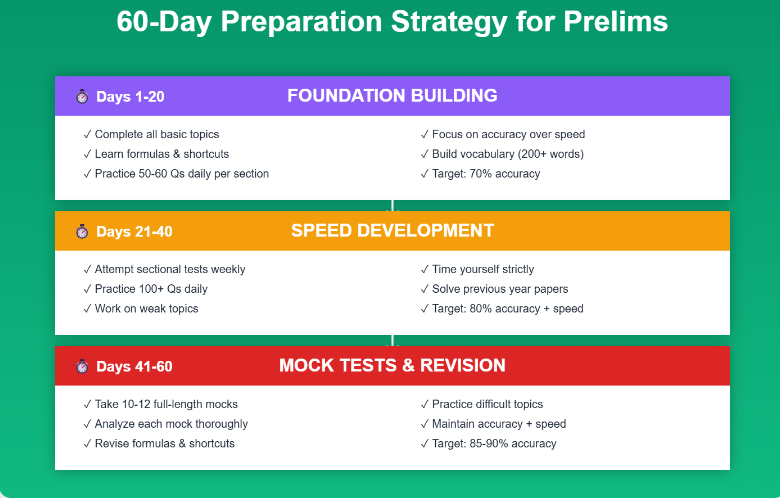
Strategic prioritization is key for SBI PO preparation. Here’s a phased approach:
Phase 1: Foundation Building (Weeks 1-6)
- Master all arithmetic formulas and basic concepts
- Learn grammar rules thoroughly
- Understand puzzle-solving techniques and approaches
- Build calculation speed (tables, squares, cubes, percentages)
- Develop daily reading habit (30 minutes editorials)
Phase 2: Topic-Wise Mastery (Weeks 7-12)
- Solve 150+ DI questions of all types
- Complete 80+ puzzle sets (all patterns)
- Master high-weight English topics
- Practice topic-wise quizzes daily with timer
- Maintain comprehensive error log
Phase 3: Speed Building & Mock Tests (Weeks 13-18)
- Take 30+ full-length mocks in exam conditions
- Analyze every mock thoroughly (identify weak areas)
- Work on sectional timing (complete sections in 18 minutes)
- Revise weak topics identified from mock analysis
- Practice accuracy improvement (reduce silly mistakes)
Common Mistakes to Avoid
Strategic Mistakes
- Starting with difficult DI sets first – Begin Quant with Simplification/Series to build confidence
- Getting stuck on one complex puzzle – Set 8-minute limit per puzzle set; move if stuck
- Ignoring sectional cut-offs – Must clear all three sections individually
- Poor time distribution – Practice completing each section in 18 minutes (2 min buffer)
- Attempting all questions blindly – Focus on accuracy; 65-75 attempts with 80% accuracy is ideal
Preparation Mistakes
- Neglecting Reading Comprehension practice – RC carries highest weight in English
- Not practicing enough DI sets – DI is core of Quant section
- Solving puzzles without timer – Speed is crucial for SBI puzzles
- Taking mocks without analysis – Analysis is more important than taking mocks
- Memorizing without understanding – SBI tests application, not rote learning
Frequently Asked Questions (FAQs) – SBI PO Prelims Syllabus 2026
The core topics are similar, but SBI PO has higher difficulty level, especially in Data Interpretation and Puzzles. SBI also introduces new question patterns more frequently than other banks.
Generally, 65-75 attempts with 75-85% accuracy (net score 55-65) can clear cut-offs. However, this varies yearly based on difficulty and vacancies.
All three sections are equally important due to sectional cut-offs. However, Reasoning carries maximum weightage (35 questions) and is often the deciding factor.
No. Computer Aptitude appears only in Mains exam as part of “Reasoning & Computer Aptitude” section.
Extremely difficult. Puzzles carry 15-20 questions. Skipping them means you need near-perfect scores in other sections which is highly unlikely.
Not mandatory. With disciplined self-study, quality materials, online resources, and consistent mock tests, you can clear SBI PO. Coaching can provide structure if you need guidance.
Suggested Next Reads
Conclusion
The SBI PO Prelims Syllabus 2026 follows a predictable pattern but tests depth of understanding and application skills. While the topics may seem standard, the level of difficulty and time pressure make SBI PO one of the most challenging banking exams.
Key success factors for SBI PO Prelims include mastering high-weight topics thoroughly, developing speed with accuracy through timed practice, practicing SBI-specific question patterns, taking regular mock tests with detailed analysis, and ensuring sectional cut-off clearance in all three sections.
Remember, SBI PO Prelims is just the first hurdle. Clearing it comfortably not only qualifies you for Mains but also builds confidence for the subsequent stages. A well-planned 4-6 month preparation strategy with focus on weak areas can help you succeed.
- Start preparation at least 6 months before exam
- Focus on conceptual clarity rather than rote learning
- Solve previous 5 years SBI PO papers thoroughly
- Join a reliable mock test series for realistic practice
- Maintain physical and mental fitness throughout preparation
📌 For the latest updates and official notification, visit SBI Careers — sbi.co.in/careers