
Last Updated: June 19, 2026
IBPS PO Mains Exam Pattern 2026: Latest Structure, Marks, Timing & Question Breakdown
Before you start preparing for IBPS PO Mains 2026, you need to understand exactly what you’re up against. This guide breaks down the Mains exam pattern — section by section, mark by mark — so you can plan your preparation strategically and maximize your score.
The IBPS Probationary Officer Mains examination is the most decisive and challenging stage of the entire recruitment process. While the Preliminary exam serves as a qualifying filter, the Mains examination carries substantial weight in determining your final merit score and ultimately your selection as a Probationary Officer in one of India’s 11 participating public sector banks.
Understanding the Mains exam pattern thoroughly is absolutely crucial for success. Unlike Prelims which tests basic proficiency across three subjects, the Mains exam evaluates candidates on a much deeper level with five comprehensive sections including high-level reasoning puzzles, complex data interpretation sets, advanced English language skills, extensive general and banking awareness, and a descriptive writing test that assesses your communication abilities.
What makes IBPS PO Mains particularly significant is that it carries 80% weightage in your final merit calculation, while the interview carries only 20%. This means your Mains performance essentially determines whether you’ll be selected or not. A strong Mains score can compensate for an average interview, but a weak Mains score cannot be overcome even with an excellent interview performance.
This comprehensive guide provides you with complete, exam-oriented information about the IBPS PO Mains Exam Pattern 2026, including detailed section-wise breakdowns, marking schemes, difficulty analysis, preparation strategies, and expert tips to help you navigate this critical examination successfully and maximize your chances of selection.
📘 Table of Contents
- Introduction: Why Mains Exam Pattern Matters
- IBPS PO Mains Exam Pattern 2026 (At a Glance)
- Section-wise Breakdown
- Reasoning & Computer Aptitude
- English Language
- Data Analysis & Interpretation
- General Economy & Banking Awareness
- Descriptive Writing
- Marking Scheme & Negative Marking Impact
- Weightage in Final Selection
- Difficulty Level Trend
- Most Important Topics (High-Weight Areas)
- Good Attempts Strategy for Mains
- Exam-Day Rules & Instructions
- Frequently Asked Questions
- Suggested Next Reads
- Conclusion
⚡ Quick Summary – IBPS PO Mains Exam Pattern 2026
- Total Questions: 157 questions (155 objective + 2 descriptive)
- Total Marks: 225 marks (200 objective + 25 descriptive)
- Total Duration: 3 hours 30 minutes with mandatory sectional timing
- Sections: Reasoning & Computer Aptitude (60 marks), English (40 marks), Data Analysis (60 marks), GA (40 marks), Descriptive (25 marks)
- Negative Marking: 0.25 marks deducted for each wrong answer in objective sections
- Weightage in Selection: 80% (Mains) + 20% (Interview) = Final Merit
- Sectional Timing: Mandatory — cannot switch between sections during allocated time
- Difficulty Level: High — significantly tougher than Prelims examination
Introduction: Why Understanding the Mains Exam Pattern Matters Before You Start Preparing
The IBPS PO Mains examination is the most important stage of the entire recruitment process. While Prelims serves as a qualifying filter, Mains carries 80% weightage in your final merit score. This means your Mains performance essentially decides whether you get selected or not.
Every year, thousands of candidates who clear Prelims fail in Mains because they don’t understand the exam pattern properly. They treat Mains like a longer version of Prelims, but that’s a critical mistake. The Mains exam is fundamentally different — it has more sections, tougher questions, stricter time limits, and a descriptive component that tests your writing skills.
This comprehensive guide covers everything you need to know about the IBPS PO Mains exam pattern for 2026, including section-wise breakdown, marking scheme, weightage in final selection, difficulty trends, high-weight topics, and strategic tips to maximize your score within the 3.5-hour window.

IBPS PO Mains Exam Pattern 2026 — Complete Structure
IBPS PO Mains Exam Pattern 2026 (At a Glance)
The IBPS PO Mains examination is a computer-based online test consisting of five sections with mandatory sectional timing. This means you cannot move to the next section until the allocated time for the current section expires, and you cannot return to previous sections once their time is over. This format tests your time management skills and ensures balanced performance across all sections.
- Longer Duration: 3 hours 30 minutes compared to Prelims’ 60 minutes — tests stamina and concentration
- More Sections: Five sections instead of three, covering broader knowledge areas
- Variable Question-to-Mark Ratio: Unlike Prelims where 1 question = 1 mark, Mains has sections where some questions carry more than 1 mark
- Descriptive Component: Tests written communication skills, grammar, and coherent expression
- Computer Aptitude: Additional topic tested along with reasoning
- Higher Difficulty: Questions are significantly more complex and time-consuming than Prelims
Section-wise Breakdown: Complete Analysis
Each section of the IBPS PO Mains exam has its unique characteristics, difficulty level, and strategic approach requirements. Understanding the detailed pattern of each section helps you allocate preparation time effectively and develop section-specific strategies for maximum scoring.
1. Reasoning & Computer Aptitude (45 Questions, 60 Marks, 60 Minutes)
This is typically the lengthiest and most time-consuming section in the entire Mains examination. The Reasoning & Computer Aptitude section combines traditional logical reasoning questions with basic computer knowledge questions. The reasoning portion is significantly more complex than Prelims, featuring multi-layered puzzles and intricate seating arrangements that require deep analytical thinking.
- Difficulty Level: High to Very High
- Average Time per Question: 80 seconds (1 minute 20 seconds)
- Key Challenge: Time management — solving complex puzzles within time constraints
- Scoring Potential: High for those who master puzzle-solving techniques
High-Weight Topics in Reasoning
- Seating Arrangement (Linear & Circular): 8-12 questions based on complex conditions involving multiple variables like designation, age, city, preference, etc.
- Puzzles: Box-based puzzles, floor-based puzzles, scheduling puzzles, tabular puzzles with 10-15 questions typically consuming 15-20 minutes
- Input-Output: 4-5 questions based on step-by-step logical operations on words/numbers
- Coding-Decoding: Advanced level coding involving alphanumeric patterns and conditional coding
- Syllogism: 5-6 questions testing logical deduction skills with complex statement sets
- Inequality: 4-5 questions involving comparison of coded relationships
- Data Sufficiency: 3-5 questions testing ability to determine if given data is sufficient to answer the question
- Direction Sense & Blood Relations: 2-3 questions each, relatively easier and scoring
Computer Aptitude Topics
- Computer Fundamentals: Hardware, software, input/output devices, memory types
- Operating Systems: Windows, Linux basics, file management, system utilities
- MS Office: Word, Excel, PowerPoint features and shortcuts
- Internet & Networking: WWW, browsers, email, protocols (HTTP, FTP), network types (LAN, WAN, MAN)
- Computer Security: Viruses, malware, firewalls, encryption, cyber security basics
- Banking Technology: Core banking, CBS, NEFT, RTGS, IMPS, UPI, digital banking
- Emerging Technologies: Cloud computing, AI, blockchain, IoT basics
- Flowcharts & Logic Gates: Understanding algorithm representations and basic logic operations

Reasoning & Computer Aptitude Section Overview
2. English Language (35 Questions, 40 Marks, 40 Minutes)
The English Language section in Mains is moderately difficult and tests comprehensive language skills including reading comprehension, grammar, vocabulary, and sentence structuring. Unlike Prelims which focuses more on basic grammar and vocabulary, Mains English tests your ability to understand complex passages, identify subtle errors, and demonstrate advanced language proficiency.
- Difficulty Level: Moderate
- Average Time per Question: 68 seconds (approximately 1 minute)
- Key Challenge: Lengthy reading comprehension passages requiring careful reading
- Scoring Potential: Very high — most scoring section if you have good English skills
High-Weight Topics in English
- Reading Comprehension: 10-12 questions based on 1-2 passages (600-800 words each) covering topics like economy, social issues, technology, environment. Questions test vocabulary, inference, main idea, author’s tone, and factual understanding.
- Para Completion/Para Jumbles: 5-6 questions where you need to arrange jumbled sentences in logical order or complete a given paragraph coherently
- Error Detection/Spotting: 4-5 questions identifying grammatical errors in sentences involving tense, subject-verb agreement, prepositions, articles
- Sentence Correction/Improvement: 3-4 questions requiring you to identify and correct errors or improve sentence structure
- Fill in the Blanks: 4-5 questions testing vocabulary and contextual usage with single or double blanks
- Word Replacement: 3-4 questions where you replace underlined words with contextually appropriate synonyms
- Sentence Rearrangement: 2-3 questions involving proper sequencing of sentences to form coherent paragraphs
- Cloze Test: 5-6 questions based on a passage with blanks to be filled maintaining flow and coherence
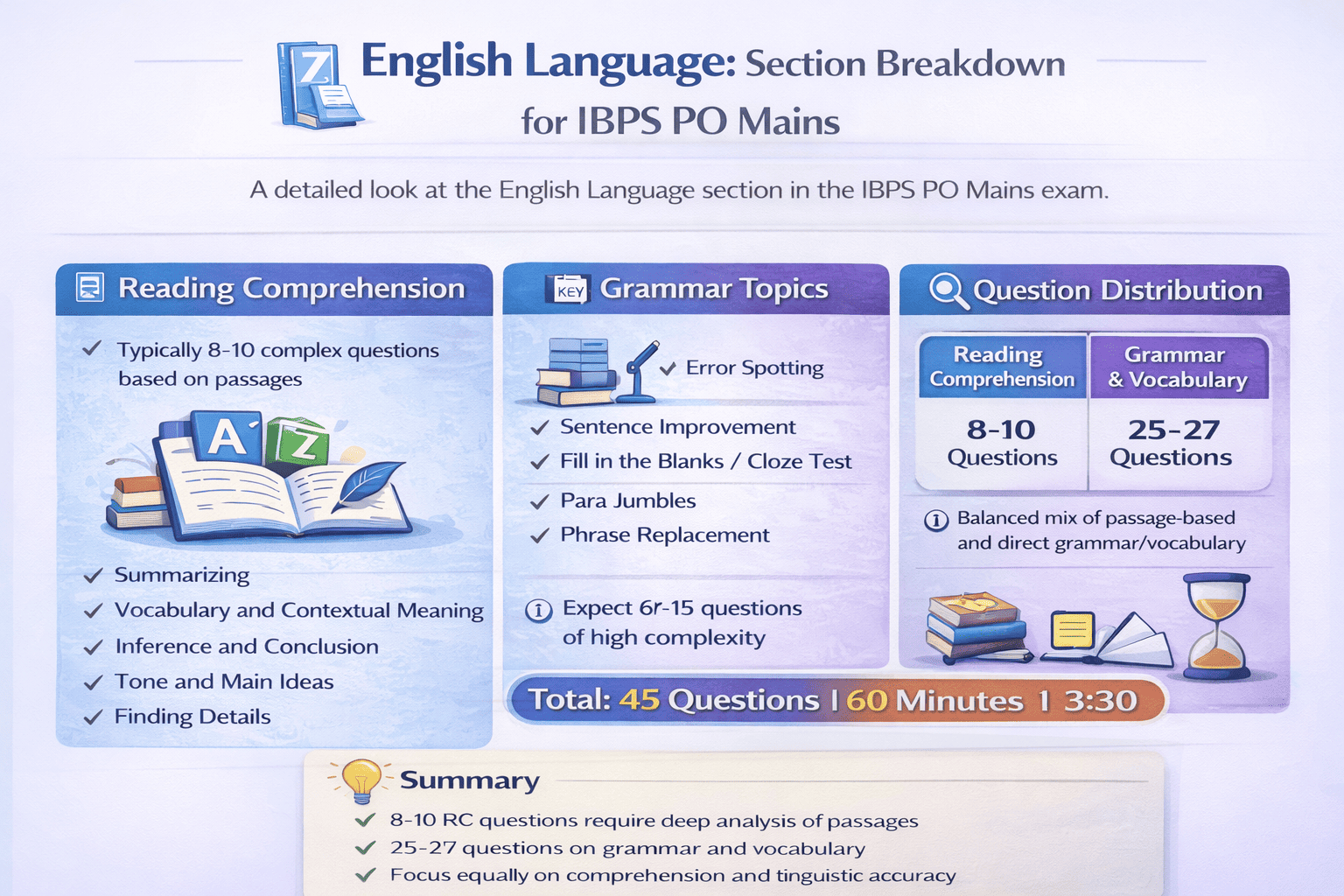
English Language Section Complete Breakdown
3. Data Analysis & Interpretation (35 Questions, 60 Marks, 45 Minutes)
This section is often considered the toughest in the entire IBPS PO Mains examination. Data Analysis & Interpretation tests your quantitative aptitude, calculation speed, data interpretation skills, and ability to analyze complex numerical information presented in various formats. The difficulty level is significantly higher than Prelims Quantitative Aptitude.
- Difficulty Level: Very High
- Average Time per Question: 77 seconds (approximately 1 minute 15 seconds)
- Key Challenge: Complex calculations, lengthy DI sets, time pressure
- Scoring Potential: Moderate — requires strong calculation skills and practice
High-Weight Topics in Data Analysis
- Data Interpretation Sets: 15-20 questions based on 4-5 DI sets including bar graphs, line charts, pie charts, tables, and mixed graphs. Each set contains 3-5 questions requiring calculation, comparison, and analysis.
- Caselets: 5-8 questions based on 1-2 caselets presenting data in paragraph format requiring extraction and calculation
- Missing Data Interpretation: 3-5 questions where some data points are missing and need to be calculated before solving main questions
- Data Comparison: Questions comparing two or more data sets and finding relationships, ratios, or percentages
- Quadratic Equations: 5-6 questions solving quadratic equations and comparing roots
- Number Series: 2-3 questions finding missing numbers or wrong numbers in series
- Arithmetic Problems: 6-8 questions covering Time-Speed-Distance, Profit-Loss-Discount, Simple and Compound Interest, Mixtures-Alligations, Partnerships, Time-Work, Percentages, Ratios, Averages, and Age-based problems
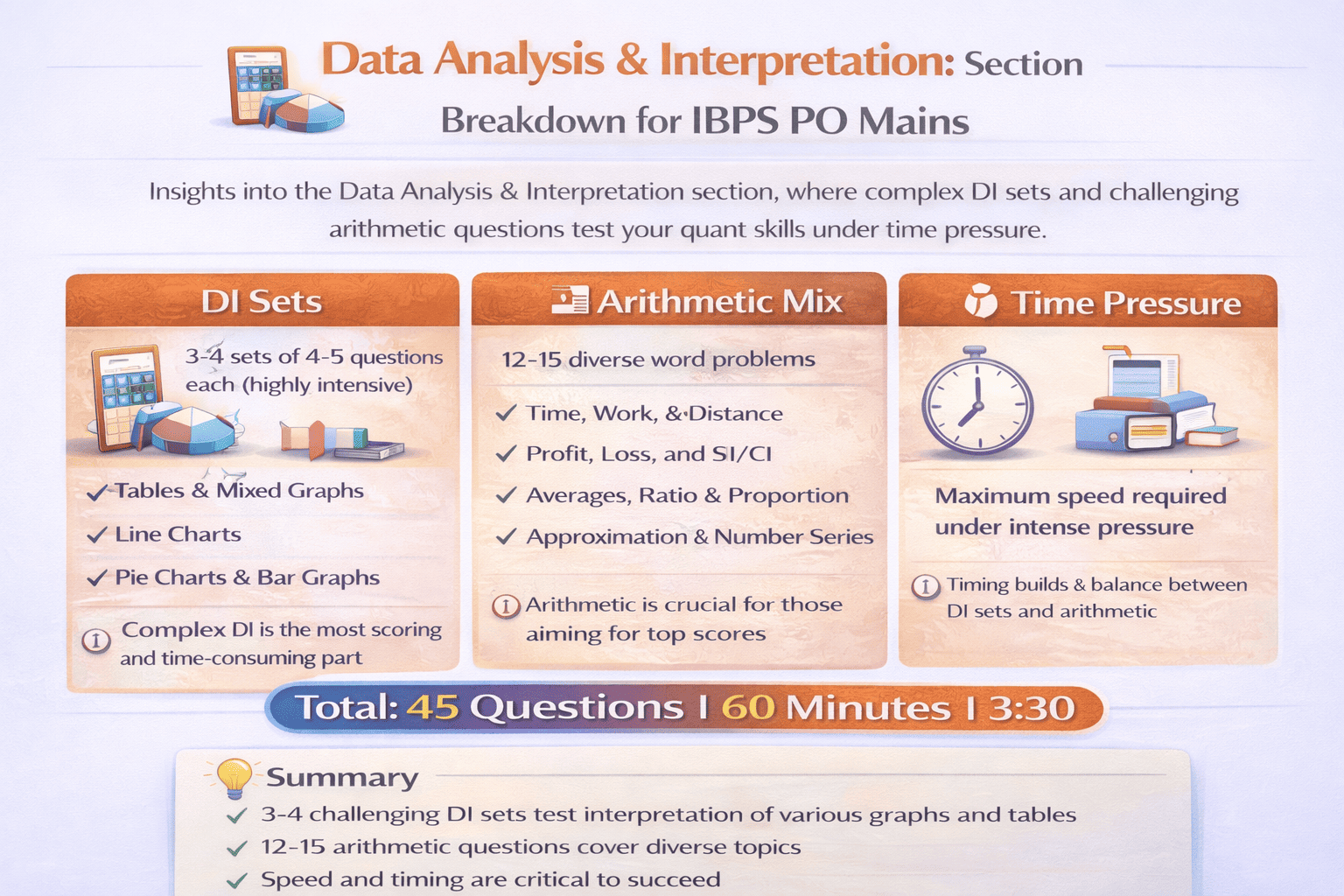
Data Analysis & Interpretation — Most Challenging Section
4. General / Economy / Banking Awareness (40 Questions, 40 Marks, 35 Minutes)
The General Awareness section plays a decisive role in IBPS PO Mains because it is the only section that does not involve calculations or lengthy reasoning. With proper preparation, this section can become a high-scoring area and significantly boost your overall Mains score.
- Difficulty Level: Moderate
- Average Time per Question: ~50 seconds
- Key Advantage: Concept-based, no negative calculation burden
- Scoring Potential: Very High with proper revision
Important Topics in General & Banking Awareness
- Banking Awareness: RBI functions, monetary policy tools, repo & reverse repo, CRR, SLR, NPA, Basel norms, digital banking products
- Financial Awareness: Budget highlights, Economic Survey, GDP, inflation, fiscal deficit, monetary policy committee (MPC)
- Current Affairs: Last 6–8 months national & international events relevant to banking, economy, awards, appointments
- Static GK (Limited): Important days, countries & capitals, currencies, international organizations (World Bank, IMF, WTO)
- Government Schemes: Financial inclusion schemes, banking-linked government initiatives
5. Descriptive Writing Test (2 Questions, 25 Marks, 30 Minutes)
The Descriptive Test evaluates your written communication skills, clarity of thought, and ability to express ideas logically and professionally — essential qualities for a Probationary Officer.
Descriptive Paper Structure
- Essay Writing: 1 question (15 marks)
- Letter Writing: 1 question (10 marks)
The descriptive test is conducted online immediately after the objective sections. Candidates must type their answers using a keyboard.
Essay Topics Generally Asked
- Banking & financial reforms
- Digital banking & cybersecurity
- Economic growth & inflation
- Social issues linked with economy
- Technology in banking
Letter Writing Topics
- Formal complaint letters
- Bank-related customer letters
- Official communication letters
Marking Scheme & Negative Marking Impact
The IBPS PO Mains examination follows a standardized marking scheme. Understanding the marking system is crucial for developing your attempt strategy and managing risk during the exam.
| Response Type | Marks Awarded | Impact on Score |
|---|---|---|
| Correct Answer | +1 mark (varies by section) | Positive contribution to your score |
| Wrong Answer | -0.25 marks | Penalty for incorrect attempt |
| Unattempted Question | 0 marks | No penalty, no reward |
Weightage in Final Selection
Understanding the weightage of each stage in the final selection process helps you prioritize your preparation effectively.
| Stage | Marks | Weightage |
|---|---|---|
| IBPS PO Mains | 225 | 80% |
| Interview | 100 | 20% |
Difficulty Level Trend of IBPS PO Mains
The IBPS PO Mains exam is consistently rated as difficult. Compared to Prelims, questions are longer, trickier, and more analytical. Time pressure is the biggest challenge.
Section-Wise Difficulty Analysis
- Reasoning & Computer Aptitude: High to Very High — complex puzzles and seating arrangements dominate
- English Language: Moderate — lengthy reading comprehension passages
- Data Analysis & Interpretation: Very High — complex DI sets with lengthy calculations
- General/Banking Awareness: Moderate — requires extensive memory-based preparation
- Descriptive Writing: Moderate — tests written communication skills
Most Important Topics (High-Weight Areas)
Focusing on high-weight topics is the smartest way to maximize your Mains score within limited preparation time.
Reasoning & Computer Aptitude
- High-level puzzles & seating arrangements
- Input-Output
- Syllogism
- Computer fundamentals & banking technology
English Language
- Reading Comprehension
- Para Jumbles
- Error Detection
- Cloze Test
Data Analysis & Interpretation
- Data Interpretation (mixed & caselet DI)
- Quadratic Equations
- Arithmetic Problems
- Number Series
General/Banking Awareness
- Banking & Economy current affairs
- RBI policies & monetary tools
- Government schemes
- Financial awareness
Good Attempts Strategy for IBPS PO Mains
Good attempts depend on exam difficulty, accuracy, and category-wise cut-offs. However, based on recent trends, the following range is considered safe for General category candidates.
| Section | Good Attempts |
|---|---|
| Reasoning & Computer Aptitude | 28 – 32 |
| English Language | 22 – 26 |
| Data Analysis & Interpretation | 18 – 22 |
| General/Banking Awareness | 25 – 30 |
| Total (Objective) | 95 – 110 |
Accuracy above 85–90% is more important than pushing attempts beyond this range. In Mains, quality of attempts matters significantly more than quantity.
Exam-Day Rules & Instructions
- Carry printed admit card and valid photo ID
- Reach exam center at least 60 minutes early
- No electronic gadgets allowed
- Use only the on-screen calculator
- Follow sectional timing strictly
- Follow invigilator instructions strictly
Frequently Asked Questions (FAQs) – IBPS PO Mains Exam Pattern 2026
Yes, IBPS PO Mains is significantly tougher than Prelims. The questions are more analytical, lengthy, and time-consuming. In addition, Mains includes a descriptive writing test and covers advanced topics in reasoning, data interpretation, banking awareness, and English.
Yes. IBPS PO Mains carries 80% weightage in the final merit list, while the interview carries the remaining 20%. Prelims marks are only qualifying and are not included in the final score calculation.
Yes, the descriptive test (Essay + Letter) is compulsory. Although it is evaluated only after clearing the objective cut-off, poor performance in the descriptive paper can significantly reduce your final merit rank.
Yes. Candidates must clear both sectional cut-offs and the overall cut-off in IBPS PO Mains. Failing in even one section will lead to disqualification, regardless of overall score.
Only the on-screen calculator provided in the exam interface is allowed. Physical calculators, mobile phones, smart watches, or any electronic devices are strictly prohibited inside the exam hall.
Yes. IBPS uses a normalization process using equipercentile equating to adjust scores across different shifts and ensure fairness when question paper difficulty varies.
Suggested Next Reads
Conclusion
IBPS PO Mains is the real battleground of the selection process. With structured preparation, smart question selection, and consistent mock practice, cracking Mains is achievable.
The exam pattern is designed to test not just your knowledge but your time management, accuracy under pressure, and ability to handle complex problems. Focus on accuracy, manage time wisely, and strengthen high-weight sections. A strong Mains performance can decisively secure your place as a Probationary Officer.
Your goal should be to clear both sectional and overall cutoffs with a comfortable margin. Regular mock tests, section-wise practice, and accurate time management will help you achieve this.
- Understand the Mains exam pattern thoroughly before starting preparation
- Target accuracy, not just attempts
- Master sectional timing through mock tests
- Focus on high-weight topics for maximum ROI
- IBPS PO Mains is achievable with the right strategy and consistent practice