
Last Updated: June 19, 2026
IBPS PO Prelims 2026 Exam Pattern: Latest Exam Structure & Marking Scheme
Before you start preparing for IBPS PO 2026, you need to understand the exam pattern inside out. This guide breaks down the Prelims structure, sectional timing, marking scheme, and high-weight topics so you can plan your preparation strategically.
The IBPS PO Prelims exam is the first stage of the three-tier selection process and acts as a qualifying round to shortlist candidates for the Mains examination. Despite being qualifying in nature and not contributing to the final merit list, the Prelims stage is extremely competitive with lakhs of aspirants competing for limited seats in the Mains exam.
Understanding the exam pattern thoroughly is the foundation of effective preparation. The IBPS PO Prelims 2026 follows a structured format with three sections, strict sectional timing, and negative marking that penalizes guesswork. This comprehensive guide breaks down every aspect of the exam pattern, including section-wise question distribution, marking scheme, difficulty trends, high-weight topics, and strategic approach to maximize your score.
Whether you’re a first-time aspirant or appearing again to improve your performance, this detailed article will help you understand exactly what to expect on exam day and how to plan your preparation strategy accordingly.
📘 Table of Contents
- Introduction: Why Exam Pattern Matters
- IBPS PO Prelims Exam Pattern 2026 (At a Glance)
- Section-Wise Breakdown
- English Language
- Quantitative Aptitude
- Reasoning Ability
- Marking Scheme & Negative Marking Impact
- Sectional Timing & Strategic Implications
- Difficulty Level Trend
- Most Important Topics (High-Weight Areas)
- Good Attempts in IBPS PO Prelims
- Prelims Cut-Off Note
- Exam-Day Instructions
- Frequently Asked Questions
- Suggested Next Reads
- Conclusion
⚡ Quick Summary – IBPS PO Prelims Pattern 2026
- Total Questions: 100
- Total Marks: 100
- Duration: 60 minutes
- Sections: English (30), Quantitative Aptitude (35), Reasoning (35)
- Sectional Timing: 20 minutes per section (strict — cannot switch)
- Negative Marking: -0.25 for each wrong answer
- Nature: Prelims is qualifying only, not counted in final merit
- Safe Attempts: 60-70 questions with high accuracy (85-90%+)
Introduction: Why Understanding Exam Pattern Matters Before You Start Preparing
Every year, over 10 lakh aspirants apply for the IBPS PO exam, competing for approximately 5,000-5,500 positions across 11 public sector banks. The Prelims exam is the first hurdle, and it’s a challenging one — not because the questions are exceptionally difficult, but because of the strict sectional timing and the pressure to perform across three different sections within 60 minutes.
Here’s the reality — thousands of candidates who have strong subject knowledge still fail to clear Prelims simply because they don’t adapt their strategy to the exam pattern. They spend too much time on one section, neglect sectional cutoffs, or attempt too many questions with poor accuracy.
This comprehensive guide covers everything you need to know about the IBPS PO Prelims exam pattern for 2026, including section-wise breakdown, marking scheme, difficulty trends, high-weight topics, and strategic tips to maximize your score within the 60-minute window.
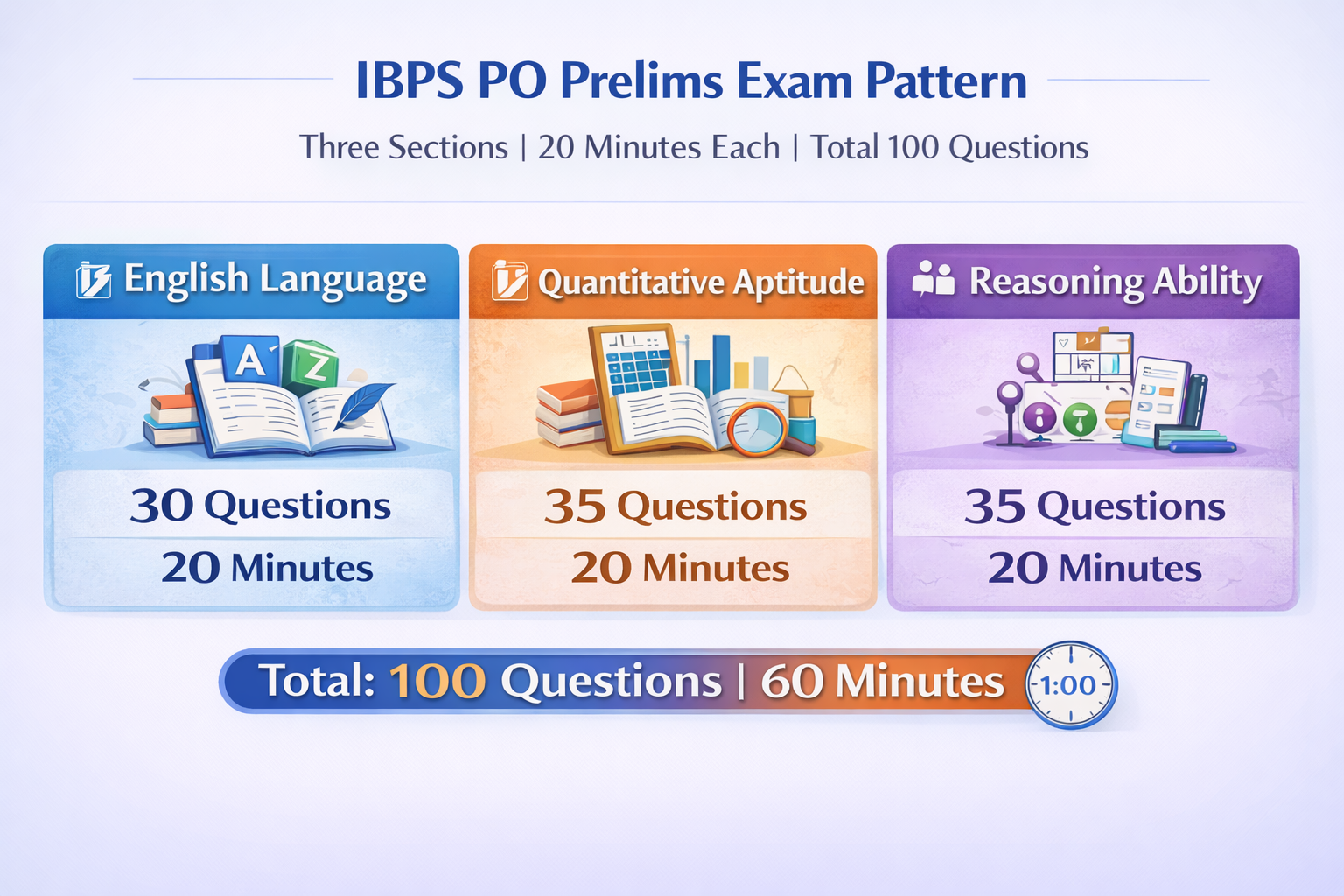
IBPS PO Prelims 2026 Exam Pattern Overview
IBPS PO Prelims Exam Pattern 2026 (At a Glance)
The IBPS PO Prelims examination is conducted online in multiple shifts across India. The exam tests three core areas essential for banking operations: English proficiency, quantitative aptitude, and logical reasoning ability. Here’s the complete pattern structure for 2026.
| Section | Number of Questions | Maximum Marks | Time Allotted |
|---|---|---|---|
| English Language | 30 | 30 | 20 minutes |
| Quantitative Aptitude | 35 | 35 | 20 minutes |
| Reasoning Ability | 35 | 35 | 20 minutes |
| TOTAL | 100 | 100 | 60 minutes |
Section-Wise Breakdown
Each section of the IBPS PO Prelims exam has unique characteristics in terms of difficulty level, question types, and strategic approach required. Let’s examine each section in detail to understand what you can expect and how to prepare effectively.
1. English Language (30 Questions, 30 Marks, 20 Minutes)
The English Language section is typically the most scoring and accuracy-oriented section in IBPS PO Prelims. With consistent practice, candidates can achieve near-perfect scores in this section, making it crucial for clearing sectional cut-offs comfortably.
Difficulty Level: Easy to Moderate
English questions are straightforward and test your basic to intermediate level proficiency in grammar, vocabulary, and comprehension. The difficulty has remained consistent over the years, making it the most predictable section.
High-Weight Topics in English Language
- Reading Comprehension (RC): One passage with 5-7 questions testing your understanding, inference ability, and vocabulary. RC forms the largest chunk of the English section and requires careful reading.
- Para Jumbles: Sentence rearrangement questions where you need to arrange 4-5 jumbled sentences in logical order (typically 5 questions).
- Error Spotting: Identifying grammatical errors in sentences, testing tenses, subject-verb agreement, prepositions, and articles (5-7 questions).
- Cloze Test: Fill-in-the-blank questions in a passage testing vocabulary and contextual understanding (5 questions).
- Sentence Improvement: Identifying and correcting grammatically or contextually incorrect parts of sentences.
- Vocabulary-based questions: Synonyms, antonyms, idioms and phrases.
- Start with your strongest area (RC or Grammar-based questions)
- Target 90%+ accuracy as this section is highly scoring
- Attempt 22-25 questions with confidence rather than attempting all 30 with guesswork
- Read RC passage carefully once and then attempt questions to save time
- Don’t spend more than 5-6 minutes on RC
2. Quantitative Aptitude (35 Questions, 35 Marks, 20 Minutes)
Quantitative Aptitude is typically the most challenging section in IBPS PO Prelims, with Data Interpretation questions dominating the section. This section requires both speed and accuracy, along with strong fundamentals in arithmetic and data analysis.
Difficulty Level: Moderate to Difficult
The difficulty of the Quant section has increased over recent years, with complex DI sets and calculation-intensive questions. However, with focused practice, you can identify doable questions and maximize your score.
High-Weight Topics in Quantitative Aptitude
- Data Interpretation (DI): 15-20 questions based on 3-4 sets of data presented as tables, line graphs, bar charts, pie charts, or mixed graphs. DI forms the backbone of the Quant section.
- Simplification & Approximation: 5-10 questions involving BODMAS, percentage calculations, square roots, and approximations. These are time-saving questions if practiced well.
- Arithmetic: 5-8 questions covering Time and Work, Time-Speed-Distance, Simple and Compound Interest, Profit-Loss-Discount, Ratio-Proportion, Percentage, Average, and Mixture-Alligation.
- Number Series: 3-5 questions where you need to identify the pattern and find missing numbers.
- Quadratic Equations: 0-5 questions comparing roots of two equations (appearing less frequently now).
- Start with Simplification and Number Series for quick scoring
- Identify one easy DI set and solve it completely
- Focus on accuracy over attempting all questions
- Skip lengthy calculation-based DI and move to Arithmetic questions
- Target 20-23 good attempts rather than 30+ with low accuracy
- Use approximation techniques to save time
3. Reasoning Ability (35 Questions, 35 Marks, 20 Minutes)
Reasoning Ability tests your logical thinking and problem-solving skills through puzzles, seating arrangements, and various logical reasoning questions. This section is puzzle-heavy and requires strong analytical abilities along with time management.
Difficulty Level: Moderate to Difficult
The Reasoning section has become increasingly puzzle-oriented with complex seating arrangements and multi-variable puzzles. However, if you can solve 2-3 puzzle sets accurately, you can achieve a good score.
High-Weight Topics in Reasoning Ability
- Seating Arrangement: 10-15 questions across 2-3 sets involving linear, circular, rectangular, or square seating arrangements. These are high-scoring if solved correctly.
- Puzzles: 10-12 questions involving scheduling, floor-based puzzles, box arrangements, or comparison-based puzzles with multiple variables.
- Inequality: 3-5 questions where you derive conclusions based on given coded inequalities.
- Syllogism: 3-5 questions testing logical deduction from given statements using Venn diagrams.
- Coding-Decoding: 3-5 questions involving pattern-based coding of letters or numbers.
- Blood Relations: 2-3 questions establishing family relationships.
- Direction Sense: 2-3 questions involving distance and direction calculations.
- Alphanumeric Series: 0-3 questions based on letter/number sequences.
- Order and Ranking: 0-2 questions.
- Quickly scan all puzzle sets and identify 2 easier ones to attempt
- Don’t spend more than 6-7 minutes on a single puzzle set
- Attempt Syllogism and Inequality first as they are quick scorers
- Use pen-paper extensively for solving puzzles
- If stuck in a puzzle after 3-4 minutes, move to the next one
- Target 22-25 good attempts with high accuracy

IBPS PO Prelims Section-Wise Question Distribution
Marking Scheme & Negative Marking Impact
The IBPS PO Prelims examination follows a standardized marking scheme that rewards accuracy and penalizes guesswork. Understanding the marking system is crucial for developing your attempt strategy and managing risk during the exam.
| Response Type | Marks Awarded | Impact on Score |
|---|---|---|
| Correct Answer | +1 mark | Positive contribution to your score |
| Wrong Answer | -0.25 marks | Penalty for incorrect attempt |
| Unattempted Question | 0 marks | No penalty, no reward |
For example, if you attempt 80 questions and get 60 correct and 20 wrong, your net score will be: 60 – (20 × 0.25) = 60 – 5 = 55 marks. Compare this with attempting 65 questions with 60 correct and 5 wrong: 60 – (5 × 0.25) = 60 – 1.25 = 58.75 marks. Quality always trumps quantity.
Sectional Timing & Strategic Implications
One of the most critical aspects of the IBPS PO Prelims exam pattern is the mandatory sectional timing. Unlike many other exams where you can freely navigate between sections, IBPS imposes strict time limits for each section that fundamentally changes your exam strategy.
How Sectional Timing Works
The 60-minute exam is divided into three equal segments of 20 minutes each, one for each section. Once you begin a section, you have exactly 20 minutes to attempt those questions. After 20 minutes, the system automatically moves you to the next section, regardless of how many questions you’ve attempted.
- You get exactly 20 minutes for each section — no more, no less
- You cannot switch between sections or revisit previous sections
- The system auto-advances to the next section after 20 minutes
- You cannot borrow time from one section to use in another
- Within a section, you can navigate freely between questions and mark for review
- The section order is fixed: English → Quantitative → Reasoning (may vary by shift)
Strategic Implications of Sectional Timing
Sectional timing requires you to develop section-specific strategies and time management skills. You must be proficient enough in each section to maximize your score within the 20-minute window. Here’s how to approach it strategically.
Time Allocation Within Each Section
| Section | Questions | Avg Time Per Question | Recommended Strategy |
|---|---|---|---|
| English Language | 30 | 40 seconds | Attempt 22-25 questions; RC: 5-6 mins, Grammar: 12-14 mins, Review: 1-2 mins |
| Quantitative Aptitude | 35 | 34 seconds | Attempt 20-23 questions; Simplification: 3-4 mins, DI: 10-12 mins, Arithmetic: 4-5 mins |
| Reasoning Ability | 35 | 34 seconds | Attempt 22-25 questions; Puzzles: 12-14 mins, Other topics: 5-7 mins, Review: 1-2 mins |
Common Mistakes Due to Sectional Timing
- Spending too much time on one DI or puzzle set
- Trying to attempt all questions instead of focusing on accuracy
- Panic due to clock pressure leading to careless mistakes
- Ignoring sectional cut-offs while chasing overall attempts
Difficulty Level Trend of IBPS PO Prelims
The difficulty level of IBPS PO Prelims has remained largely consistent over the years, with slight variations depending on the shift and year. However, the nature of questions has evolved, especially in Quantitative Aptitude and Reasoning Ability.
Section-Wise Difficulty Analysis
- English Language: Easy to Moderate — predictable pattern, grammar and RC based
- Quantitative Aptitude: Moderate to Difficult — DI-heavy with lengthy calculations
- Reasoning Ability: Moderate to Difficult — puzzle and seating arrangement dominated
While English continues to be the most scoring section, Quant and Reasoning often decide the fate of candidates due to time pressure and complexity.
Most Important Topics (High-Weight Areas)
Focusing on high-weight topics is the smartest way to maximize your Prelims score within limited preparation time.
English Language
- Reading Comprehension
- Cloze Test
- Error Spotting
- Para Jumbles
- Sentence Improvement
Quantitative Aptitude
- Data Interpretation (Tables, Line Graphs, Caselets)
- Simplification & Approximation
- Percentage, Ratio & Average
- Time & Work, Time-Speed-Distance
- Number Series
Reasoning Ability
- Seating Arrangement (Linear & Circular)
- Puzzles (Floor, Box, Scheduling)
- Inequality
- Syllogism
- Coding-Decoding
Good Attempts in IBPS PO Prelims
Good attempts depend on exam difficulty, accuracy, and category-wise cut-offs. However, based on recent trends, the following range is considered safe for General category candidates.
| Section | Good Attempts |
|---|---|
| English Language | 22 – 25 |
| Quantitative Aptitude | 18 – 22 |
| Reasoning Ability | 22 – 25 |
| Total | 60 – 70 |
Accuracy above 85–90% is more important than pushing attempts beyond this range.
IBPS PO Prelims Cut-Off Note
IBPS PO Prelims cut-off varies every year based on:
- Number of vacancies
- Difficulty level of exam
- Total candidates appearing
- Category-wise reservation
Candidates must clear:
- Sectional cut-off in all three sections
- Overall cut-off to qualify for Mains
Exam-Day Instructions
- Carry printed admit card and valid photo ID
- Reach exam center at least 60 minutes early
- No electronic gadgets allowed
- Use only the on-screen calculator
- Follow invigilator instructions strictly
Frequently Asked Questions (FAQs) – IBPS PO Prelims Pattern 2026
Yes, IBPS PO Prelims is purely qualifying in nature. The marks obtained in the Prelims examination are not added to the final merit list. It is conducted only to shortlist candidates for the Mains examination.
Yes, sectional timing is strictly enforced. Each section — English, Quantitative Aptitude, and Reasoning Ability — has a fixed duration of 20 minutes, and candidates cannot move between sections or revisit previous sections.
For every incorrect answer, 0.25 marks are deducted. There is no penalty for unattempted questions, which makes accuracy more important than attempting too many questions.
No physical calculator is allowed inside the exam hall. However, IBPS provides an on-screen calculator that candidates can use during the Quantitative Aptitude section.
A total of 60-70 attempts with high accuracy (85-90%) is usually considered safe for General category candidates. However, this may vary depending on exam difficulty and category.
Yes, IBPS applies a normalization process using equipercentile equating to adjust scores across different shifts and ensure fairness when question paper difficulty varies.
Suggested Next Reads
Conclusion
The IBPS PO Prelims Exam Pattern 2026 is designed to test speed, accuracy, and consistency under strict time constraints. Understanding the structure, focusing on high-weight topics, and practicing with sectional timing are the keys to clearing this stage.
Treat Prelims as a precision-based qualifying exam rather than a scoring one. With disciplined practice and a smart strategy, qualifying IBPS PO Prelims is completely achievable. The exam is not about attempting all 100 questions — it’s about attempting the right questions with high accuracy.
Your goal should be to clear both sectional and overall cutoffs with a comfortable margin. Regular mock tests, section-wise practice, and accurate time management will help you achieve this.
- Understand the exam pattern thoroughly before starting preparation
- Target accuracy, not just attempts
- Master sectional timing through mock tests
- Focus on high-weight topics for maximum ROI
- IBPS PO Prelims is achievable with the right strategy and consistent practice