
Last Updated: June 19, 2026
IBPS PO Prelims Syllabus 2026: Topic-wise Syllabus for English, Quant & Reasoning
Before you start preparing for IBPS PO Prelims 2026, you need to know exactly what to study and what to skip. This guide breaks down the complete syllabus — topic by topic, with weightage and difficulty analysis — so you can plan your preparation strategically.
The IBPS PO Prelims examination is the first and most crucial stage in the IBPS Probationary Officer recruitment process. This preliminary examination acts as a screening test to shortlist candidates for the Mains examination. While it is qualifying in nature, the increasing competition and rising cut-offs make it essential to prepare strategically and thoroughly.
The IBPS PO Prelims Syllabus 2026 is designed to evaluate three core competencies that are fundamental for banking professionals: language proficiency through English Language, numerical ability through Quantitative Aptitude, and logical thinking through Reasoning Ability. Each section tests your speed, accuracy, and problem-solving skills under strict time constraints.
Understanding the syllabus comprehensively is the foundation of effective preparation. This detailed guide provides you with a complete, topic-wise breakdown of the IBPS PO Prelims Syllabus 2026, including weightage analysis based on previous year question papers, difficulty trends, high-priority topics, and strategic preparation tips to help you score maximum marks and clear the cut-off comfortably.
Whether you’re a first-time aspirant or attempting the exam again, this structured approach to the syllabus will help you identify your strengths, work on weaknesses, and optimize your preparation time for maximum results.
📘 Table of Contents
- Introduction: Why Syllabus Awareness Matters
- IBPS PO Prelims Exam Pattern 2026 (Overview)
- Topic-Wise Syllabus
- English Language Syllabus
- Quantitative Aptitude Syllabus
- Reasoning Ability Syllabus
- Weightage: Topic-Wise Marks Distribution
- Most Important Topics (High-Weight Areas)
- Difficulty Level Overview
- What to Prioritize for IBPS PO Prelims 2026
- Common Mistakes to Avoid
- Frequently Asked Questions
- Suggested Next Reads
- Conclusion
⚡ Quick Summary – IBPS PO Prelims Syllabus 2026
- Sections: English Language, Quantitative Aptitude, Reasoning Ability
- Total Questions: 100 Questions | 100 Marks | 60 Minutes
- Sectional Timing: 20 minutes per section (strict sectional timing)
- High-weight topics: Reading Comprehension, Data Interpretation, Puzzles & Seating Arrangement
- Difficulty Level: Moderate to Difficult
- Best scoring areas: Simplification, Syllogism, Error Detection, Cloze Test
- Strategy: Topic-wise mastery + consistent practice + speed-building exercises
- Negative Marking: 0.25 marks deducted for each wrong answer
Introduction: Why Understanding the Syllabus Matters Before You Start Preparing
The IBPS PO Prelims examination is the first hurdle in your banking career journey. Every year, over 10 lakh aspirants apply for approximately 5,000-5,500 positions across 11 public sector banks. The competition is fierce, and understanding the syllabus is your first strategic advantage.
Many candidates make the mistake of preparing without knowing what to focus on. They waste time on topics that rarely appear, ignore high-weight areas, and end up with poor scores. A smart aspirant studies the syllabus carefully, identifies the most important topics, and allocates preparation time accordingly.
This comprehensive guide covers the complete IBPS PO Prelims syllabus for 2026, including topic-wise breakdown, weightage analysis, difficulty trends, and strategic preparation tips. Whether you’re a first-time aspirant or appearing again, this structured approach will help you maximize your score within the 60-minute window.
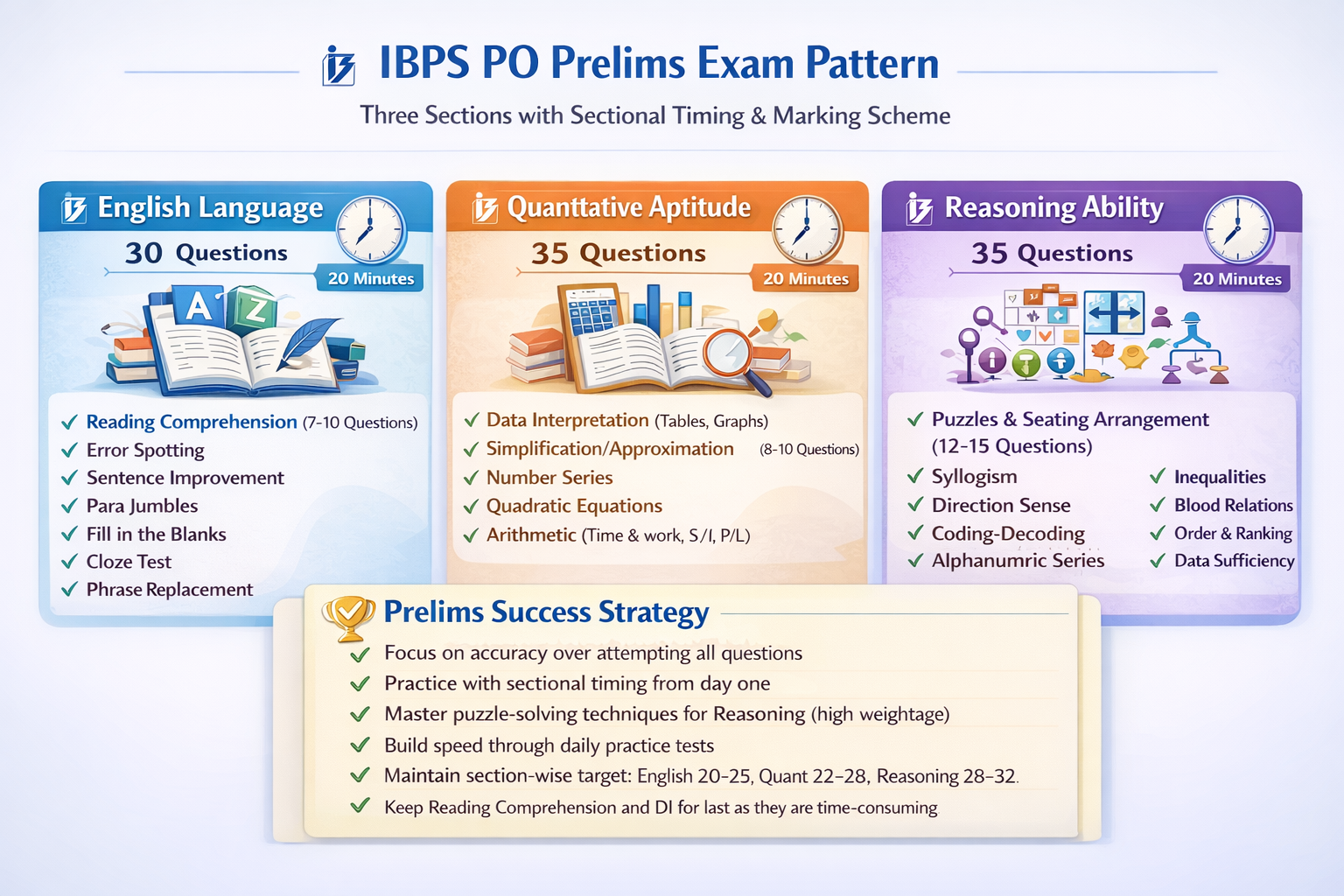
IBPS PO Prelims 2026 Exam Pattern Structure
- Sectional Timing: Strict 20-minute limit for each section — cannot move between sections
- Negative Marking: 0.25 marks deducted for every wrong answer
- Qualifying Nature: You must clear sectional cut-offs as well as overall cut-off
- Online Mode: Computer-based test with on-screen questions
- Language Options: Questions available in English and Hindi (except English Language section)
- No Sectional Movement: Once time expires for a section, you automatically move to the next
Topic-Wise Syllabus: Complete Breakdown
The IBPS PO Prelims syllabus is divided into three distinct sections, each testing different skill sets. Let’s explore each section in detail with complete topic coverage, subtopic breakdowns, and question trends from previous years.
1. English Language Syllabus (30 Questions)
The English Language section evaluates your command over the English language, including vocabulary, grammar, comprehension skills, and ability to understand contextual usage. This section is generally considered easy to moderate in difficulty and is often the best-scoring section for candidates with good language skills.
Difficulty Level: Easy to Moderate
Exam Focus: Vocabulary, Reading Comprehension, Grammar accuracy, Contextual understanding
| Topic Area | Sub-Topics Covered | Expected Questions | PYQ Consistency |
|---|---|---|---|
| Reading Comprehension | Fact-based questions, opinion-based questions, inference questions, vocabulary in context, theme identification, title selection, tone and style | 7-10 | Always present |
| Error Detection / Sentence Correction | Subject-Verb Agreement, tense errors, article errors, preposition errors, modifier errors, pronoun errors, conjunction errors | 4-5 | Highly frequent |
| Cloze Test / Fill in the Blanks | Grammar-based blanks, context-based blanks, vocabulary-based blanks, logical flow | 5-6 | Very frequent |
| Para Jumbles | Sentence rearrangement, logical sequence, contextual flow, opening/closing statements | 4-5 | Regular |
| Sentence Completion | Single filler, double filler, context-based completion | 3-4 | Moderate |
| Vocabulary | Synonyms, antonyms, word usage, idioms and phrases, one-word substitution | 2-3 | Occasional |
- Reading Comprehension: Contributes 25-33% of section marks
- Error Detection: High-scoring if grammar rules are clear
- Cloze Test: Tests both grammar and vocabulary simultaneously
Preparation Strategy: Read newspapers daily (The Hindu, Indian Express), practice RC passages from banking/economy themes, revise grammar rules thoroughly, and build a strong vocabulary foundation.
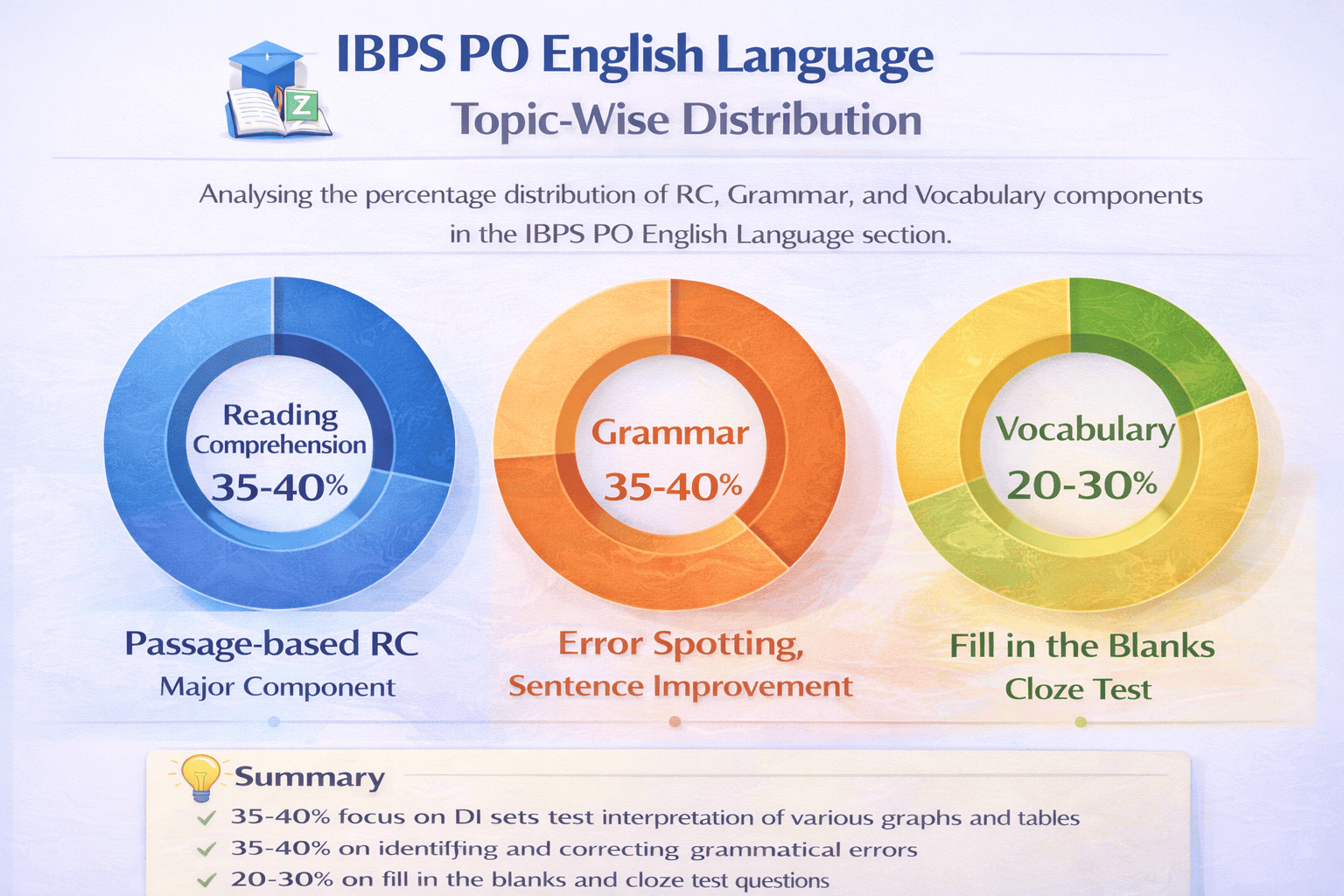
English Language Topic Distribution in IBPS PO Prelims
2. Quantitative Aptitude Syllabus (35 Questions)
Quantitative Aptitude is often considered the most challenging section in IBPS PO Prelims. It tests your mathematical skills, calculation speed, and ability to interpret data quickly. This section requires consistent practice and strong conceptual clarity across various arithmetic and data interpretation topics.
Difficulty Level: Moderate to Difficult
Exam Focus: Fast calculation skills, Data Interpretation mastery, Arithmetic problem-solving
| Topic | Sub-Topics Included | Expected Weightage | PYQ Trend |
|---|---|---|---|
| Number Series | Missing number series, wrong number series, pattern recognition, square/cube-based series, prime number series | 4-5 questions | Highly consistent |
| Simplification | BODMAS rule, square roots and cube roots, fraction calculations, decimal operations, percentage calculations | 5-7 questions | Very frequent |
| Approximation | Rounding off numbers, estimation techniques, quick calculation methods | Included in Simplification | Very frequent |
| Quadratic Equations | Comparing roots (x and y), relationship determination, factorization method, quadratic formula | 3-5 questions | Regular appearance |
| Data Interpretation (DI) | Table DI, bar graph (simple, stacked, grouped), pie chart, line graph, caselet DI, mixed DI (combination of 2+ types), missing DI | 10-12 questions | Most important topic |
| Arithmetic | Percentage, Profit and Loss, Simple Interest & Compound Interest, Time-Speed-Distance, Time & Work, Average, Ratio & Proportion, Mixture & Alligation, Partnership, Ages | 10-12 questions | Extremely high |
| Miscellaneous | Probability, Permutation & Combination, Data Sufficiency, Quantity comparison | 1-3 questions | Occasional |
- Memorize multiplication tables up to 30
- Learn squares up to 40 and cubes up to 20
- Practice Vedic mathematics shortcuts
- Use approximation techniques for complex calculations
- Master percentage-fraction conversions
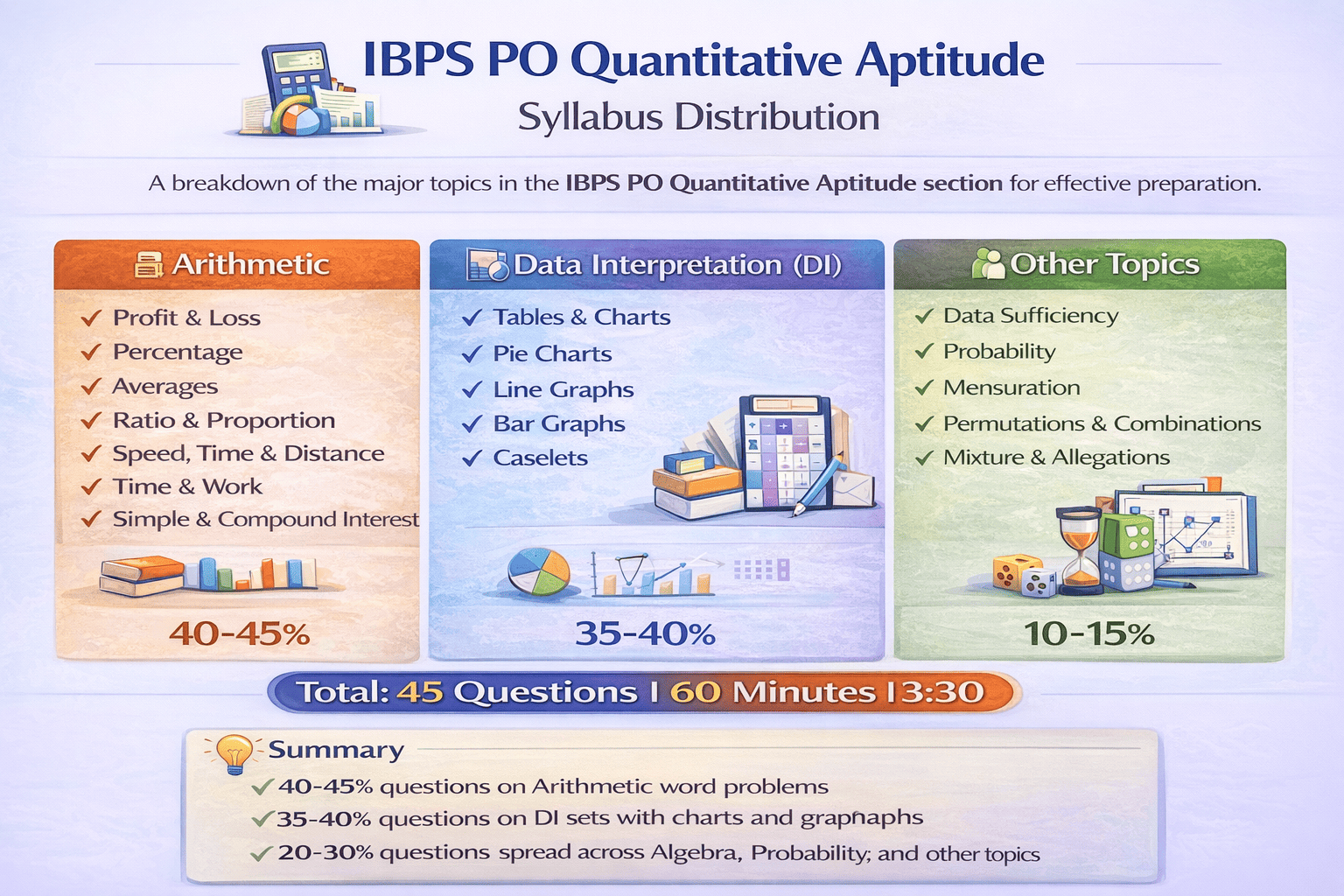
Quantitative Aptitude Topic Distribution in IBPS PO Prelims
3. Reasoning Ability Syllabus (35 Questions)
The Reasoning Ability section evaluates a candidate’s logical thinking, analytical skills, and ability to identify patterns under time pressure. This section has become increasingly puzzle-centric in recent years, making conceptual clarity and practice extremely important.
Difficulty Level: Moderate to Difficult
Exam Focus: Logical deduction, puzzle-solving speed, accuracy in reasoning statements
| Topic | Sub-Topics Covered | Expected Weightage | PYQ Trend |
|---|---|---|---|
| Puzzles & Seating Arrangement | Linear seating (single & double row), circular seating (inside & outside), floor-based puzzles, box-based puzzles, scheduling & comparison puzzles | 15–20 questions | Highest weightage |
| Inequality | Coded inequalities, mathematical symbols, logical conclusions | 3–5 | Very frequent |
| Syllogism | Traditional syllogism, reverse syllogism, either–or cases | 3–5 | Very frequent |
| Coding–Decoding | Letter coding, word coding, symbol coding | 2–4 | Regular |
| Blood Relations | Family tree problems, generation-based logic | 1–2 | Occasional |
| Direction Sense | Distance & direction logic, movement-based questions | 1–2 | Occasional |
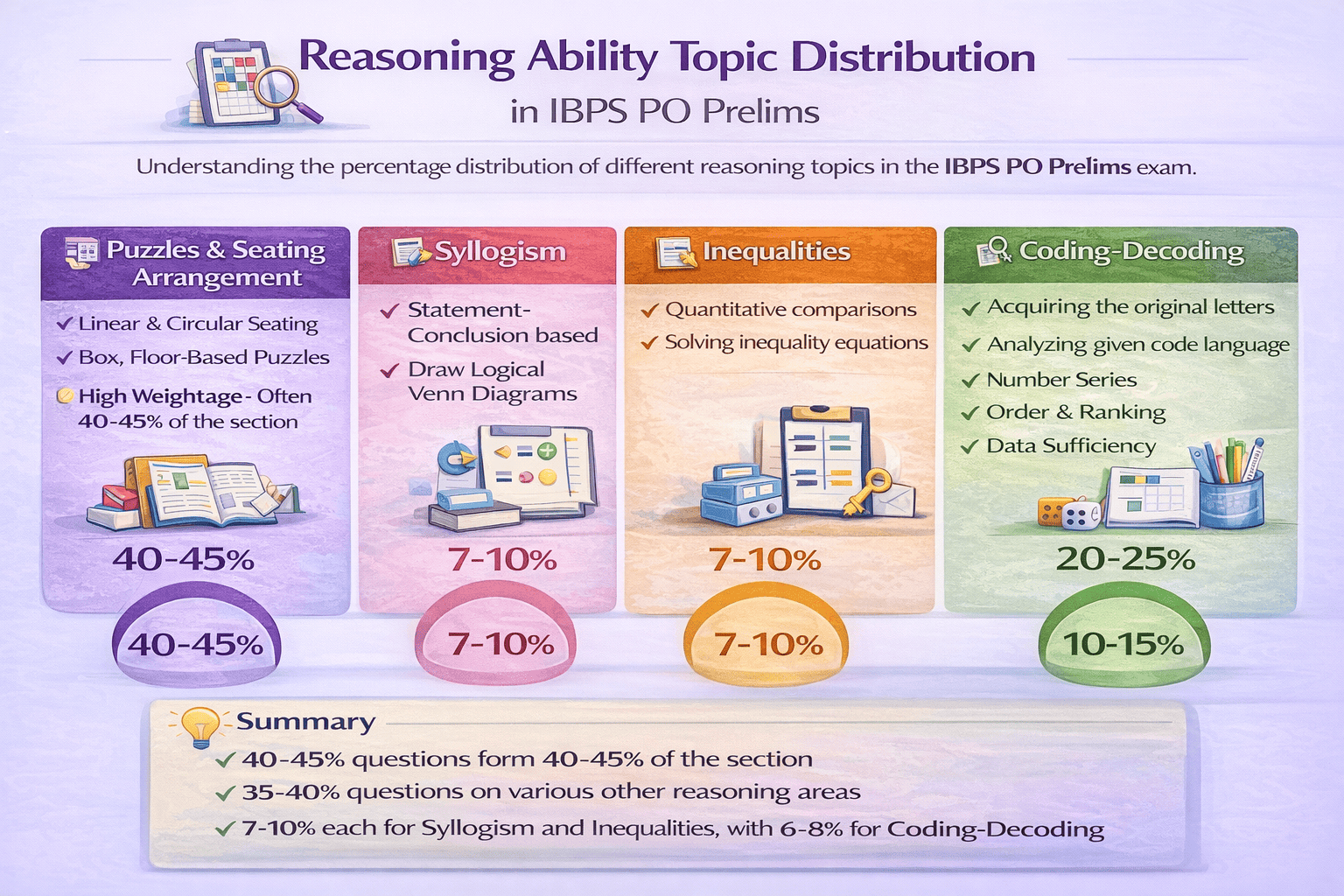
Reasoning Ability Topic Distribution in IBPS PO Prelims
Weightage: Topic-Wise Marks Distribution
Understanding weightage helps you allocate preparation time intelligently. Below is a realistic weightage distribution based on multiple years of IBPS PO Prelims analysis.
| Section | High-Weight Topics | Approx. Share |
|---|---|---|
| English Language | Reading Comprehension, Cloze Test | 50–60% |
| Quantitative Aptitude | Data Interpretation, Arithmetic | 60–70% |
| Reasoning Ability | Puzzles & Seating Arrangement | 55–65% |
Most Important Topics (High-Weight Areas)
Focusing on high-weight topics is the smartest way to maximize your Prelims score within limited preparation time.
English Language
- Reading Comprehension
- Cloze Test
- Error Detection
- Para Jumbles
Quantitative Aptitude
- Data Interpretation (Tables, Line Graphs, Caselets)
- Simplification & Approximation
- Arithmetic (Time-Speed-Distance, Profit-Loss, SI-CI, Ratio-Proportion)
- Number Series
Reasoning Ability
- Seating Arrangement (Linear & Circular)
- Puzzles (Floor, Box, Scheduling)
- Syllogism
- Inequality
Difficulty Level Overview
The IBPS PO Prelims exam is generally classified as Moderate to Difficult. While individual sections like English may feel easier, the combined pressure of sectional timing and cut-offs raises the overall difficulty level.
- English Language: Easy to Moderate — predictable pattern, grammar and RC based
- Quantitative Aptitude: Moderate to Difficult — DI-heavy with lengthy calculations
- Reasoning Ability: Moderate to Difficult — puzzle and seating arrangement dominated
While English continues to be the most scoring section, Quant and Reasoning often decide the fate of candidates due to time pressure and complexity.
What to Prioritize for IBPS PO Prelims 2026
- Master high-weight topics before touching low-frequency ones
- Practice sectional mock tests regularly
- Focus on accuracy over blind attempts
- Strengthen calculation speed and puzzle-solving skills
- Ensure balanced preparation across all three sections
Common Mistakes Candidates Must Avoid
- Ignoring sectional cut-offs
- Over-attempting Quant or Reasoning without accuracy
- Skipping English preparation assuming it is easy
- Not practicing under strict time limits
- Relying only on theory without mock practice
Frequently Asked Questions (FAQs) – IBPS PO Prelims Syllabus 2026
Yes, the IBPS PO Prelims syllabus remains largely the same every year. However, IBPS may change the difficulty level, question pattern, or weightage of topics based on exam trends. Hence, aspirants should focus on concepts rather than memorizing patterns.
English Language is generally considered the most scoring section due to predictable question patterns and fewer calculations. With strong grammar fundamentals and reading comprehension practice, candidates can maximize their score here.
A safe attempt range is usually 60-70 questions with high accuracy (85-90%) for General category candidates. Attempting fewer questions with better accuracy is often more beneficial than blind guessing.
Yes, sectional timing is strictly enforced. Each section has exactly 20 minutes, and candidates cannot switch between sections or carry forward unused time, making balanced preparation across all sections essential.
Yes, Data Interpretation is the most important topic in Quantitative Aptitude and appears consistently every year. At least 10-12 questions are based on DI, making it a must-prepare area.
Mock tests are extremely important for Prelims preparation. They help candidates adapt to sectional timing, improve speed and accuracy, identify weak areas, and develop an effective exam-day strategy.
Suggested Next Reads
Conclusion
The IBPS PO Prelims Syllabus 2026 is comprehensive but highly predictable. With a clear understanding of topic-wise weightage, focused preparation, and regular mock practice, clearing Prelims is completely achievable.
Treat Prelims as a precision-based exam — prioritize accuracy, manage time wisely, and strengthen high-weight areas. With consistency and smart strategy, you can confidently move one step closer to becoming a Probationary Officer.
Your goal should be to clear both sectional and overall cutoffs with a comfortable margin. Regular mock tests, section-wise practice, and accurate time management will help you achieve this.
- Understand the syllabus thoroughly before starting preparation
- Target accuracy, not just attempts
- Master sectional timing through mock tests
- Focus on high-weight topics for maximum ROI
- IBPS PO Prelims is achievable with the right strategy and consistent practice