
Last Updated: June 19, 2026
IBPS PO Mains Syllabus 2026: Complete Topic-wise Guide with Weightage & Strategy
Before you start preparing for IBPS PO Mains 2026, you need to know exactly what to study and where to focus. This guide breaks down the complete Mains syllabus — section by section, topic by topic, with weightage analysis and preparation strategy — so you can plan your preparation intelligently.
The IBPS PO Mains examination is the decisive and most challenging stage of the IBPS Probationary Officer selection process. Unlike the Prelims, which acts as a qualifying round, the Mains exam score directly contributes to your final merit ranking and determines whether you proceed to the interview stage.
The IBPS PO Mains exam is designed to comprehensively assess a candidate’s analytical reasoning, data interpretation capabilities, advanced English proficiency, banking and economic knowledge, and written communication skills. The examination goes beyond testing basic concepts and focuses heavily on application-based questions that require deep understanding and analytical thinking.
The exam consists of five distinct sections conducted in a single sitting with strict sectional timing. Each section is designed to test specific competencies essential for a banking professional. The addition of the descriptive paper makes this exam unique among banking examinations, as it directly evaluates your ability to articulate thoughts clearly and professionally in written format.
This comprehensive guide covers the complete IBPS PO Mains syllabus for 2026, including section-wise topic breakdown, weightage analysis, previous year trends, descriptive writing guide, and expert preparation strategies to help you maximize your score and secure a top rank.
📘 Table of Contents
- IBPS PO Mains 2026 Overview
- IBPS PO Mains Exam Pattern 2026
- Complete Syllabus — Section-wise & Topic-wise
- Reasoning & Computer Aptitude
- Data Analysis & Interpretation
- English Language
- General/Economy/Banking Awareness
- Descriptive Writing
- Previous Year Exam Analysis (Last 3 Years)
- Expected Question Trend 2026
- High-Weight Topics (Most Scoring Areas)
- Frequently Asked Questions
- Suggested Next Reads
- Conclusion
⚡ Quick Summary – IBPS PO Mains Syllabus 2026
- Total Sections: 5 (4 Objective + 1 Descriptive)
- Total Questions: 157 (155 Objective + 2 Descriptive)
- Total Marks: 225 (200 Objective + 25 Descriptive)
- Duration: 3 hours 30 minutes (with sectional timing)
- Highest Weightage: Reasoning & DI together account for 120/225 marks
- Difficulty Level: Moderate to High (significantly tougher than Prelims)
- Negative Marking: 0.25 marks for each wrong answer in objective sections
- Key Focus Areas: Puzzles, Caselet DI, Reading Comprehension, Banking Awareness
IBPS PO Mains 2026 — Overview
The IBPS PO Mains examination is the most important stage of the entire recruitment process. While Prelims serves as a qualifying filter, Mains carries 80% weightage in your final merit score. This means your Mains performance essentially decides whether you get selected or not.
The exam is designed to test not just your knowledge but your analytical ability, decision-making skills, awareness of the banking ecosystem, and professional communication. The examination goes beyond testing basic concepts and focuses heavily on application-based questions that require deep understanding and analytical thinking.

IBPS PO Mains 2026 Exam Pattern Overview
IBPS PO Mains Exam Pattern 2026
The IBPS PO Mains examination follows a structured pattern with five sections, each having its own time limit and specific focus areas. Understanding this pattern is fundamental to developing an effective preparation strategy and time management approach.
| Section | No. of Questions | Maximum Marks | Time Allotted |
|---|---|---|---|
| Reasoning & Computer Aptitude | 45 | 60 | 60 minutes |
| Data Analysis & Interpretation | 35 | 60 | 45 minutes |
| English Language | 35 | 40 | 40 minutes |
| General/Economy/Banking Awareness | 40 | 40 | 35 minutes |
| Descriptive: Essay + Letter | 2 | 25 | 30 minutes |
| TOTAL | 157 | 225 | 3 hr 30 min |
- Sectional Timing is Mandatory: Each section has a fixed time limit, and you cannot switch between sections or borrow time from one section to another. The system automatically moves you to the next section when time expires.
- Negative Marking: There is a penalty of 0.25 marks for each incorrect answer in the objective sections. The descriptive section does not have negative marking but is evaluated for content quality, grammar, and coherence.
- Marks Weightage: Notice that Data Interpretation and Reasoning together account for 120 out of 225 marks (53% of total marks), making these sections extremely crucial for your overall score.
Complete IBPS PO Mains Syllabus 2026 — Section-wise & Topic-wise
The IBPS PO Mains syllabus is vast and requires thorough preparation across multiple domains. Each section tests different competencies and requires specific preparation strategies. Let’s examine each section in comprehensive detail with topic-wise breakdown and weightage analysis.
A. Reasoning & Computer Aptitude (45 Questions, 60 Marks, 60 Minutes)
This section combines traditional reasoning questions with computer aptitude, testing your logical thinking, analytical abilities, and basic computer knowledge. The reasoning portion is heavily puzzle-oriented and requires strong problem-solving skills and time management.
1. Topic-Wise Syllabus — Reasoning
The reasoning portion dominates this section with approximately 40-42 questions, while computer aptitude typically has 3-5 questions.
Core Reasoning Topics:
- Puzzle Sets: Complex multi-variable puzzles including floor-based arrangements, box arrangements, scheduling puzzles, and attribute-based puzzles. These are the most time-consuming but highest-scoring questions.
- Seating Arrangement: Linear seating (single/double row), circular seating (facing center/outside), rectangular and square arrangements. Often combined with additional conditions to increase complexity.
- Input-Output: Machine input-output questions where you need to identify the logic/pattern and determine outputs for given steps. These questions test pattern recognition and logical deduction.
- Syllogism (New Pattern): Advanced syllogism questions going beyond basic Venn diagrams, including either-or cases, conclusion-based questions, and reverse syllogism.
- Inequalities: Coded inequality questions where you derive relationships and conclusions based on given symbols representing greater than, less than, or equal to.
- Blood Relations: Complex family relationship questions, sometimes combined with coding-decoding or direction sense.
- Direction Sense: Questions involving distance and direction calculations, path tracing, and shadow-based direction problems.
- Logical Reasoning: Statement-based questions testing assumptions, inferences, conclusions, courses of action, and strengthening/weakening of arguments.
- Statement & Argument: Evaluating the strength of arguments supporting or opposing a given statement.
- Cause & Effect: Identifying cause-effect relationships between given statements.
Computer Aptitude Topics:
- Internet Basics: Web browsers, search engines, URLs, HTTP/HTTPS, email protocols
- Networking: LAN, WAN, MAN, topology types, IP addresses, routers, modems
- Computer Memory & Storage: RAM, ROM, cache memory, hard disk, SSD, storage units (KB, MB, GB, TB)
- MS Office Basics: Word, Excel, PowerPoint features and shortcuts
- Cyber Security: Viruses, malware, firewall, encryption, phishing, password security
- Number Systems: Binary, octal, decimal, hexadecimal conversions
- Computer Hardware: Input/output devices, CPU components, motherboard basics
2. Weightage Distribution — Reasoning & Computer
| Topic | Expected Questions | Difficulty Level |
|---|---|---|
| Puzzles | 10-12 | Moderate to High |
| Seating Arrangement | 8-10 | Moderate to High |
| Input-Output | 4-5 | Moderate |
| Logical Reasoning | 4-6 | Easy to Moderate |
| Syllogism | 3-4 | Easy to Moderate |
| Inequality | 2-3 | Easy |
| Blood Relations | 2-3 | Easy to Moderate |
| Direction Sense | 2-3 | Easy to Moderate |
| Computer Aptitude | 3-5 | Easy |
| Miscellaneous | 2-3 | Variable |
- Master puzzle-solving techniques as they carry maximum weightage (20-22 questions combined with seating)
- Start with easy topics like Inequality and Syllogism to build momentum
- Practice 50+ diverse puzzle sets to handle any complexity level
- For computer aptitude, focus on banking-related technology and current digital initiatives
- Allocate 12-14 minutes for puzzles, 3-4 minutes for quick topics, and keep buffer time for review
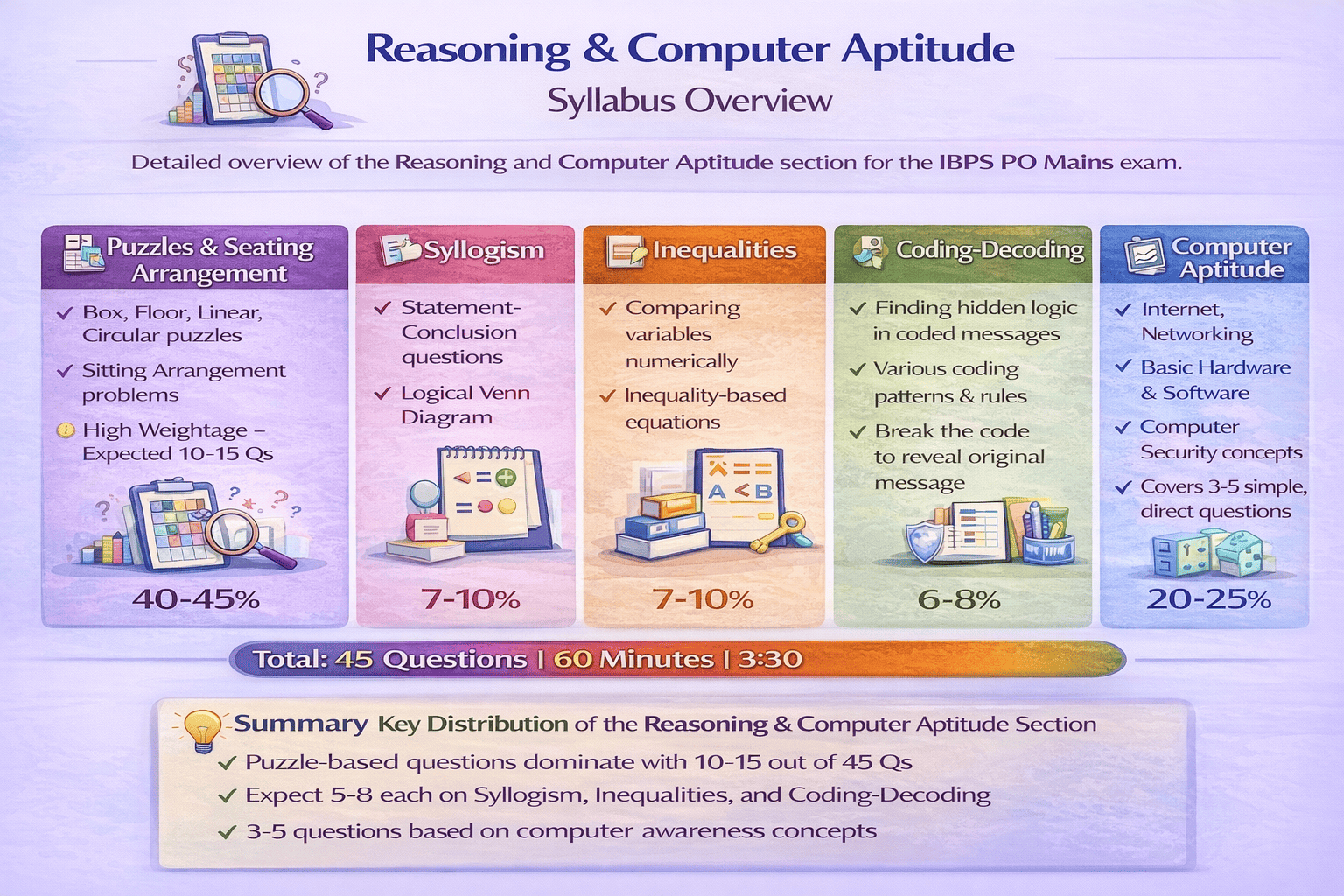
Reasoning and Computer Aptitude Topic Distribution in IBPS PO Mains
B. Data Analysis & Interpretation (35 Questions, 60 Marks, 45 Minutes)
The Data Interpretation section is the highest-scoring section in IBPS PO Mains with 60 marks for just 35 questions. This section tests your ability to interpret complex data sets, perform calculations quickly, and derive meaningful conclusions. The questions are calculation-intensive and require strong arithmetic fundamentals.
1. Topic-Wise Syllabus — Data Interpretation
- Caselet DI: Paragraph-based data interpretation where information is presented in text format rather than charts or tables. These require careful reading and data extraction before calculation.
- Bar Graph: Single or multiple bar graphs showing comparative data across categories. Questions may involve percentage calculations, ratio comparisons, and trend analysis.
- Line Graph: Line charts showing trends over time periods. Questions test your ability to identify patterns, calculate growth rates, and compare multiple data series.
- Pie Chart: Circular graphs showing percentage distribution. Often combined with other data types for complex questions.
- Tabular DI: Data presented in table format with multiple rows and columns. These test your ability to locate information quickly and perform calculations efficiently.
- Mixed DI: Combination of two or more chart types (bar + line, table + pie) testing your ability to correlate data from multiple sources.
- Missing DI: Data sets with some values missing, requiring you to derive them using given information or relationships.
- Data Sufficiency: Questions testing whether given statements provide sufficient information to answer a question. These require logical reasoning along with quantitative aptitude.
- Quantity Comparison: Comparing two quantities and determining which is greater, or if they’re equal, or if comparison is impossible with given data.
- Probability: Questions on probability calculations including conditional probability, independent events, and combinatorial probability.
- Permutation & Combination: Arrangement and selection problems using P&C formulas.
- Arithmetic DI: Questions involving arithmetic concepts embedded in data interpretation including Time-Speed-Distance, Profit-Loss-Discount, Simple and Compound Interest, Mensuration, Partnership, and Mixture-Alligation.
2. Weightage Distribution — Data Interpretation
| Topic | Expected Questions | Marks Weightage |
|---|---|---|
| Caselet DI | 10-12 | Very High |
| Mixed/Tabular DI | 5-7 | High |
| Bar/Line Graph | 7-8 | High |
| Missing DI | 4-5 | Moderate |
| Data Sufficiency | 4-6 | Moderate |
| Probability/Permutation & Combination | 2-3 | Low to Moderate |
- Strengthen arithmetic fundamentals first — all DI questions ultimately involve calculations
- Practice reading and extracting data from caselets within 2-3 minutes
- Learn approximation and calculation shortcuts to save time
- Solve easier chart-based DI first, then move to complex caselets
- Target 20-25 high-accuracy attempts rather than attempting all 35 questions
- Use rough work space efficiently and maintain clear calculation notes

Data Interpretation Topic Distribution in IBPS PO Mains
C. English Language (35 Questions, 40 Marks, 40 Minutes)
The English Language section in IBPS PO Mains is significantly more challenging than Prelims, with emphasis on reading comprehension, contextual vocabulary, and advanced grammar. The section tests not just your knowledge of English but your ability to understand complex passages, identify subtle errors, and comprehend nuanced language usage.
1. Topic-Wise Syllabus — English Language
- Reading Comprehension (RC): The most important topic with 12-15 questions typically based on 2-3 passages. RC passages in Mains are longer (400-600 words) and cover complex topics related to Economy and Banking, Technology and Innovation, Environment and Climate Change, Social Issues and Development, and Business and Finance. Questions test vocabulary, inference, tone identification, author’s intent, paragraph completion, and critical reasoning.
- Para Jumbles: Sentence rearrangement questions where 5-6 jumbled sentences need to be arranged in coherent order. These test logical flow and contextual understanding.
- Cloze Test (New Pattern): Passage-based fill-in-the-blank questions that test grammar, vocabulary, and contextual understanding. These questions require you to understand the overall theme of the passage before selecting the correct word.
- Error Detection: Identification of grammatical, contextual, or structural errors in sentences. Questions may test subject-verb agreement, tense consistency, prepositions, articles, modifiers, and sentence structure.
- Word Swap / Word Usage: Questions where words in a sentence are incorrectly placed and need to be swapped, or incorrect usage of a word needs to be identified.
- Sentence Rearrangement: Rearranging sentences or phrases to form a meaningful and grammatically correct sentence.
- Fillers: Phrase-based or grammar-based fillers that test contextual vocabulary and sentence flow.
- Para Completion: Completing an incomplete paragraph by choosing the most appropriate concluding sentence.
2. Weightage Distribution — English Language
| Topic | Expected Questions | Weightage Level |
|---|---|---|
| Reading Comprehension | 12-15 | Very High |
| Para Jumbles | 3-4 | Medium |
| Error Detection | 4-5 | High |
| Cloze Test | 4-5 | High |
| Vocabulary & Usage | 3-4 | Medium |
| Miscellaneous | 4-5 | Medium |
- Allocate 18-20 minutes exclusively for Reading Comprehension
- Read editorials daily to improve comprehension speed
- Focus on accuracy — English is a high-scoring section
- Do not overthink vocabulary questions; rely on context

English Language Topic Distribution in IBPS PO Mains
D. General / Economy / Banking Awareness (40 Questions, 40 Marks, 35 Minutes)
This section is scoring yet unpredictable and plays a decisive role in final merit. Questions are direct but require consistent current affairs preparation and strong conceptual clarity in banking and economic topics.
1. Topic-Wise Syllabus
- Current Affairs: Last 6-8 months with focus on banking, economy, government schemes, national & international events
- Banking Awareness: RBI functions, monetary policy, CRR, SLR, repo rate, reverse repo, NPAs, Basel norms
- Financial Awareness: Inflation, GDP, fiscal deficit, monetary vs fiscal policy
- Government Schemes: PMJDY, PMFBY, Mudra, Digital India, Startup India
- Static Banking: Banking history, committees, headquarters, taglines
- International Reports & Indexes: World Bank, IMF, UN reports
- Union Budget & Economic Survey: Key highlights, growth projections, sectoral focus
2. Weightage Distribution — GA
| Topic | Expected Questions |
|---|---|
| Current Affairs (6-8 months) | 20-22 |
| Banking Awareness | 10-12 |
| Static GK | 4-5 |
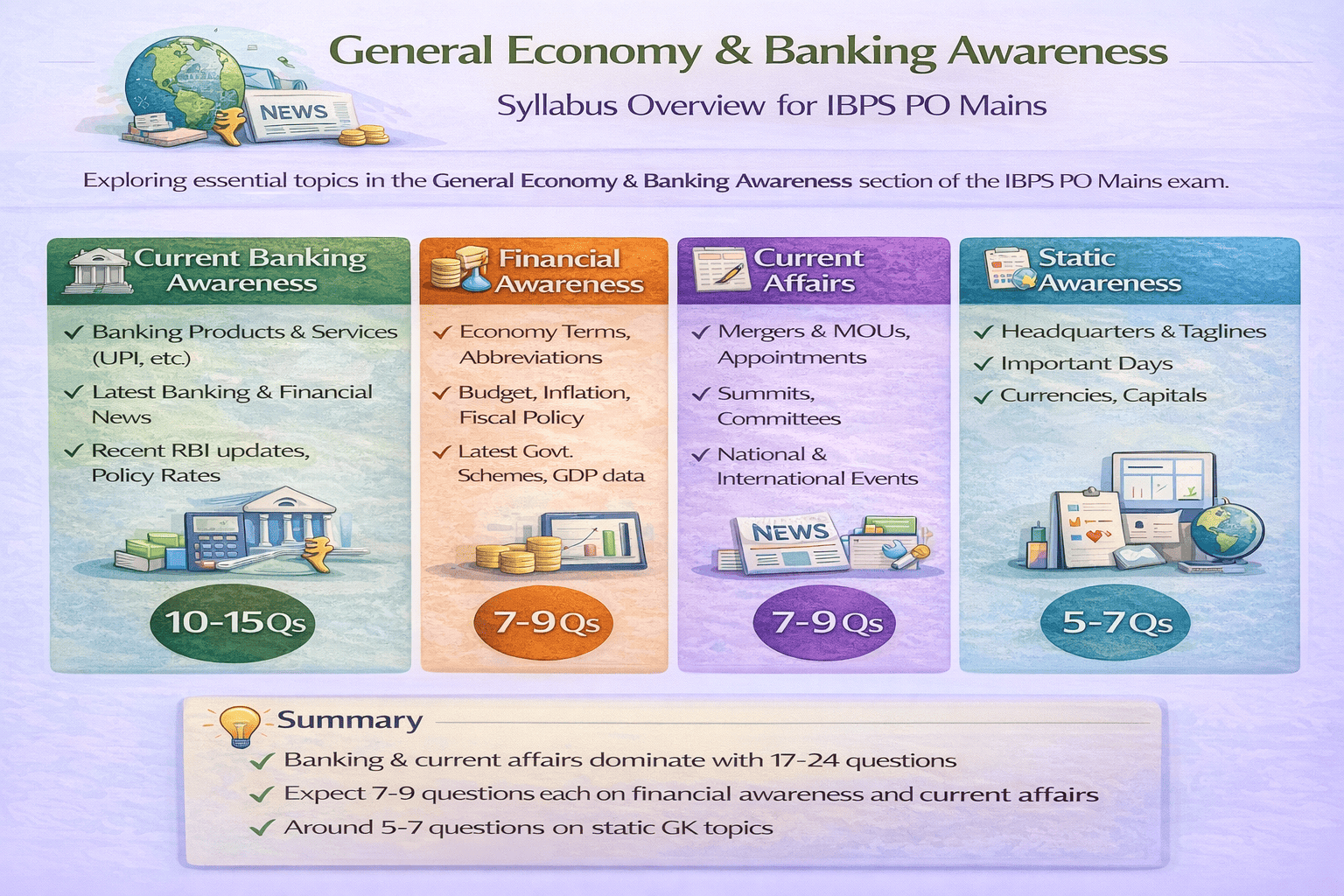
General Economy and Banking Awareness Topic Distribution in IBPS PO Mains
E. Descriptive Writing — Essay & Letter (25 Marks, 30 Minutes)
The descriptive section evaluates your written communication skills. Answers are typed on-screen and assessed for clarity, structure, grammar, and relevance.
Expected Essay Topics
- Digital Banking & Fintech
- Artificial Intelligence in Banking
- Financial Inclusion
- Inflation & Monetary Policy
- UPI & Cashless Economy
Letter Writing Topics
- Formal complaint to bank
- Letter to branch manager
- Letter regarding loan, KYC, or service issue

Descriptive Writing Topic Distribution in IBPS PO Mains
Previous Year Exam Analysis (Last 3 Years)
Analysis of recent years shows a clear trend toward analytical reasoning, caselet-based DI, and banking-heavy GA.
- Reasoning: Puzzle complexity increasing with multi-variable arrangements
- DI: Caselet + mixed DI dominant with calculation-intensive questions
- English: RC weightage consistently high with economy-based passages
- GA: Banking awareness gaining importance over general current affairs
Expected Question Trend 2026
- Reasoning: Multi-variable puzzles + logic-based questions
- DI: Caselet-heavy with arithmetic integration
- English: Economy and banking-based RC passages
- GA: RBI policies + Banking sector focus
- Descriptive: Economy & digital finance topics
High-Weight Topics (Most Scoring Areas)
- Reasoning: Seating Arrangement & Puzzles
- DI: Caselet & Mixed DI
- English: Reading Comprehension
- GA: Banking & Economy
- Descriptive: Banking/Economy Essays
Frequently Asked Questions (FAQs) – IBPS PO Mains Syllabus 2026
The IBPS PO Mains syllabus consists of five sections: Reasoning & Computer Aptitude, Data Analysis & Interpretation, English Language, General/Economy/Banking Awareness, and Descriptive Writing (Essay + Letter). The syllabus focuses on analytical reasoning, advanced DI, reading comprehension, banking and economic awareness, and professional written communication.
Yes. IBPS PO Mains is significantly more difficult than Prelims. Questions are longer, more analytical, and concept-based. Time pressure is higher due to sectional timing, and the descriptive paper adds an additional evaluation layer that tests written clarity and structure.
IBPS PO Mains carries 80% weightage in the final merit list, while the interview carries 20%. This makes Mains the most decisive stage of the entire selection process.
Reasoning & Computer Aptitude and Data Analysis & Interpretation together account for 120 out of 225 marks, which is more than 53% of the total paper. These two sections largely determine your final score and rank.
Candidates should prepare at least the last 6-8 months of current affairs, with special focus on banking, economy, RBI updates, monetary policy, government schemes, budget, and financial news.
Yes. Computer aptitude questions are merged with the Reasoning section in IBPS PO Mains. These questions are basic and practical, covering banking technology, internet, cybersecurity, number systems, and digital banking concepts.
Suggested Next Reads
Conclusion
IBPS PO Mains 2026 is not just an examination of knowledge, but a comprehensive assessment of analytical ability, decision-making skills, awareness of the banking ecosystem, and professional communication. The exam is challenging, time-bound, and highly competitive, but it is also predictable when approached with the right strategy.
A clear understanding of the syllabus and weightage allows aspirants to prioritize high-return topics such as puzzles, caselet DI, reading comprehension, and banking awareness. Since Reasoning and Data Interpretation together form more than half of the total marks, mastering these sections is crucial for securing a strong overall score.
The descriptive paper, often underestimated, plays a vital role in differentiating serious candidates from average ones. Regular practice of essays and letters, combined with proper structure and relevant content, can significantly boost your Mains score.
Success in IBPS PO Mains depends on smart preparation rather than random hard work. Consistent mock practice, regular revision, accuracy-focused attempts, and a calm exam-day strategy are the true keys to clearing this stage. With disciplined preparation and a structured plan, cracking IBPS PO Mains 2026 is absolutely achievable.
- Understand the Mains syllabus thoroughly before starting preparation
- Prioritize high-weight topics — Puzzles, DI, RC, and Banking Awareness
- Master sectional timing through mock tests
- Practice descriptive writing regularly
- IBPS PO Mains is achievable with the right strategy and consistent effort