
Last Updated: June 19, 2026
IBPS PO 90-Day Preparation Plan 2026: Complete Day-Wise Strategy to Crack Prelims & Mains
Cracking IBPS PO 2026 in just 90 days is absolutely possible — if and only if you follow a disciplined, day-wise, and mock-driven strategy. This guide gives you a complete day-by-day study blueprint, mock schedule, weekly goals, and realistic practice targets based on the latest exam trends and successful candidates’ experiences.
Many aspirants fail not due to lack of ability, but because of poor planning and no clarity on what to study each day. This article solves that problem. Unlike generic plans floating on the internet, this guide offers a true day-by-day study blueprint, detailed mock schedules, weekly goals, and realistic practice targets based on the latest IBPS PO exam trends and successful candidates’ experiences.
Whether you’re a final-year student with 6-8 hours daily, a working professional managing 4-5 hours, or a repeater looking to convert your prelims score into final selection, this comprehensive 90-day plan is designed to maximize your preparation efficiency and exam performance. You’ll get actionable strategies, not vague advice.
📘 Table of Contents
- Introduction: Why a Structured Plan Matters
- Who Should Follow This 90-Day Plan?
- IBPS PO Exam Structure Overview 2026
- 90-Day Preparation Roadmap (Big Picture)
- Phase 1 (Day 1-30): Foundation Building — Day-Wise Plan
- Phase 2 (Day 31-60): Practice & Sectional Mastery
- Phase 3 (Day 61-90): Mocks, Analysis & Final Revision
- Ideal Daily Routine (Students & Working Professionals)
- Complete Mock Test Schedule (Day-Wise)
- Mock Analysis Framework (Step-by-Step)
- Topic-Wise Practice Targets
- Beginner vs Repeater Strategy
- Progress Tracking & Self-Assessment System
- Last 15 Days Strategy Before Exam
- Frequently Asked Questions
- Suggested Next Reads
- Conclusion
⚡ Quick Summary — IBPS PO 90-Day Preparation Plan 2026
- Total Duration: 90 days divided into 3 phases of 30 days each
- Phase 1 (Day 1-30): Foundation building with concept clarity and basic practice
- Phase 2 (Day 31-60): Intensive practice with sectional tests and advanced topics
- Phase 3 (Day 61-90): Full-length mocks, analysis, and targeted revision
- Practice Target: 3,000+ questions across all sections
- Mock Tests: 20-25 full-length tests with detailed analysis
- Daily Investment: 6-8 hours for students, 4-5 hours for working professionals
- Success Rate: Proven strategy followed by thousands of successful candidates
Introduction: Why a Structured 90-Day Plan Matters More Than Random Preparation
Cracking IBPS PO in 90 days is not about being exceptionally intelligent — it’s about following a disciplined, structured approach that covers every aspect of the exam systematically. Most aspirants fail not because they lack ability, but because they lack clarity on what to study each day.
Imagine this — you have 90 days. You know you need to cover English, Quant, Reasoning, GA, and Descriptive writing. But where do you start? How many questions should you solve daily? When should you start taking mocks? How do you balance Prelims and Mains preparation?
This plan answers all these questions and gives you a clear, day-by-day roadmap. It breaks down your preparation into three distinct phases, each with specific goals, daily targets, and measurable outcomes. Whether you’re a beginner or a repeater, this plan will help you maximize your score within the 90-day window.
Who Should Follow This 90-Day Plan?
This comprehensive preparation plan has been specifically designed for different categories of IBPS PO aspirants. Understanding whether this plan suits your situation is crucial before you commit to the rigorous 90-day journey.
Ideal Candidates for This Plan
- IBPS PO 2026 Aspirants with 3 Months Left: If you have exactly 90 days before the exam and are starting fresh or want to restructure your preparation
- Final-Year Students & Fresh Graduates: Those who can dedicate 6-8 hours daily to structured preparation with minimal other commitments
- Working Professionals: Individuals who can invest 4-5 hours daily (2 hours morning, 2-3 hours evening) alongside their job responsibilities
- Repeaters Aiming to Convert: Candidates who have appeared for IBPS PO before, cleared prelims but couldn’t make it to the final list, or failed narrowly
- Banking Exam Veterans: Those appearing for multiple banking exams (SBI PO, RBI Grade B, etc.) and want a structured approach
Who Should NOT Follow This Plan?
This plan may not be suitable if you have less than 60 days remaining (in which case, you need an accelerated 60-day crash course), are targeting only prelims and not serious about mains preparation, cannot commit at least 4 hours daily to focused study, or expect success without solving the recommended number of practice questions.
IBPS PO Exam Structure Overview 2026
Before diving into the preparation strategy, understanding the complete exam structure is essential. IBPS PO 2026 follows a three-stage selection process, and your preparation strategy must align with each stage’s requirements.
Stage 1: Preliminary Examination (Qualifying Nature)
| Section | No. of Questions | Maximum Marks | Duration |
|---|---|---|---|
| English Language | 30 | 30 | 20 minutes |
| Quantitative Aptitude | 35 | 35 | 20 minutes |
| Reasoning Ability | 35 | 35 | 20 minutes |
| Total | 100 | 100 | 60 minutes |
Stage 2: Main Examination (Merit-Based)
| Section | No. of Questions | Maximum Marks | Duration |
|---|---|---|---|
| Reasoning & Computer Aptitude | 45 | 60 | 60 minutes |
| Data Analysis & Interpretation | 35 | 60 | 45 minutes |
| General/Economy/Banking Awareness | 40 | 40 | 35 minutes |
| English Language | 35 | 40 | 40 minutes |
| English (Descriptive) | 2 (Letter + Essay) | 25 | 30 minutes |
| Total | 157 | 225 | 210 minutes |
Stage 3: Personal Interview
The interview carries 100 marks and tests your personality, communication skills, banking awareness, current affairs knowledge, and overall suitability for a banking officer role. Candidates must secure minimum qualifying marks in both mains and interview separately. The final merit list is prepared based on marks obtained in mains and interview combined.
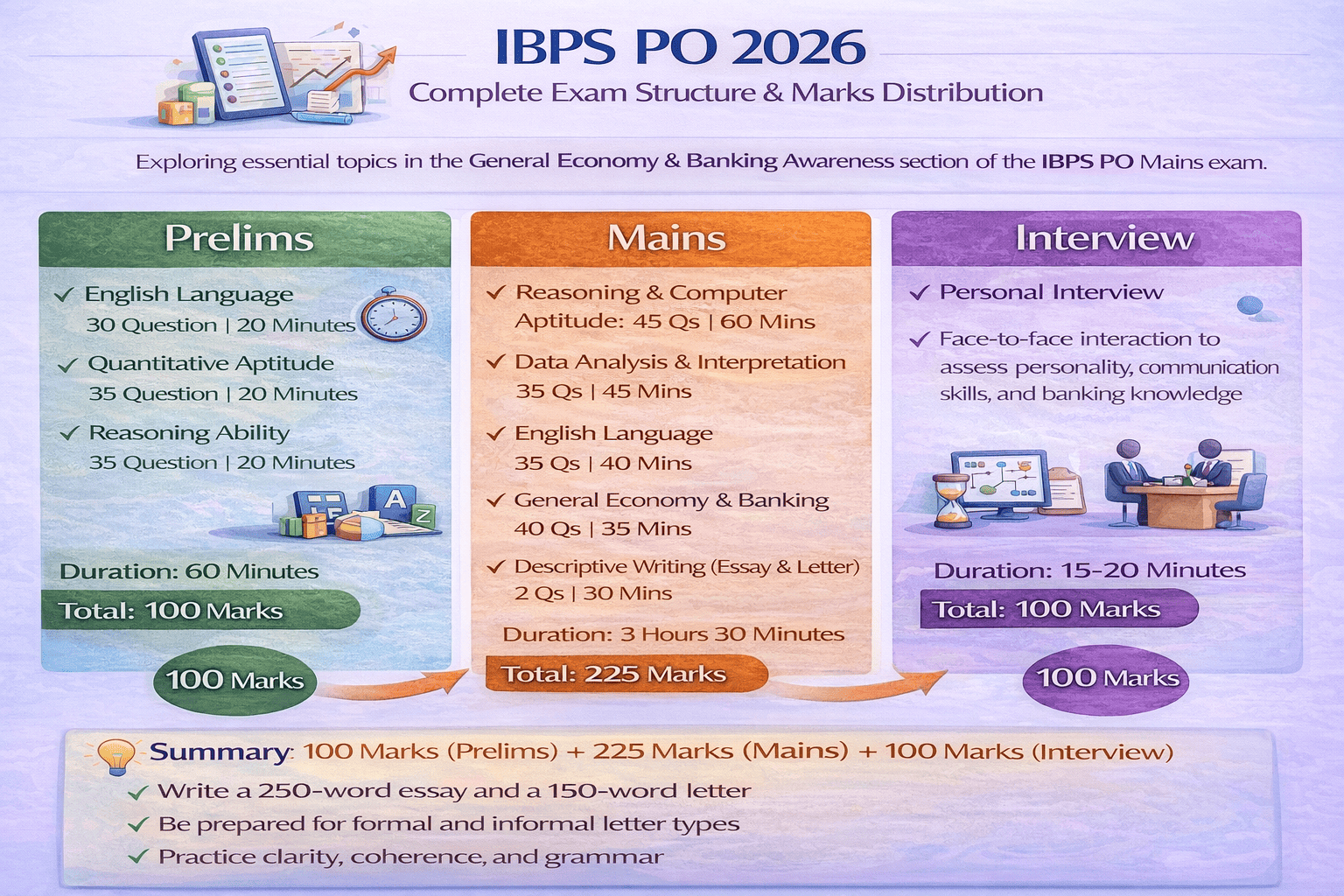
IBPS PO 2026 Complete Exam Structure & Selection Process
- Phase 1: Build a strong foundation. Don’t rush through concepts. Quality over quantity matters here.
- Phase 2: Transform knowledge into skills. Practice until concepts become reflexes.
- Phase 3: Simulate real exam conditions. Identify and fix gaps relentlessly.
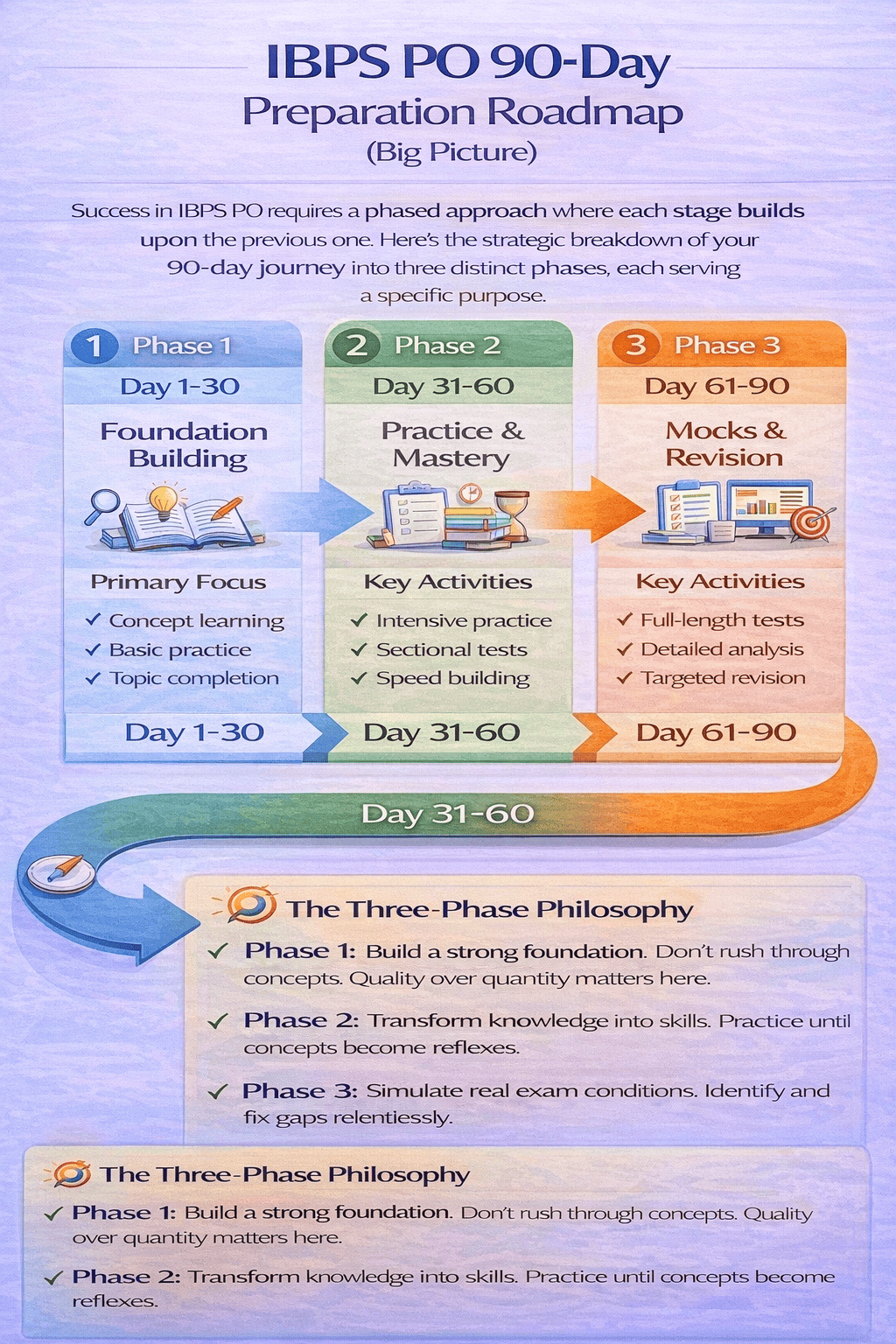
IBPS PO 90-Day Preparation Roadmap — Big Picture
Phase 1 (Day 1-30): Foundation Building — Complete Day-Wise Plan
The first 30 days are absolutely critical for setting the right foundation. During this phase, your focus should be on understanding concepts thoroughly rather than solving hundreds of questions. A strong conceptual base will make the next two phases significantly easier and more productive.
Week 1 (Day 1-7): Arithmetic & Basic Reasoning
| Day | Quantitative Aptitude | Reasoning Ability | English Language | General Awareness |
|---|---|---|---|---|
| Day 1 | Number System & Simplification (50 Qs) | Inequality Basics (30 Qs) | Reading Editorial + 10 vocab words | Daily current affairs |
| Day 2 | Ratio & Proportion (50 Qs) | Syllogism (30 Qs) | Error Spotting (20 Qs) | Banking news |
| Day 3 | Percentage (50 Qs) | Coding-Decoding (30 Qs) | Cloze Test (15 Qs) | Current affairs |
| Day 4 | Average (40 Qs) | Blood Relations (30 Qs) | Reading Comprehension (2 passages) | Banking awareness |
| Day 5 | Profit & Loss (50 Qs) | Direction Sense (25 Qs) | Para Jumbles (15 Qs) | Economic news |
| Day 6 | Time & Work (40 Qs) | Revision of Week 1 topics | Sentence Improvement (20 Qs) | Static GK banking |
| Day 7 | Weekly Revision + Sectional Practice Tests (All subjects) | |||
- Complete all basic arithmetic topics with concept clarity
- Master fundamental reasoning patterns
- Build vocabulary base of 70+ words
- Start daily current affairs habit
- Solve minimum 350+ questions across sections
Week 2 (Day 8-14): Data Interpretation & Advanced Reasoning
| Day | Focus Areas | Practice Target |
|---|---|---|
| Day 8 | Simple Interest & Compound Interest | 45 questions |
| Day 9 | Time, Speed & Distance | 40 questions |
| Day 10 | Introduction to Data Interpretation (Tables & Bar Charts) | 20 sets (4-5 questions each) |
| Day 11 | Line Charts & Pie Charts DI | 20 sets |
| Day 12 | Seating Arrangement (Linear) | 15 sets (3-5 questions each) |
| Day 13 | Seating Arrangement (Circular) | 15 sets |
| Day 14 | Weekly Revision + Mixed Practice | 2-hour sectional test |
During Week 2, English focus should be on reading comprehension (1 passage daily), vocabulary building (10 words daily), and grammar rules (one topic per day). General Awareness should cover last 3 months’ current affairs, banking terminology, and important economic indicators.
Week 3 (Day 15-21): Advanced Puzzles & Mains-Level Topics
This week introduces you to IBPS PO Mains level complexity. Start with Floor-based puzzles (Day 15-16), Box/Scheduling puzzles (Day 17-18), and advanced DI like Caselet and Missing DI (Day 19-20). Quantitative section should cover Mixture & Alligation, Pipes & Cisterns, and Age-based problems. Day 21 is for comprehensive revision with a full-length sectional test for each subject.
Week 4 (Day 22-30): Completion & First Assessment
The final week of Phase 1 focuses on covering remaining topics including Probability, Permutation & Combination basics, Computer Aptitude fundamentals, Descriptive English (Letter & Essay writing), and completing all pending reasoning patterns. Days 28-30 should be dedicated to taking your first three sectional tests (Quant, Reasoning, English) under timed conditions to assess your Phase 1 progress.

IBPS PO Foundation Phase Preparation Chart
Phase 2 (Day 31-60): Practice & Sectional Mastery
Phase 2 is where most aspirants either make or break their IBPS PO journey. The focus now shifts from learning concepts to applying them under time pressure. You will practice Mains-level questions, attempt sectional mocks regularly, and refine your problem-solving approach.
Key Objectives of Phase 2
- Convert concepts into speed-based execution
- Master high-weightage Mains topics (Puzzles, Caselet DI, RC)
- Improve sectional accuracy above 80%
- Build exam temperament using timed tests
Day 31–45: Sectional Dominance
During this period, you should attempt at least one sectional test every alternate day. Focus heavily on Reasoning puzzles, Caselet DI, and Reading Comprehension. GA preparation should now cover the last 6 months of current affairs with emphasis on banking and economy.
- Reasoning: 25–30 full puzzle sets
- DI: 40+ Caselet & Mixed DI sets
- English: 25+ RC passages
- GA: Complete 6 months current affairs revision twice
Day 46–60: Full-Length Exposure Begins
In the last 15 days of Phase 2, start attempting full-length Prelims mocks (2 per week) and at least 2 Mains-level sectional mocks weekly. This is also the phase where descriptive writing practice must begin seriously.
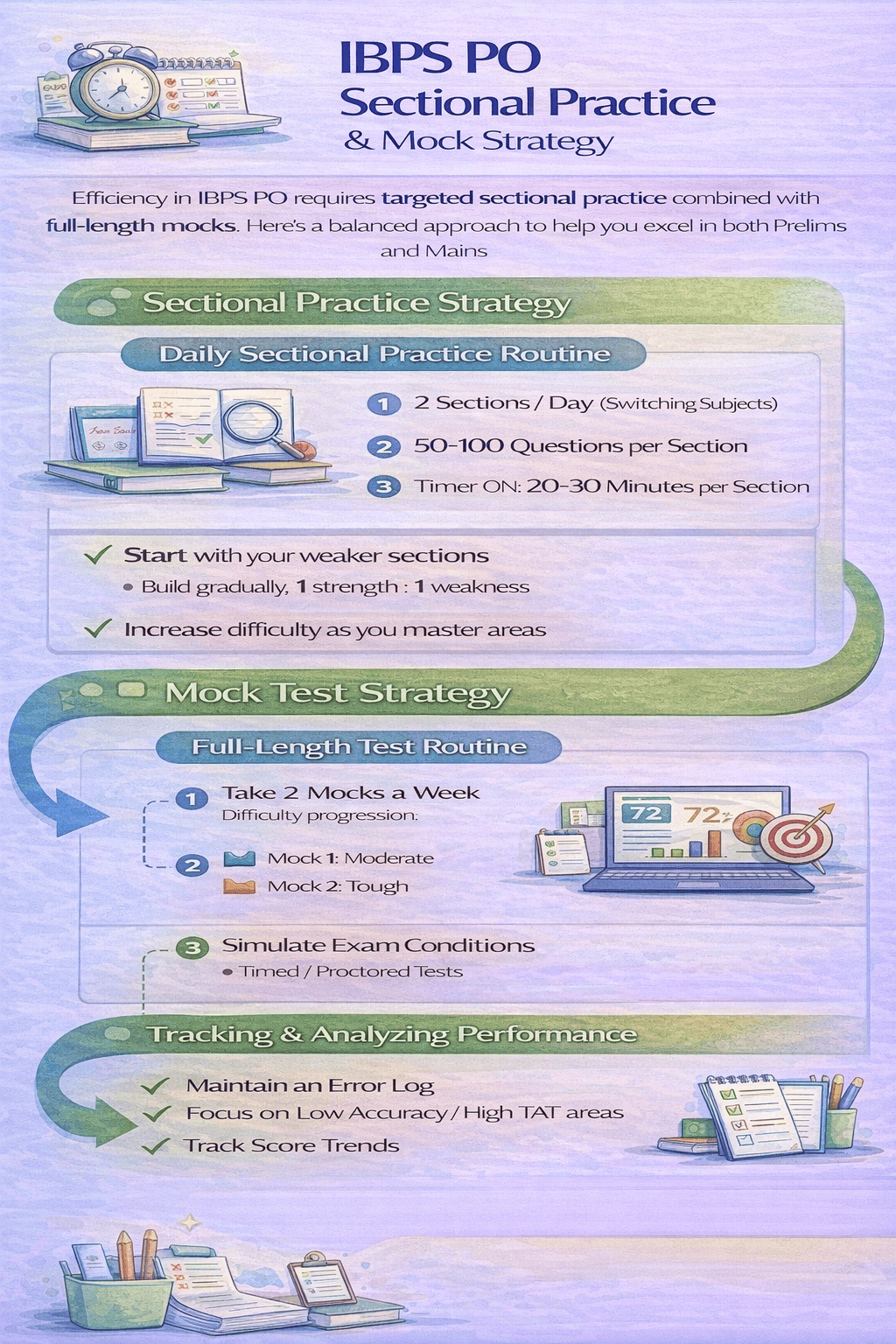
IBPS PO Sectional Practice and Mock Strategy
Phase 3 (Day 61-90): Mocks, Analysis & Final Revision
Phase 3 is entirely performance-driven. At this stage, studying new topics should be minimal. Your score improvement will come from mock analysis, error correction, and strategic fine-tuning.
Mock Test Strategy
- Prelims Mocks: 2–3 per week
- Mains Mocks: 1 per week
- Sectional Tests: Based on weak areas
Mock Analysis Framework
- Identify incorrect attempts due to concept gaps
- Mark questions that consumed excess time
- Create an error notebook for recurring mistakes
- Revise weak topics within 24 hours of the mock
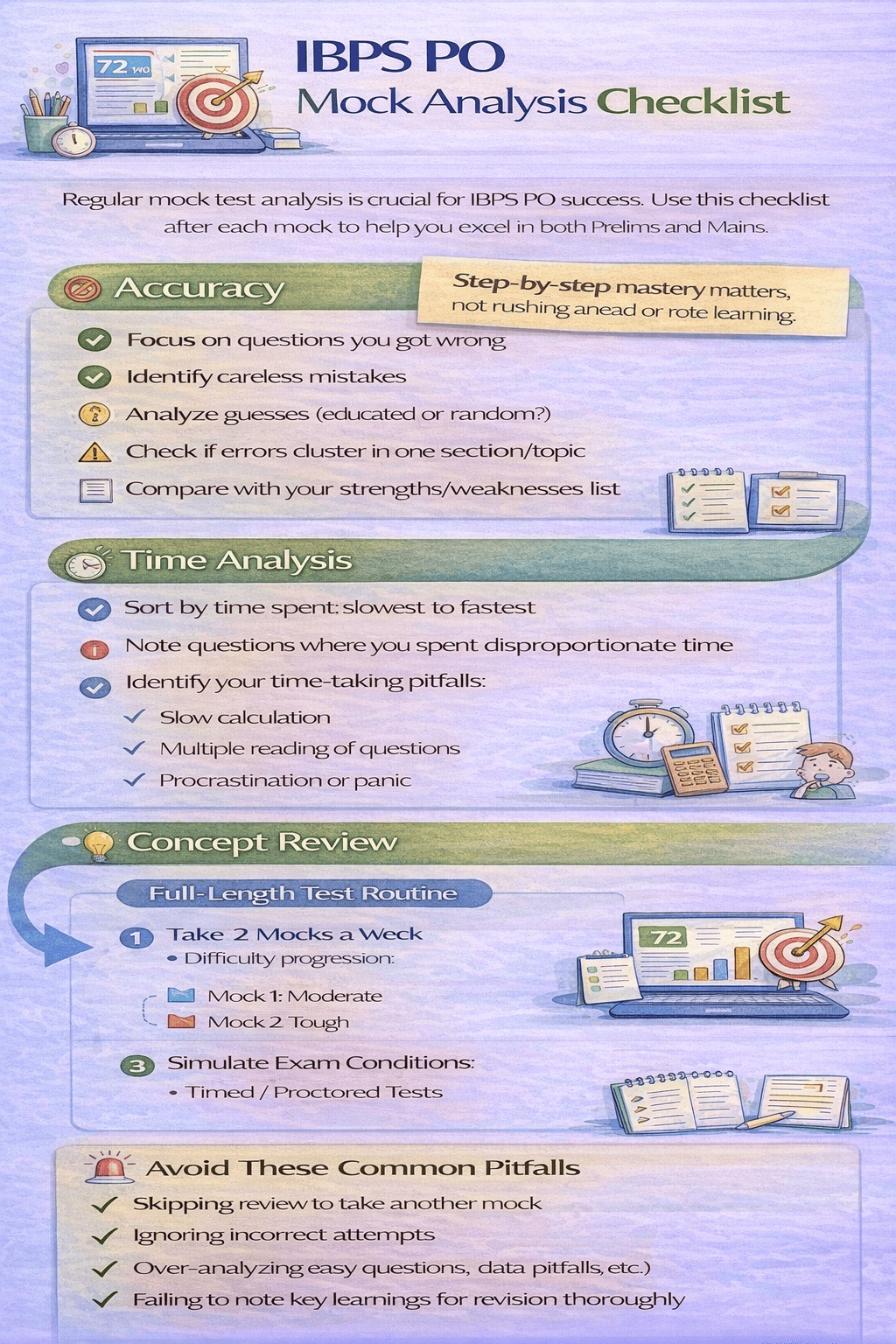
IBPS PO Mock Analysis Checklist
Ideal Daily Routine (Students & Working Professionals)
A realistic daily routine is the backbone of a successful 90-day IBPS PO preparation. Your routine should balance concept learning, practice, revision, and mock analysis without causing burnout.
Daily Routine for Full-Time Students (6–8 Hours)
| Time Slot | Activity |
|---|---|
| 6:30 AM – 8:30 AM | Quant / DI practice (fresh mind) |
| 10:00 AM – 12:00 PM | Reasoning (puzzles / arrangements) |
| 2:00 PM – 3:00 PM | English (RC + grammar) |
| 4:30 PM – 5:30 PM | General Awareness (current affairs) |
| 7:00 PM – 8:00 PM | Revision / mock analysis |
Daily Routine for Working Professionals (4–5 Hours)
| Time Slot | Activity |
|---|---|
| 6:00 AM – 7:30 AM | Quant or Reasoning practice |
| 8:30 PM – 9:30 PM | English + GA |
| Weekend | Mocks + detailed analysis |
- Study during peak focus hours — morning is best for calculation-heavy topics
- Never skip revision slots — they consolidate learning
- Mocks should be treated as real exams — simulate exam conditions
- Take short breaks every 90 minutes to maintain concentration
Complete Mock Test Schedule (Day-Wise)
Mock tests convert preparation into performance. Below is a structured mock schedule aligned with all three phases.
| Phase | Prelims Mocks | Mains Mocks | Sectional Tests |
|---|---|---|---|
| Day 1–30 | — | — | 1–2 per week |
| Day 31–60 | 1 per week | — | 2–3 per week |
| Day 61–90 | 2–3 per week | 1 per week | As needed |
Mock Analysis Framework (Step-by-Step)
Mock analysis is where real improvement happens. Every mock must be analyzed with the same seriousness as preparation.
- Identify incorrect answers due to concept gaps
- Identify time-consuming questions
- Mark questions you guessed incorrectly
- Check skipped questions that were solvable
- Revise weak topics within 24 hours
Topic-Wise Practice Targets
Clear practice targets help you avoid under-preparation and over-practice.
| Section | Recommended Practice |
|---|---|
| Quantitative Aptitude | 800–1000 questions |
| Reasoning Ability | 600–800 questions |
| English Language | 500+ questions |
| General Awareness | 6–8 months current affairs (multiple revisions) |
| Descriptive | 10–12 essays + 10 letters |
Beginner vs Repeater Strategy
For Beginners
- Focus on concept clarity before speed
- Limit mock tests in early phase
- Spend more time on basics
For Repeaters
- Focus on weak areas identified from previous attempts
- Increase mock frequency
- Refine attempt strategy
Progress Tracking & Self-Assessment System
Tracking progress keeps preparation objective and measurable.
- Maintain a mock score tracker
- Track accuracy percentage weekly
- Maintain an error notebook
- Review weak areas every Sunday
- Improvement trend > individual scores
- Consistency beats intensity
- Celebrate small wins — they compound into big results
Last 15 Days Strategy Before Exam
The final 15 days should focus on confidence building, revision, and mental conditioning. Avoid learning anything new. Revise formulas, puzzle patterns, GA notes, and descriptive templates.
- Revise GA daily (static + current)
- One light mock every 2–3 days
- Daily RC reading to maintain flow
- Sleep well and avoid burnout
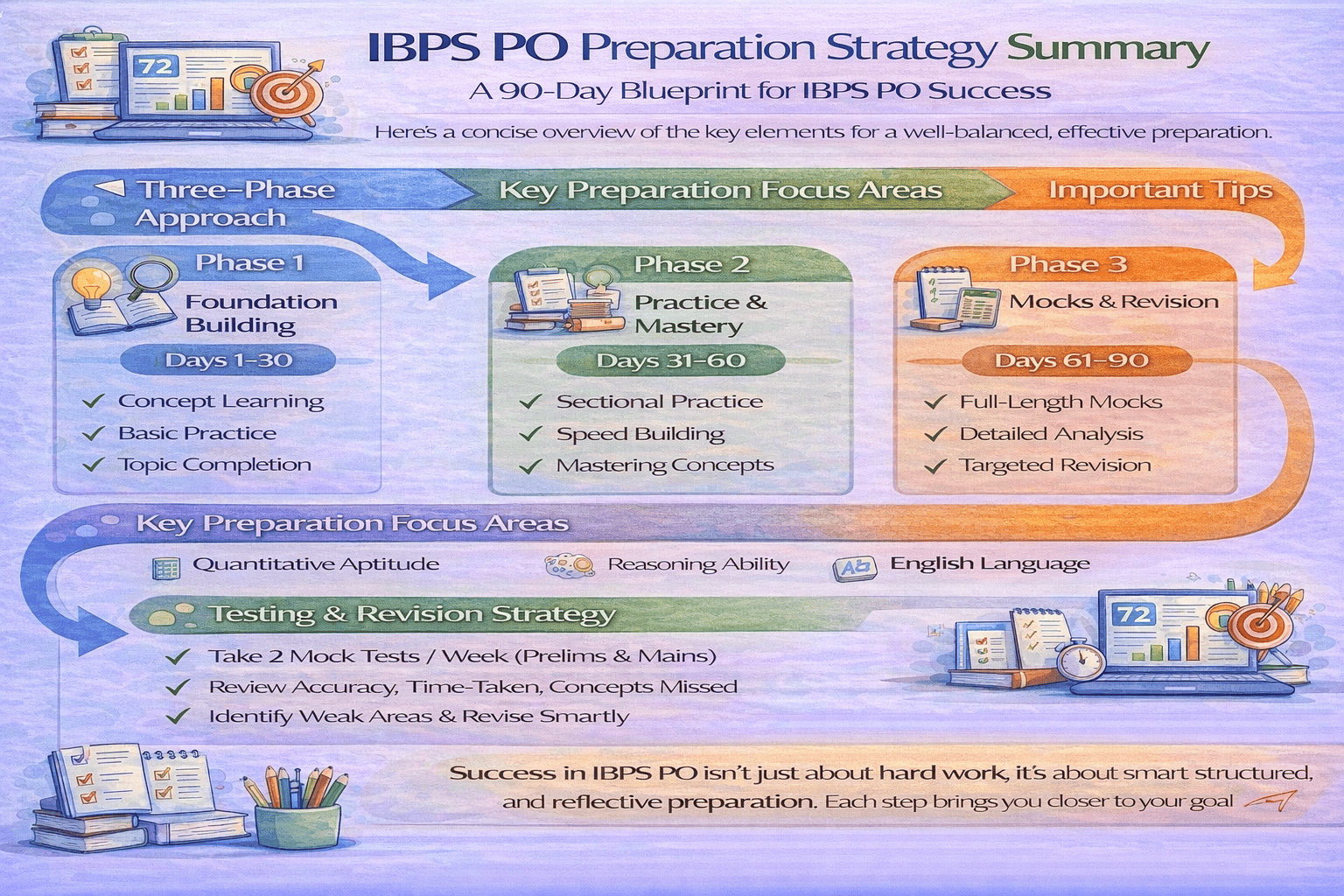
A 90-Day Blueprint for IBPS PO Success
Frequently Asked Questions (FAQs) – IBPS PO 90-Day Preparation Plan 2026
Yes, a 90-day plan is sufficient if followed with discipline, consistency, and proper mock analysis. IBPS PO does not test syllabus depth alone but evaluates speed, accuracy, and exam temperament, all of which can be built effectively within three months using a structured plan.
Absolute beginners can follow this plan only after spending 10–15 days learning basic arithmetic, fundamental grammar rules, and simple reasoning concepts. The plan assumes you already understand basic formulas and question patterns.
Students should dedicate 6–8 focused hours daily, while working professionals can succeed with 4–5 well-planned hours. The key is focused study with mock analysis rather than passive reading for long hours.
Yes, preparing for Mains alongside Prelims is essential. Topics like puzzles, data interpretation, and current affairs overlap, and early Mains exposure prevents panic after clearing Prelims.
Mock tests are the backbone of this plan. They help you build speed, identify weak areas, understand exam-level difficulty, and improve decision-making under time pressure. Without mock analysis, improvement stagnates.
Ideally, attempt 20–25 full-length mocks along with multiple sectional tests. However, quality analysis of each mock is more important than the number of mocks attempted.
Suggested Next Reads
Conclusion
Cracking IBPS PO 2026 in 90 days is not about extraordinary intelligence — it is about discipline, consistency, and strategy. This plan removes confusion by giving you a clear daily roadmap, realistic practice targets, and a structured mock strategy.
The biggest advantage of this plan is balance. It prepares you for Prelims without sacrificing Mains readiness, builds strong fundamentals before pushing speed, and emphasizes analysis over blind practice.
If you commit honestly to this plan, track your progress, and learn from your mistakes, clearing IBPS PO 2026 is not just possible — it is probable. Stay consistent, trust the process, and let your preparation compound day by day.
- Follow the day-wise plan with discipline and consistency
- Prioritize mock analysis over just taking mocks
- Track your progress and adjust your strategy weekly
- Trust the process — 90 days is enough if you use them wisely
- IBPS PO 2026 is achievable with the right strategy and consistent effort