
Last Updated: June 19, 2026
IBPS PO Selection Process 2026: Prelims, Mains & Interview Complete Guide
Before you start preparing for IBPS PO 2026, you need to understand exactly how the selection process works — from application to final merit list. This guide breaks down all three stages, exam patterns, marking schemes, cut-off rules, and interview preparation so you know exactly what to expect at every step.
The IBPS Probationary Officer (PO) examination is one of India’s most competitive and prestigious banking recruitment exams, conducted annually by the Institute of Banking Personnel Selection. This national-level examination serves as the gateway to officer-level positions in 11 public sector banks, attracting lakhs of aspirants every year who dream of building successful banking careers.
Understanding the complete selection process is absolutely crucial for every IBPS PO aspirant. Many candidates prepare extensively for the exam but lack clarity about how the three-stage selection process works, how marks are calculated, what weightage each stage carries, and ultimately how the final merit list is prepared. This comprehensive guide eliminates all confusion and provides you with complete, accurate information about every aspect of the IBPS PO selection process 2026.
The IBPS PO selection process consists of three distinct stages: Preliminary Examination (Prelims), Main Examination (Mains), and Personal Interview. Each stage has its own exam pattern, marking scheme, difficulty level, and purpose. While Prelims acts as a screening test to shortlist candidates, the Mains examination and Interview together determine your final merit score and bank allocation. This article explains each stage in detail with exam patterns, marking schemes, preparation strategies, and expert tips to help you navigate the entire selection journey successfully.
📘 Table of Contents
- Introduction: Why the Selection Process Matters
- IBPS PO Selection Process Overview
- Stage 1: IBPS PO Prelims Exam
- Exam Pattern & Sectional Timing
- Marking Scheme
- Cut-off Rules
- Stage 2: IBPS PO Mains Exam
- Exam Pattern
- Marking Scheme
- Descriptive Paper
- Cut-off Rules
- Stage 3: Interview Process
- Weightage & Scoring
- Final Merit Calculation
- Interview Topics
- Normalisation in IBPS Exams
- Documents Required During Interview
- Frequently Asked Questions
- Suggested Next Reads
- Conclusion
⚡ Quick Summary – IBPS PO Selection Process 2026
- Three-Stage Process: Prelims → Mains → Interview
- Prelims: 100 marks, 60 minutes, qualifying nature (marks not counted in final merit)
- Mains: 225 marks, 3 hours 30 minutes, carries 80% weightage in final selection
- Interview: 100 marks, carries 20% weightage in final selection
- Final Merit Formula: (Mains Score × 0.80) + (Interview Score × 0.20)
- Sectional Timing: Mandatory in both Prelims and Mains objective sections
- Negative Marking: 0.25 marks deducted for each wrong answer
- Descriptive Paper: Part of Mains with 25 marks (Letter + Essay)
Introduction: Why Understanding the Selection Process Matters Before You Start Preparing
The IBPS PO examination is one of India’s most competitive banking recruitment exams, with over 10 lakh aspirants applying for approximately 5,000-5,500 positions each year. The selection process is designed to identify the most capable and well-rounded candidates for officer-level positions in public sector banks.
Many candidates make the mistake of preparing without understanding the selection process fully. They focus only on the Prelims, assuming that clearing it is enough. But the reality is that Prelims is just the first filter — your final selection depends almost entirely on your Mains and Interview performance.
This comprehensive guide covers the complete IBPS PO selection process for 2026, including detailed exam patterns, marking schemes, sectional timing rules, cut-off requirements, normalisation process, interview preparation, and document verification. Whether you’re a first-time aspirant or a repeater, understanding the selection process will help you prepare strategically and maximize your chances of success.
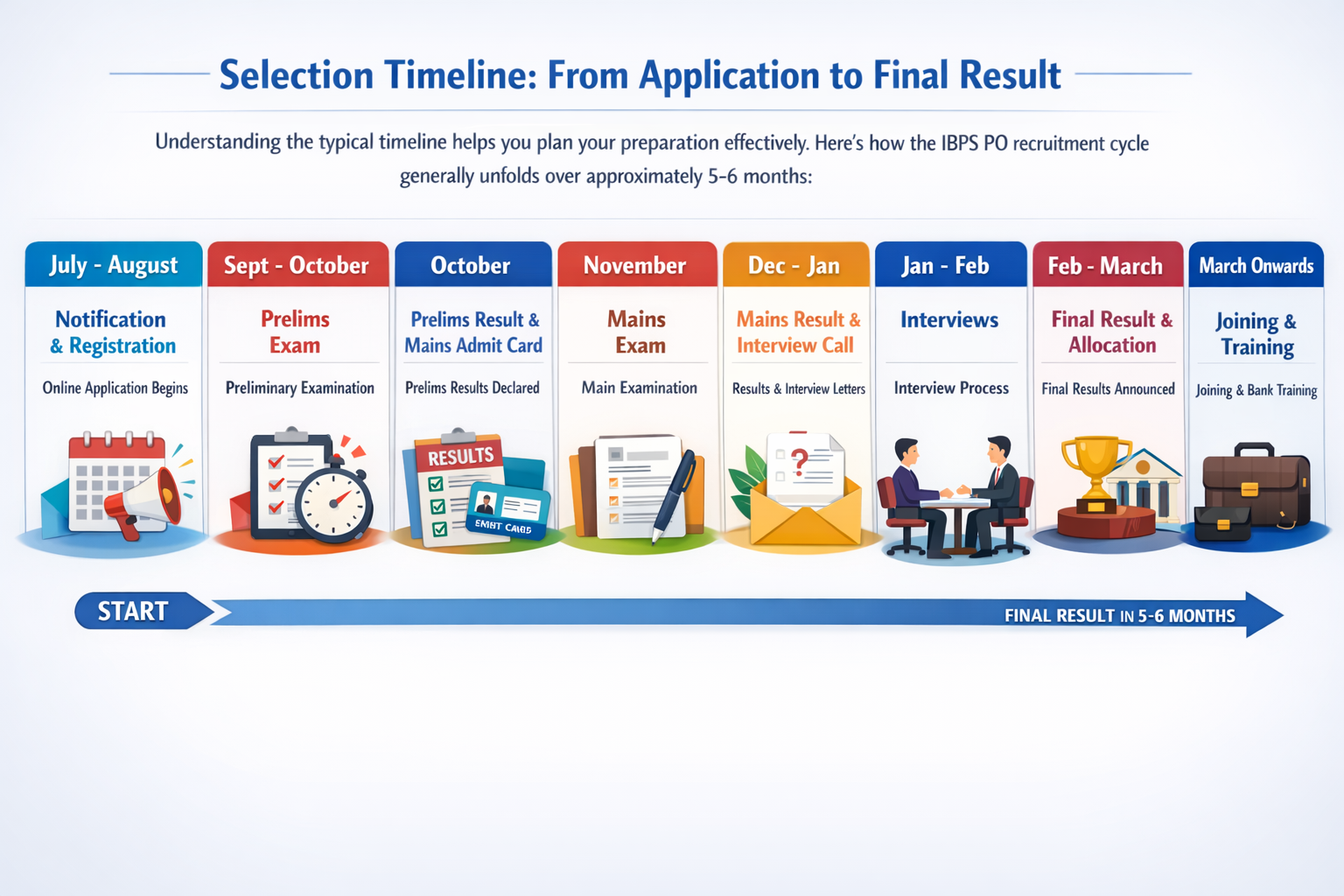
IBPS PO Selection Process Timeline (Application to Final Result)
IBPS PO Selection Process Overview
The IBPS PO recruitment follows a scientifically designed three-tier selection mechanism that evaluates candidates on multiple parameters including speed, accuracy, analytical ability, reasoning skills, language proficiency, computer knowledge, general awareness, and personality traits. Each stage serves a specific purpose in filtering and assessing candidates progressively.
| Stage | Purpose | Total Marks | Weightage in Final Merit |
|---|---|---|---|
| Stage 1: Prelims | Screening test to qualify for Mains | 100 marks | 0% (Qualifying only) |
| Stage 2: Mains | Main examination testing comprehensive knowledge | 225 marks | 80% weightage |
| Stage 3: Interview | Personality assessment and suitability test | 100 marks | 20% weightage |
| Final Merit Calculation | (Mains × 0.80) + (Interview × 0.20) | ||
This multi-stage selection process ensures that only the most capable, well-rounded candidates who excel in both written examination and personal interview are selected for Probationary Officer positions. The process tests not just your subject knowledge but also your speed, decision-making ability under pressure, communication skills, and overall personality fit for a managerial banking role.
Selection Timeline: From Application to Final Result
Understanding the typical timeline helps you plan your preparation effectively. Here’s how the IBPS PO recruitment cycle generally unfolds over approximately 5-6 months:
- July-August: Official notification released, online registration opens
- September-October: Prelims examination conducted
- October: Prelims result declared, Mains admit card released
- November: Mains examination conducted
- December-January: Mains result declared, Interview call letters issued
- January-February: Interviews conducted at various centers
- February-March: Final result declared, bank allocation announced
- March onwards: Joining formalities and bank-specific training begins
Stage 1: IBPS PO Preliminary Examination
The Preliminary Examination, commonly called Prelims, is the first stage of the IBPS PO selection process. It serves as a screening test designed to filter candidates and shortlist them for the Main examination. The Prelims is a computer-based online test that evaluates candidates’ proficiency in three core areas: English Language, Quantitative Aptitude, and Reasoning Ability.
The key characteristic of IBPS PO Prelims is its sectional timing. Unlike some other exams where you can freely move between sections, IBPS Prelims allocates specific time to each section, and you must complete that section within the allotted time. This format tests your time management skills and ensures you cannot compensate weakness in one section by spending extra time from another section.
1. IBPS PO Prelims Exam Pattern
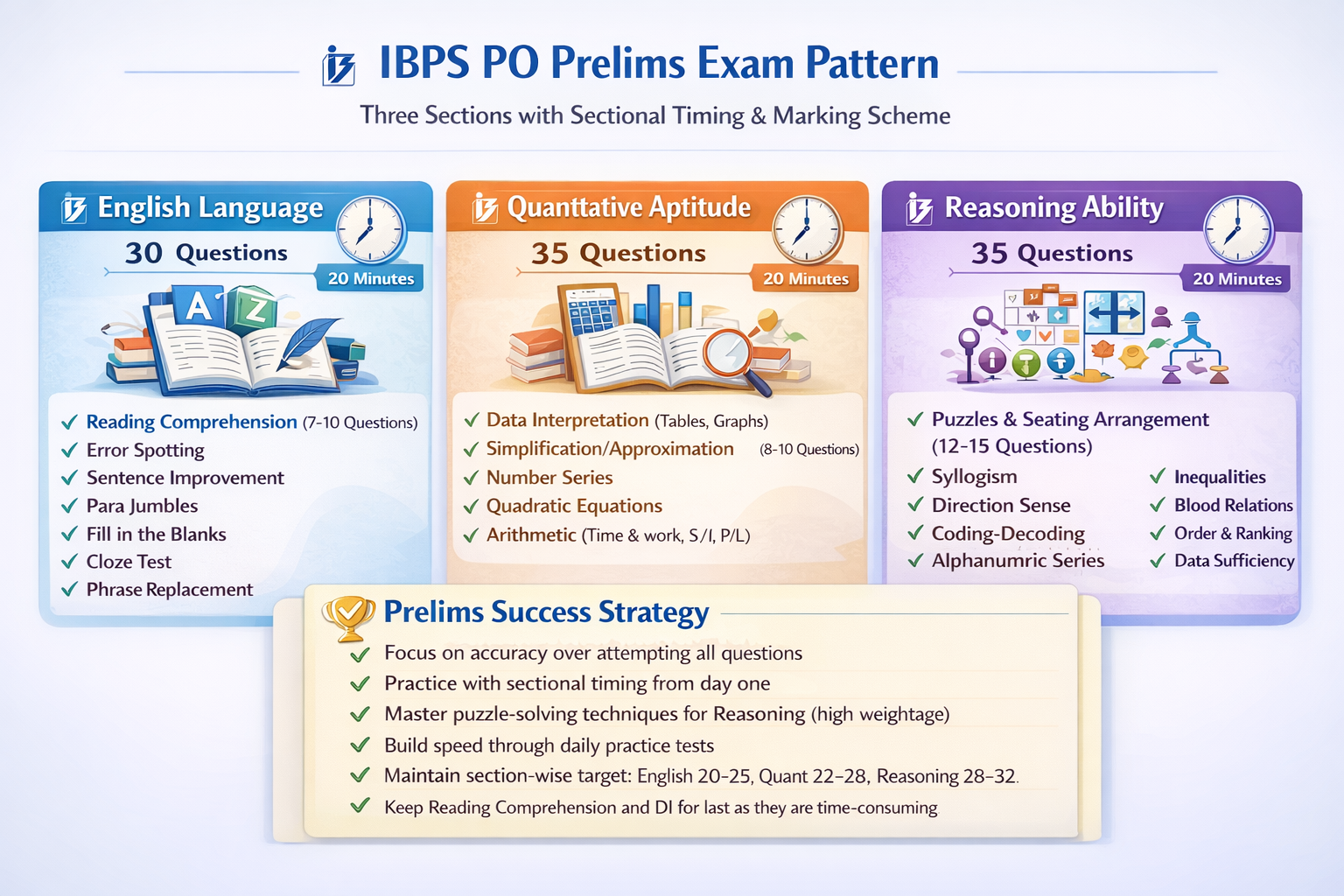
The Prelims examination consists of 100 questions to be attempted in 60 minutes with mandatory sectional timing. Here’s the detailed breakdown:
| Section | Number of Questions | Maximum Marks | Sectional Time |
|---|---|---|---|
| English Language | 30 | 30 | 20 minutes |
| Quantitative Aptitude | 35 | 35 | 20 minutes |
| Reasoning Ability | 35 | 35 | 20 minutes |
| Total | 100 | 100 | 60 minutes |
- Sectional Timing is Mandatory: You get exactly 20 minutes for each section and cannot switch between sections during that time
- No Carry Forward: Unused time from one section cannot be used in another section
- Sequential Attempt: Sections appear in a fixed order and must be attempted sequentially
- Time Pressure: With only 20 minutes per section, speed and accuracy are equally important
- Single Sitting: All three sections are completed in one continuous 60-minute session
2. Marking Scheme for Prelims
Understanding the marking scheme is crucial for developing an effective exam strategy. The IBPS PO Prelims follows a standardized marking pattern with negative marking to discourage random guessing:
| Answer Type | Marks Awarded | Impact |
|---|---|---|
| Correct Answer | +1 mark | Adds to your score |
| Wrong Answer | -0.25 marks (¼ negative) | Deducted from your score |
| Unattempted Question | 0 marks | No penalty, no benefit |
Sample Score Calculation
Let’s understand with an example: If you attempt 75 questions in Prelims, get 65 correct and 10 wrong, your score would be calculated as:
- Correct answers: 65 × 1 = 65 marks
- Wrong answers: 10 × (-0.25) = -2.5 marks
- Unattempted: 25 × 0 = 0 marks
- Final Score: 65 – 2.5 = 62.5 marks out of 100
3. Cut-off Rules for Prelims Qualification
Qualifying the Prelims requires clearing two types of cut-offs, both of which must be satisfied simultaneously to proceed to the Mains examination:
- Sectional Cut-off: Minimum marks required in each individual section (English, Quant, Reasoning)
- Overall Cut-off: Minimum total marks required across all three sections combined
You must clear BOTH cut-offs to qualify. Clearing only overall but failing sectional cut-off in any one section means disqualification.
Cut-offs vary each year based on factors like exam difficulty level, number of vacancies, number of candidates appearing, and category-wise reservation. Generally, cut-offs are announced separately for different categories:
- General/UR (Unreserved): Highest cut-offs
- EWS (Economically Weaker Section): Slightly lower than General
- OBC (Other Backward Classes): Lower than General
- SC (Scheduled Caste): Significantly lower than General
- ST (Scheduled Tribe): Generally lowest cut-offs
- PwD (Persons with Disabilities): Special relaxation provided
| Category | Expected Sectional Cut-off Range | Expected Overall Cut-off Range |
|---|---|---|
| General/UR | 8-12 marks per section | 75-82 marks |
| EWS | 7-11 marks per section | 72-78 marks |
| OBC | 6-10 marks per section | 68-75 marks |
| SC | 5-8 marks per section | 60-68 marks |
| ST | 4-7 marks per section | 55-62 marks |
IBPS PO Prelims Exam Pattern with Sectional Timing
Stage 2: IBPS PO Main Examination
The Main Examination, commonly referred to as Mains, is the most critical stage of the IBPS PO selection process. Unlike Prelims which is only qualifying, your Mains score carries 80% weightage in the final merit calculation. This makes Mains performance absolutely decisive in determining whether you get selected and which bank you are allocated to.
IBPS PO Mains is significantly more difficult, lengthy, and comprehensive compared to Prelims. It tests your in-depth knowledge across five sections including Reasoning & Computer Aptitude, English Language, Data Analysis & Interpretation, General/Economy/Banking Awareness, and a Descriptive Paper. The exam duration is 3 hours 30 minutes, making it a test of endurance, concentration, and time management.
1. IBPS PO Mains Exam Pattern
The Mains examination consists of 157 objective questions plus 2 descriptive questions, totaling 225 marks. Here’s the complete pattern:
| Section | No. of Questions | Maximum Marks | Sectional Time |
|---|---|---|---|
| Reasoning & Computer Aptitude | 45 | 60 | 60 minutes |
| English Language | 35 | 40 | 40 minutes |
| Data Analysis & Interpretation | 35 | 60 | 45 minutes |
| General/Economy/Banking Awareness | 40 | 40 | 35 minutes |
| English (Descriptive: Letter + Essay) | 2 | 25 | 30 minutes |
| Total | 157 | 225 | 3 hrs 30 mins |
2. Marking Scheme for Mains
The marking scheme for Mains objective sections follows the same pattern as Prelims:
| Answer Type | Marks | Details |
|---|---|---|
| Correct Answer (Objective) | +1 mark | Added to your score |
| Wrong Answer (Objective) | -0.25 marks | Penalty for incorrect attempts |
| Unattempted (Objective) | 0 marks | No penalty |
| Descriptive Paper | Variable | Evaluated manually by experts |
- Higher Difficulty: Questions are significantly tougher, especially in Reasoning and DI sections
- Variable Marks per Question: Some sections have questions worth more than 1 mark
- Lengthy Calculations: Data Interpretation requires extensive calculations
- Computer Knowledge: New addition in Reasoning section (10-12 questions)
- Descriptive Writing: Tests your written communication skills separately
3. Descriptive Paper Details
The Descriptive Paper is a unique component of IBPS PO Mains that separates it from other banking exams. This section tests your English writing skills, which are essential for a managerial banking position where you need to draft letters, reports, and official communications.
Descriptive Paper Structure
| Component | Marks | Expected Word Count | Key Assessment Criteria |
|---|---|---|---|
| Letter Writing | 10-12 marks | 150-200 words | Format, tone, clarity, relevance |
| Essay Writing | 13-15 marks | 200-250 words | Structure, arguments, language, coherence |
| Total | 25 marks | 30 minutes | Grammar, vocabulary, organization |
Types of Letters Asked
- Formal Letters: Application for loan, complaint letter to bank manager, requesting services
- Business Letters: Letter to customer regarding account updates, policy changes
- Official Communication: Letters addressing banking issues, financial matters
Essay Topics Categories
- Economic Issues: Digital economy, inflation, GST impact, banking sector reforms
- Social Topics: Education, healthcare, poverty, women empowerment
- Technology: Digital banking, fintech, cybersecurity, AI in banking
- Current Affairs: Government schemes, policy changes, national issues
- Banking & Finance: Financial inclusion, NPAs, role of public sector banks
- Practice writing daily — at least 2-3 essays and letters per week
- Maintain proper structure: Introduction → Body → Conclusion
- Use formal, professional language avoiding slang or colloquialisms
- Write legibly as papers are manually evaluated by examiners
- Time yourself strictly — 30 minutes is very limited for two pieces
- Read newspapers daily to build content knowledge for essays
- Focus on grammar accuracy, spelling, and punctuation
Descriptive Paper Evaluation Criteria
Your descriptive answers are evaluated by expert examiners based on multiple parameters:
- Content Relevance (30%): How well you address the topic/purpose
- Language & Grammar (30%): Correct usage, sentence structure, vocabulary
- Organization & Structure (20%): Logical flow, proper formatting, paragraph division
- Clarity & Coherence (20%): Easy to understand, connected ideas, smooth transitions
4. Section-wise Topics for Mains
A. Reasoning & Computer Aptitude (45 questions, 60 marks, 60 minutes)
This section combines logical reasoning with basic computer knowledge:
Reasoning Topics (30-32 questions):
- Complex Puzzles & Seating Arrangement (15-18 questions — highest weightage)
- Data Sufficiency
- Input-Output
- Syllogism
- Blood Relations
- Direction Sense
- Inequalities
- Coding-Decoding (advanced level)
Computer Aptitude Topics (10-12 questions):
- Computer Fundamentals: Hardware, software, input-output devices
- Operating Systems: Windows, Linux basics
- MS Office: Word, Excel, PowerPoint features
- Internet & Networking: Protocols, browsers, email
- Computer Security: Viruses, firewalls, encryption
- Banking Technology: Core banking, ATM, NEFT, RTGS, UPI
- Shortcut Keys and Basic Commands
B. English Language (35 questions, 40 marks, 40 minutes)
More advanced than Prelims English, focusing on comprehension and grammar:
- Reading Comprehension: 2 passages with 12-15 questions (most important)
- Para Jumbles: Rearranging complex paragraphs
- Error Spotting: Advanced grammar errors
- Sentence Correction/Improvement
- Fill in the Blanks: Context-based vocabulary
- Phrase Replacement
- Vocabulary-based Questions: Synonyms, antonyms, idioms
C. Data Analysis & Interpretation (35 questions, 60 marks, 45 minutes)
The most calculation-intensive and time-consuming section:
- Data Interpretation: Complex tables, bar graphs, line charts, pie charts, radar charts, mixed graphs (20-25 questions)
- Caselet-based DI: Paragraph-format data requiring analysis
- Advanced Arithmetic: Time & work, pipes & cisterns, boats & streams
- Mensuration: Area, volume, perimeter of various shapes
- Probability & Permutation-Combination
- Number System: HCF, LCM, divisibility, factors
D. General/Economy/Banking Awareness (40 questions, 40 marks, 35 minutes)
Tests your knowledge of current affairs and banking domain:
Banking Awareness (40-50%):
- Banking Terms: CRR, SLR, Repo Rate, Reverse Repo, MSF, Bank Rate
- Types of Accounts: Savings, current, fixed deposit, recurring deposit
- Banking Products: Loans, credit cards, insurance, mutual funds
- RBI Functions, Monetary Policy, Financial Inclusion
- Banking Regulations: Banking Regulation Act, RBI Act, Negotiable Instruments Act
- Important Committees related to Banking
Current Affairs (30-40%):
- Last 4-6 months’ major national and international events
- Important appointments: CEO changes, government positions
- Awards & Honours: Nobel Prize, Booker Prize, sports awards
- Sports: Major tournaments, winners, venues
- Books & Authors
- Science & Technology developments
Economy (10-20%):
- Budget highlights, economic survey
- GDP, inflation, fiscal deficit concepts
- Government schemes: PM-KISAN, Ayushman Bharat, etc.
- Economic organizations: IMF, World Bank, ADB, BRICS
5. Mains Cut-off Rules
Similar to Prelims, you must clear both sectional and overall cut-offs in Mains to qualify for the Interview stage:
| Category | Expected Overall Cut-off | Approximate Percentage |
|---|---|---|
| General/UR | 150-165 out of 225 | 67-73% |
| EWS | 145-158 out of 225 | 64-70% |
| OBC | 140-152 out of 225 | 62-68% |
| SC | 125-140 out of 225 | 56-62% |
| ST | 115-130 out of 225 | 51-58% |
- Prioritize high-scoring sections: DI and Reasoning (60 marks each)
- Manage time wisely — don’t get stuck on difficult puzzles
- Attempt easier questions first to build confidence and score
- For Computer Aptitude, prepare from basic computer awareness books
- Read newspapers daily for Current Affairs (The Hindu, Indian Express recommended)
- Practice descriptive writing regularly — it can be a differentiator
- Solve at least 20-30 full-length Mains mock tests before the exam
Stage 3: Personal Interview
The Personal Interview is the final and decisive stage of the IBPS PO selection process. While it carries only 20% weightage in the final merit calculation, a poor interview performance can significantly impact your overall rank and bank allocation. Moreover, there’s a minimum qualifying threshold that you must cross to be considered for final selection.
The interview is conducted by a panel of experts, typically consisting of 3-5 members including bank officials, HR professionals, and sometimes retired banking executives. The interview duration ranges from 15 to 30 minutes and aims to assess your personality, communication skills, banking knowledge, current affairs awareness, confidence, decision-making ability, and overall suitability for a managerial banking role.
1. Interview Marks Distribution & Qualifying Criteria
| Aspect | Details |
|---|---|
| Total Marks | 100 marks |
| Weightage in Final Merit | 20% |
| Duration | 15-30 minutes (varies by candidate) |
| Minimum Qualifying (General/EWS/OBC) | 40% (40 marks out of 100) |
| Minimum Qualifying (SC/ST/PwD) | 35% (35 marks out of 100) |
2. Final Merit Calculation Formula
Your final selection and bank allocation depend entirely on your combined Mains and Interview score. IBPS uses the following formula:
Final Score = (Mains Score × 0.80) + (Interview Score × 0.20)
Example Calculation:
- Mains Score: 170 out of 225
- Interview Score: 75 out of 100
- Final Score = (170 × 0.80) + (75 × 0.20) = 136 + 15 = 151 marks
Understanding the Impact of Weightage
Let’s understand how the 80:20 ratio affects your final score with different scenarios:
| Scenario | Mains Score | Interview Score | Final Merit Score |
|---|---|---|---|
| High Mains, Average Interview | 180/225 | 60/100 | (180×0.8)+(60×0.2) = 156 |
| Average Mains, High Interview | 155/225 | 85/100 | (155×0.8)+(85×0.2) = 141 |
| Both High | 185/225 | 80/100 | (185×0.8)+(80×0.2) = 164 |
| Both Average | 160/225 | 65/100 | (160×0.8)+(65×0.2) = 141 |
As you can see, Mains performance has a much larger impact on your final score due to its 80% weightage. However, a strong interview can still make a significant difference of 5-10 ranks in your final position.
3. Interview Assessment Parameters
The interview panel evaluates candidates on multiple dimensions. Understanding these parameters helps you prepare more effectively:
| Parameter | What is Assessed | Approximate Weightage |
|---|---|---|
| Communication Skills | Fluency, clarity, vocabulary, confidence in speaking | 20-25% |
| Banking & Economic Awareness | Knowledge of banking sector, current economic issues | 20-25% |
| Personality & Confidence | Body language, composure, self-assurance | 15-20% |
| Academic Background | Understanding of your graduation subject, consistency | 10-15% |
| Current Affairs | Awareness of recent national and international events | 10-15% |
| Problem-Solving & Decision-Making | Analytical thinking, situational responses | 10-15% |
| Motivation & Suitability | Why banking? Career goals, commitment to public service | 5-10% |
4. Common Interview Questions & Topics
A. Introduction & Personal Questions
- Tell us about yourself
- Why do you want to join banking sector?
- Why specifically public sector banks and not private banks?
- What are your strengths and weaknesses?
- Where do you see yourself in 5 years?
- Tell us about your family background
- Why should we select you?
B. Academic & Educational Background
- Questions related to your graduation subject (Be prepared for deep questions)
- Explain your favorite subject from graduation
- Why did you choose this particular stream?
- Any gaps in your education? Explain them
- Your marks progression from 10th to graduation
C. Banking & Finance Knowledge
- What is the role of RBI in Indian economy?
- Explain Repo Rate, Reverse Repo Rate, CRR, SLR, MSF
- What are NPAs? Why are NPAs high in PSBs?
- Difference between nationalized banks and private banks
- Recent banking sector reforms
- Digital banking and its challenges
- Financial inclusion — meaning and importance
- What is RTGS, NEFT, IMPS, UPI?
- Basel III norms for banks
- Recent RBI monetary policy decisions
D. Current Affairs & Economy
- Recent government schemes and policies
- Budget highlights of current year
- India’s GDP growth rate and economic situation
- Inflation — types and current status in India
- International organizations: IMF, World Bank, WTO
- Recent major national/international events
- Cryptocurrency — should India adopt it?
- Recent economic reforms
E. Situational & Behavioral Questions
- How would you handle an angry customer?
- What will you do if you’re posted in a remote rural area?
- A customer is asking for a loan but doesn’t meet criteria — what will you do?
- How will you contribute to financial inclusion?
- You notice a colleague engaged in unethical practice — your action?
- How do you handle stress and pressure?
- A customer is not tech-savvy and frustrated with digital banking — how will you help?
F. Hobbies & Interests
- Deep questions about your stated hobbies (Be genuine about hobbies)
- Latest book you read — summarize it
- If hobby is sports — questions about recent matches, players
- If hobby is reading — questions about favorite authors, genres
- How do your hobbies help in professional life?

Common Topics Asked in IBPS PO Interview
5. Interview Preparation Strategy & Tips
- Professional Attire: Formal dress (suit for men, formal suit/saree for women), well-groomed appearance
- Body Language: Maintain eye contact, sit upright, smile naturally, avoid fidgeting
- Communication: Speak clearly and confidently, pause before answering, it’s okay to say “I don’t know” if you genuinely don’t
- Honesty: Never bluff or lie — interviewers can easily catch inconsistencies
- Be Genuine: Don’t memorize scripted answers, be yourself and speak naturally
- Prepare Your Resume: Know every detail of your biodata form, be ready for deep questions
- Mock Interviews: Practice with friends, mentors, or coaching institutes
- Stay Updated: Read newspapers daily for at least 3-4 months before interview
- Banking Knowledge: Thoroughly study basic banking concepts and recent RBI policies
- Stay Calm: Don’t panic if you don’t know an answer, politely admit and move on
Normalisation Process in IBPS Exams
Since IBPS conducts examinations in multiple shifts across different days to accommodate lakhs of candidates, the difficulty level of question papers may vary slightly between shifts. To ensure fairness and maintain a level playing field for all candidates regardless of their shift, IBPS employs a statistical method called normalisation to adjust scores.
What is Normalisation?
Normalisation is a mathematical process that adjusts raw scores obtained by candidates in different shifts to account for variations in difficulty levels. If one shift had a relatively easier paper and another had a tougher paper, normalisation ensures that candidates are not disadvantaged or advantaged based on which shift they appeared in.
Equi-Percentile Method
IBPS uses the Equi-Percentile Method for normalisation, which is recommended by experts and considered one of the fairest methods. This method works on the principle that candidates with the same percentile rank across different shifts should receive the same normalised score.
When is Normalisation Applied?
- Prelims Examination: Normalisation is applied to Prelims scores if the exam is conducted in multiple shifts
- Mains Examination: Normalisation is applied to Mains objective sections if conducted in multiple shifts
- Not Applied to: Descriptive Paper (as it’s manually evaluated) and Interview (single stage for all)
- Normalised scores, not raw scores, are used for calculating cut-offs
- Normalised scores are used for shortlisting candidates for next stages
- The normalisation formula is complex and done automatically by IBPS
- Candidates cannot calculate their exact normalised score themselves
- Focus on performing your best rather than worrying about normalisation
- Generally, if you score well, normalisation doesn’t significantly impact your chances
Impact on Cut-offs
All cut-offs announced by IBPS are based on normalised scores, not raw scores. This means when you see that the Prelims cut-off was 80 marks for General category, this refers to normalised scores after adjustment for difficulty across all shifts.
Documents Required During Interview
When you qualify for the IBPS PO Interview stage, you must bring all required documents in original along with self-attested photocopies. Missing or incorrect documents can lead to disqualification, so it’s crucial to prepare your document folder well in advance.
Mandatory Documents Checklist
| Document Type | Specific Requirements | Copies Needed |
|---|---|---|
| Interview Call Letter | Downloaded from IBPS website, duly signed | Original printout |
| Valid Photo ID Proof | Aadhaar Card / PAN Card / Passport / Driving License / Voter ID | Original + 2 copies |
| 10th Mark Sheet & Certificate | For date of birth proof and educational qualification | Original + 2 copies |
| 12th Mark Sheet & Certificate | Intermediate/Senior Secondary qualification proof | Original + 2 copies |
| Graduation Mark Sheets (All Semesters/Years) | All semester/year mark sheets and degree certificate | Original + 2 copies |
| Graduation Degree Certificate | Final degree certificate from university | Original + 2 copies |
| Category Certificate | SC/ST/OBC/EWS certificate from competent authority (if applicable) | Original + 2 copies |
| PwD Certificate | Disability certificate from medical board (if applicable) | Original + 2 copies |
| Experience Certificates | If claiming experience, all relevant experience letters | Original + 2 copies |
| Recent Passport-size Photographs | Same as uploaded in application form | 5-6 photographs |
| Signature Specimen | On plain paper, matching application signature | 2-3 sheets |
| IBPS Application Form Printout | Final submitted application with all details | 2 copies |
Additional Documents (If Applicable)
- Post-Graduation Certificates: If you have a Master’s degree or higher qualification
- Professional Qualification Certificates: CA, CS, CFA, MBA, etc.
- Domicile Certificate: For state-specific reservations or preferences
- Transfer/Character Certificate: From previous educational institutions
- Gap Certificate: If there are gaps in your education, affidavit explaining the gap
- Name Change Certificate: If your name differs across documents, gazette notification or affidavit
- Relieving Letters: From previous employers if you’ve worked before
Document Verification Process
At the interview center, before or after your interview, there will be a document verification process where officials will:
- Check all original documents against photocopies
- Verify authenticity of certificates
- Match details with your application form
- Collect required photocopies and photographs
- Ask you to sign undertakings or declarations if needed
This verification is mandatory and any discrepancy or missing document can lead to disqualification from the selection process, regardless of your interview performance.
Frequently Asked Questions (FAQs) – IBPS PO Selection Process 2026
There are three stages in the IBPS PO selection process: Stage 1 is Preliminary Examination (Prelims), Stage 2 is Main Examination (Mains), and Stage 3 is Personal Interview. Candidates must qualify each stage sequentially to proceed to the next.
No, Prelims marks are NOT counted in the final merit list. Prelims is purely a qualifying examination to shortlist candidates for Mains. Your final selection and rank depend entirely on your Mains score (80% weightage) and Interview score (20% weightage).
The Mains examination carries 80% weightage and the Interview carries 20% weightage in the final merit calculation. The formula is: Final Score = (Mains Score × 0.80) + (Interview Score × 0.20). This combined score determines your final rank and bank allocation.
Sectional timing means each section has a fixed time limit and you must complete that section within the allotted time. You cannot switch between sections or use extra time from one section in another. In Prelims, each of the three sections gets 20 minutes. In Mains, timing varies by section.
The Descriptive Paper is a writing test worth 25 marks with 30 minutes duration. Candidates must write one letter (10-12 marks) and one essay (13-15 marks) on given topics. This tests your English writing skills, grammar, vocabulary, and ability to express ideas clearly — essential skills for a banking officer role.
Normalisation is a statistical process used to adjust scores when exams are conducted in multiple shifts with potentially different difficulty levels. IBPS uses the Equi-Percentile Method to ensure fairness. Normalised scores, not raw scores, are used for determining cut-offs and merit lists. This ensures no candidate is advantaged or disadvantaged based on their exam shift.
Suggested Next Reads
Conclusion
The IBPS PO selection process is a comprehensive, multi-stage evaluation system designed to identify the most capable and well-rounded candidates for Probationary Officer positions in India’s public sector banks. Understanding each stage in detail — from the screening Prelims to the decisive Mains examination to the final personality assessment Interview — is crucial for developing an effective preparation strategy and maximizing your chances of success.
The three-stage selection mechanism ensures that only candidates who excel in speed and accuracy (Prelims), have strong analytical and reasoning abilities along with good general awareness (Mains), and possess the right personality traits and communication skills (Interview) make it to the final merit list. The 80:20 weightage split between Mains and Interview means your primary focus should be on mastering the Mains examination, while not underestimating the importance of Interview preparation.
Key takeaways for aspirants include understanding that Prelims is purely qualifying and its marks don’t count in final selection, mastering sectional timing which is mandatory in both Prelims and Mains, focusing heavily on high-scoring sections like Data Interpretation and Reasoning in Mains, preparing thoroughly for the Descriptive Paper which can be a differentiator, and building strong banking and current affairs knowledge for both Mains and Interview stages.
The normalisation process ensures fairness across multiple exam shifts, so you need not worry about which shift you get — just focus on performing your absolute best. Document preparation is equally important as your exam preparation; missing or incorrect documents during Interview can nullify all your hard work and excellent exam performance.
- Prelims: Build speed and accuracy through extensive practice
- Mains: Focus on high-weightage sections, master DI and Reasoning
- Descriptive: Practice writing daily, improve grammar and expression
- Interview: Stay updated with current affairs, be confident and genuine
- Overall: Consistency, regular practice, and strategic preparation are keys to success