
Last Updated: June 21, 2026
IBPS Customer Service Associate (CSA) Mains Exam Pattern 2026 (CRP-CSA-XVI): Latest Structure, Marks, Timing & Question Breakdown
Before you start preparing for IBPS Clerk Mains 2026, you need to understand the exam pattern inside out. This guide breaks down the Mains structure — section by section, mark by mark, with difficulty analysis and strategic tips — so you can plan your preparation intelligently.
The IBPS Customer Service Associate (CSA) Mains Exam 2026 is the final and decisive stage of the selection process under CRP-CSA-XVI. Unlike many other competitive exams where multiple stages contribute to the final merit, the IBPS CSA recruitment follows a unique two-stage process where only the Mains exam determines your final selection.
This makes the Mains exam critically important for every aspirant. While Prelims acts as a qualifying filter with scores not counted toward final merit, your performance in Mains directly translates into your rank, state-wise allotment, and ultimately, your banking career.
With a revised structure of 155 questions to be solved in 120 minutes, the exam now focuses on four critical competencies: Banking & Financial Awareness, Accuracy in problem-solving under time pressure, Reasoning Efficiency and computer knowledge, and Strategic time management across sections.
This comprehensive guide explains the latest IBPS CSA Mains Exam Pattern 2026, provides section-wise weightage analysis, discusses difficulty levels based on previous year trends, and offers strategic preparation tips to help you maximize your score in this career-defining examination.
📘 Table of Contents
- Introduction: Why Mains is the Decisive Stage
- IBPS CSA Mains Exam Pattern 2026 (At a Glance)
- Section-wise Breakdown
- General / Financial Awareness
- General English
- Reasoning Ability & Computer Aptitude
- Quantitative Aptitude
- Marking Scheme & Risk Analysis
- Role of Mains in Final Selection
- Difficulty Trend (Based on PYQs)
- Most Important Topics (High-Weight Areas)
- Good Attempts (Safe Range)
- Official Transparency Reform: Response Sheets & Answer Keys
- Result Sequencing & Recruitment Stability
- Exam-Day Rules & Instructions
- Frequently Asked Questions
- Suggested Next Reads
- Conclusion
⚡ Quick Summary — IBPS CSA Mains Exam Pattern 2026
- Total Questions: 155
- Total Marks: 200
- Duration: 120 minutes (2 hours)
- Sections: GA (40), English (40), Reasoning + Computer (40), Quant (35)
- Negative Marking: –0.25 per wrong answer
- Final Selection: Based only on Mains score (100% weightage)
- No Interview for IBPS Customer Service Associate (CSA)
- Allotment: State-wise merit + preference based
Introduction: Why Mains is the Decisive Stage of Your IBPS Clerk Journey
The IBPS Clerk Mains examination is not just another test — it’s the stage that determines your entire banking career. Unlike Prelims which is purely qualifying, your Mains score carries 100% weightage in the final selection process. There is no interview for the Customer Service Associate position, which means your written exam performance alone decides your bank allotment and posting state.
Every year, thousands of candidates who clear Prelims with ease find themselves struggling in Mains because they underestimate the jump in difficulty and syllabus breadth. The Mains exam tests deeper conceptual understanding, broader knowledge areas, and better time management skills.
This comprehensive guide covers the complete IBPS CSA Mains exam pattern for 2026, including section-wise breakdown, marking scheme, difficulty trends, and strategic preparation tips to help you maximize your score and secure a top rank.
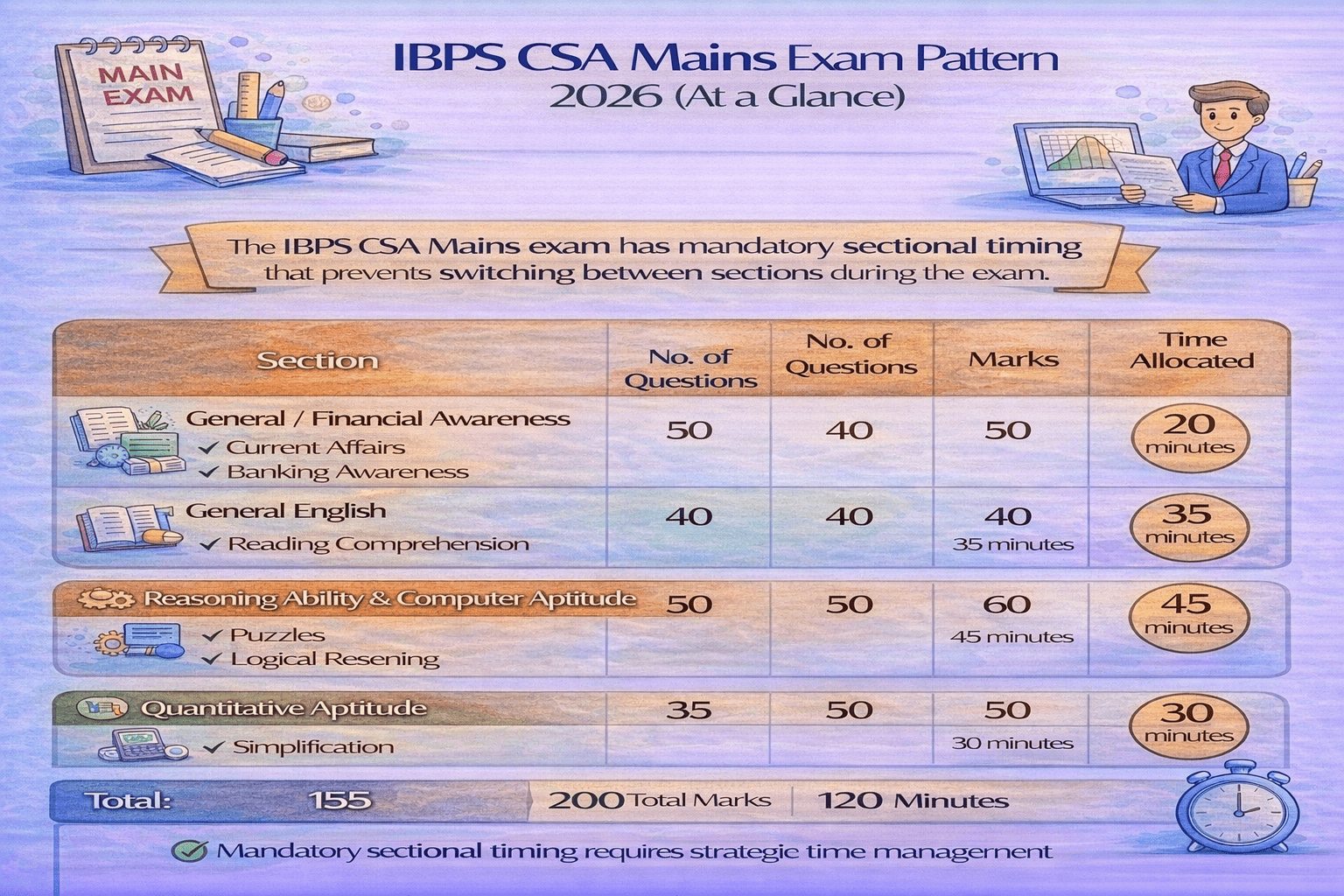
IBPS CSA Mains Exam Pattern 2026 Overview
IBPS CSA Mains Exam Pattern 2026 (At a Glance)
The IBPS CSA Mains exam follows a well-structured pattern with mandatory sectional timing that prevents candidates from switching between sections during the exam. This sectional timing makes strategic time management absolutely crucial for success.
| Section | No. of Questions | Marks | Time Allocated |
|---|---|---|---|
| General / Financial Awareness | 40 | 50 | 20 minutes |
| General English | 40 | 40 | 35 minutes |
| Reasoning Ability & Computer Aptitude | 40 | 60 | 35 minutes |
| Quantitative Aptitude | 35 | 50 | 30 minutes |
| Total | 155 | 200 | 120 minutes |
- Sectional timing is mandatory – Once time expires for a section, you automatically move to the next section and cannot return
- Objective-type online exam – All questions are Multiple Choice Questions (MCQs)
- Negative marking applies: –0.25 marks deducted for each wrong answer across all sections
- No penalty for unattempted questions – Strategic skipping is part of smart exam strategy
- No sectional cut-off – Only overall cut-off applies for final selection (state-wise)
- Decisive exam: Mains marks ALONE determine final merit and allotment
- Language options: Available in English and Hindi (except English Language section)
Section-wise Breakdown
Understanding each section in detail is crucial for building an effective preparation strategy. Let’s explore all four sections comprehensively with topic breakdowns, weightage analysis, and preparation tips.
1. General / Financial Awareness (40 Questions, 50 Marks)
Difficulty Level: Moderate
Time Allocated: 20 minutes
Expected Good Attempts: 30-35 questions
General and Financial Awareness is often considered the highest ROI section in the entire Mains exam. Unlike Reasoning or Quant where complex calculations are needed, this section primarily tests your knowledge recall and current awareness.
High-Weight Topics in General / Financial Awareness
| Topic Area | Sub-Topics Covered | Expected Questions | Preparation Priority |
|---|---|---|---|
| Banking Awareness | RBI functions, NBFCs, Payment Banks, Small Finance Banks, Basel norms, Banking Terms | 12-15 | Very High |
| Current Affairs | National & International events (last 6-8 months), Awards, Appointments, Summits | 10-12 | Very High |
| Financial Markets | Stock markets, Indices (Sensex, Nifty), SEBI, IPOs, Mutual Funds, Bonds | 6-8 | High |
| Monetary Policy | Repo Rate, Reverse Repo, CRR, SLR, MSF, Bank Rate, recent RBI policies | 4-5 | High |
| Government Schemes | Financial inclusion schemes, Social welfare programs, Agriculture schemes | 3-4 | Moderate |
| Static Banking GK | Bank headquarters, taglines, founders, established dates, important days | 2-3 | Moderate |
- Read a monthly current affairs compilation regularly
- Follow RBI notifications and circulars on the official website
- Create a personal notebook for banking terms and concepts
- Revise static GK topics weekly (bank headquarters, capitals, important days)
- Solve daily/weekly GA quizzes to track your progress
- Complete this section in 15-18 minutes during practice to build speed
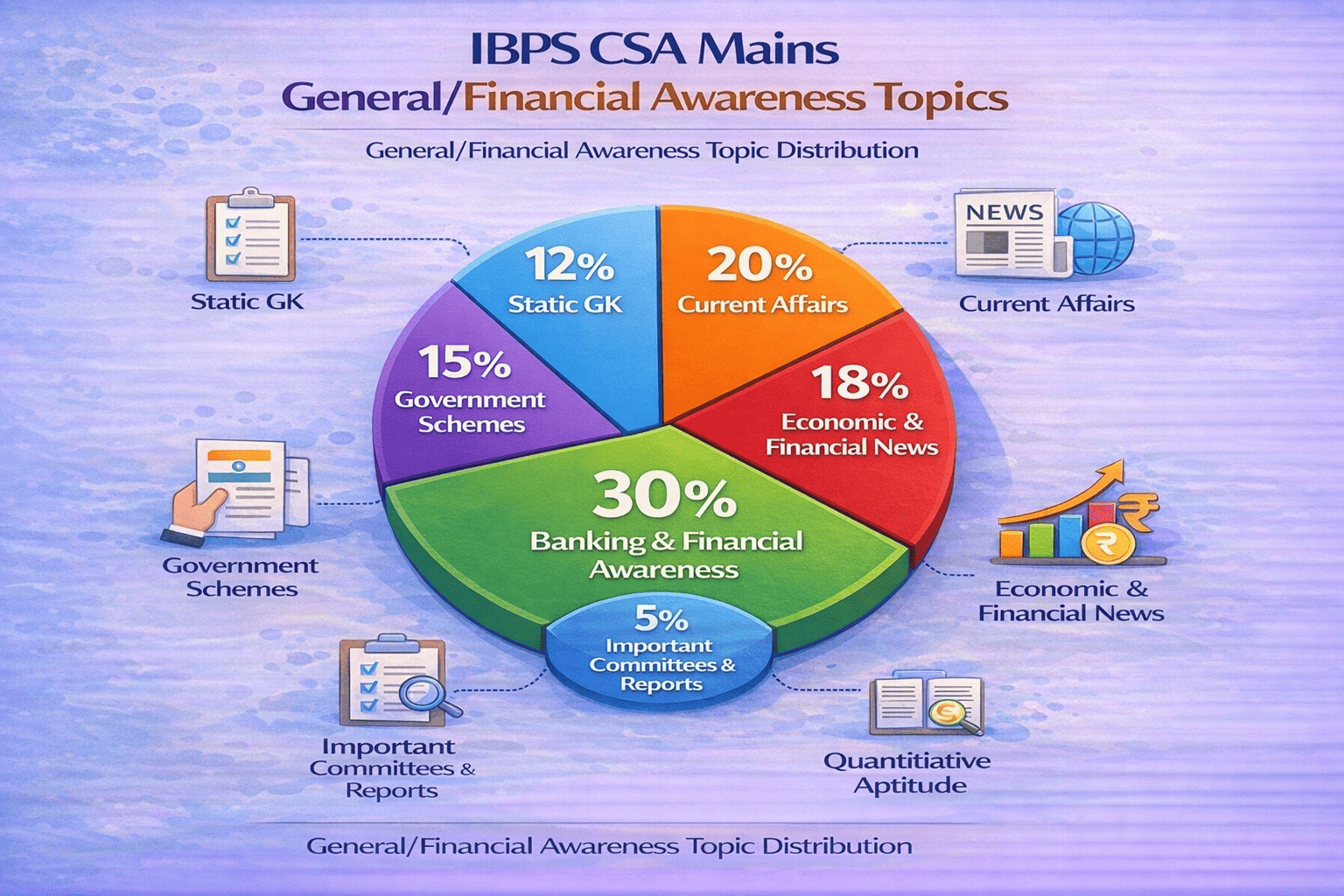
General/Financial Awareness Topic Distribution
2. General English (40 Questions, 40 Marks)
Difficulty Level: Easy to Moderate
Time Allocated: 35 minutes
Focus Areas: Reading comprehension, grammar accuracy, vocabulary usage
The English Language section in Mains is more comprehensive than Prelims, with longer reading passages and more nuanced grammar questions. However, it remains one of the more predictable sections where consistent practice yields consistent scores.
Topic-wise Weightage in General English
| Topic | Question Types | Expected Questions | Difficulty |
|---|---|---|---|
| Reading Comprehension | Main idea, Inference, Author’s tone, Vocabulary in context, Fact-based | 8–10 | Moderate |
| Cloze Test | Context-based word selection, Grammar-appropriate fills | 6–8 | Easy → Moderate |
| Error Detection | Subject-verb agreement, Tense, Prepositions, Articles, Pronouns | 5–7 | Easy → Moderate |
| Para Jumbles | Logical sequence, Connector words, Coherent paragraph formation | 4–5 | Moderate |
| Fill in the Blanks | Single blank, Double blanks, Phrase replacement | 4–5 | Easy → Moderate |
| Vocabulary | Synonyms, Antonyms, Idioms, Word usage | 3–4 | Easy → Moderate |
- Start with Error Detection (5 mins): Quick scoring, builds confidence
- Attempt RC in the middle (10-12 mins): When you’re most focused
- Cloze Test next (6-7 mins): Context-based, manageable if RC done well
- Para Jumbles (4-5 mins): Identify opening/closing sentences first
- Target 32-36 correct attempts: 80-90% accuracy achievable with practice
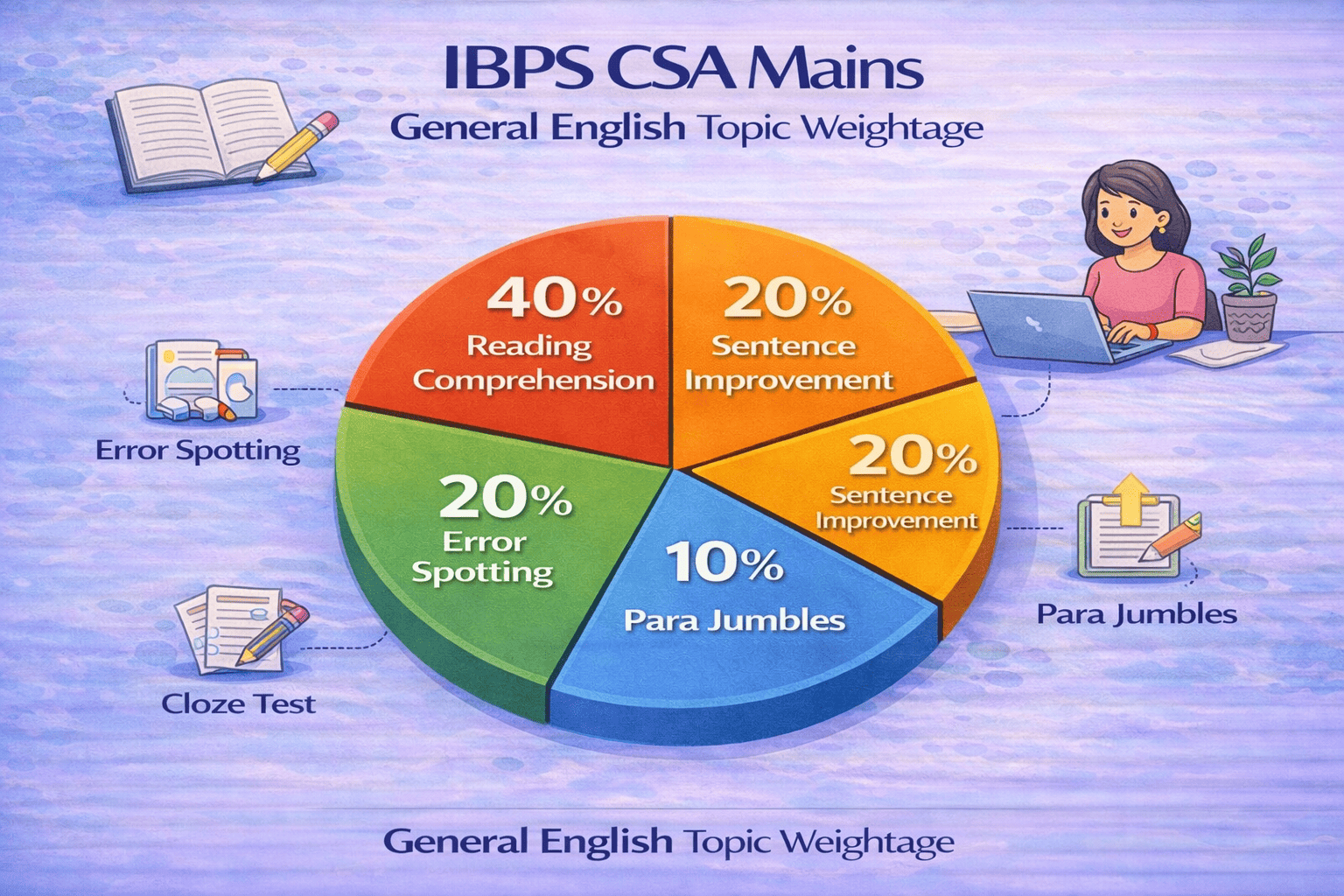
General English Topic Weightage
3. Reasoning Ability & Computer Aptitude (40 Questions, 60 Marks)
Difficulty Level: Moderate to Difficult
Time Allocated: 35 minutes
Expected Good Attempts: 15–20 questions
The Reasoning Ability & Computer Aptitude section is the most decisive and time-intensive section of the IBPS CSA Mains exam. With the highest weightage of 60 marks, this section has the power to dramatically improve — or completely derail — your final score.
Topic-wise Weightage: Reasoning & Computer Aptitude
| Topic | Sub-Topics | Expected Questions | Difficulty |
|---|---|---|---|
| Puzzles & Seating Arrangement | Linear, Circular, Floor-based, Box-based, Scheduling, Month-based | 15–18 | Difficult |
| Computer Aptitude | Computer Basics, MS Office, Internet, Networking, Banking Technology | 8–10 | Easy → Moderate |
| Input–Output | Step-wise arrangement, New pattern IO | 4–5 | Moderate |
| Syllogism | Possibility-based syllogism | 3–4 | Easy |
| Data Sufficiency | Two-statement logic questions | 3–4 | Moderate |
| Coded Inequality | Symbol-based inequality | 2–3 | Easy |
| Logical Reasoning | Statement–Conclusion, Cause–Effect | 2–3 | Moderate |
- Start with Computer Aptitude (5–7 mins)
- Solve Syllogism + Inequality (5 mins)
- Attempt 2–3 puzzle sets selectively (15–18 mins)
- Attempt Input–Output only if easy
- Target 15–20 correct attempts with 75–80% accuracy
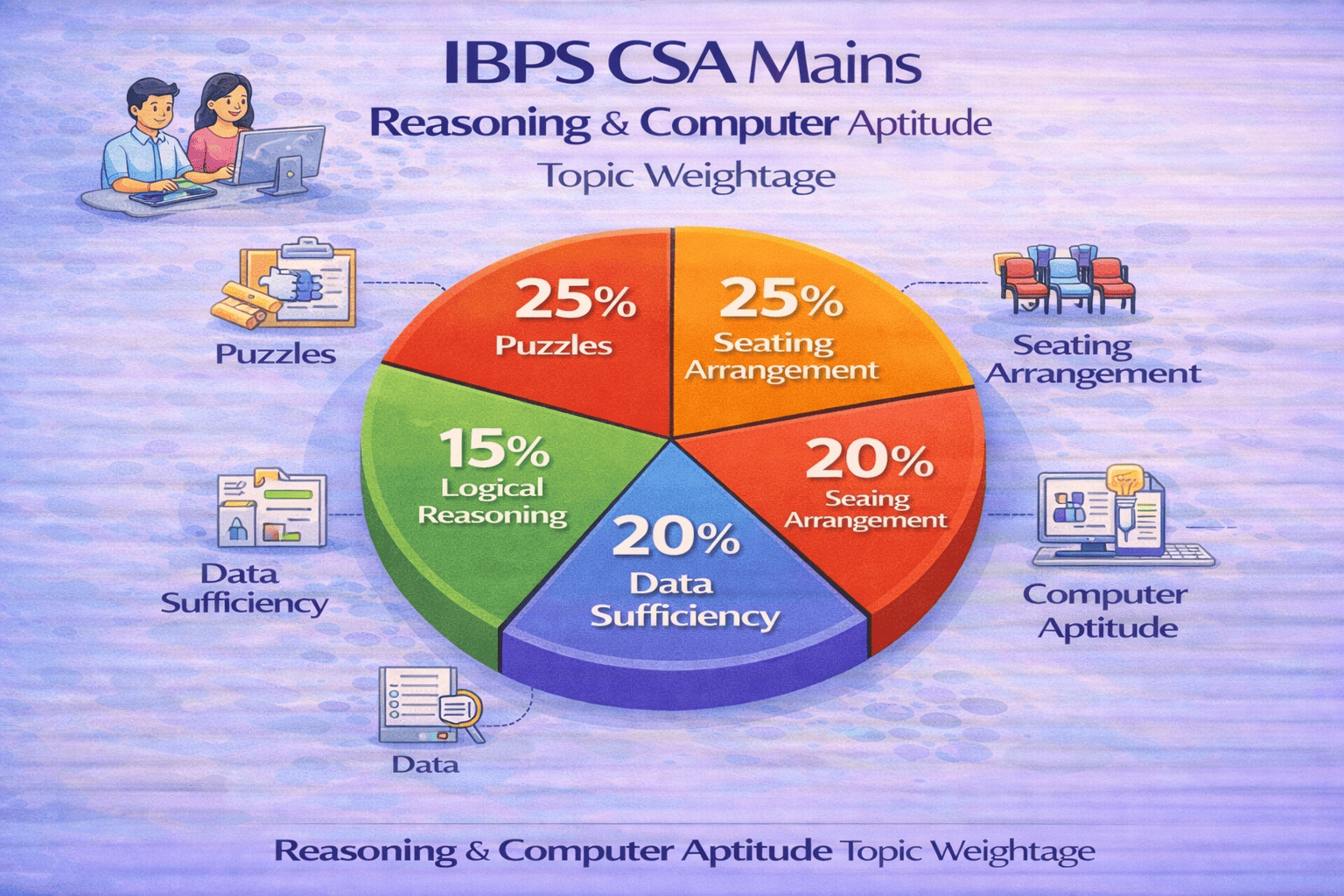
Reasoning & Computer Aptitude Topic Weightage
4. Quantitative Aptitude (35 Questions, 50 Marks)
Difficulty Level: Moderate to Difficult
Time Allocated: 30 minutes
Expected Good Attempts: 12-17 questions
Quantitative Aptitude in Mains is substantially more difficult than Prelims Numerical Ability. The questions are calculation-intensive, time-consuming, and require strong conceptual clarity in arithmetic and data interpretation.
High-Weight Topics in Quantitative Aptitude
| Topic | Sub-Topics Included | Expected Questions | Difficulty Level |
|---|---|---|---|
| Data Interpretation | Table, Line Chart, Bar Chart, Caselet DI, Missing DI | 10-12 | Moderate → Difficult |
| Arithmetic | SI-CI, Profit-Loss, Time-Speed-Distance, Time & Work, Averages, Ratio-Proportion, Mixtures, Partnership | 12-15 | Moderate |
| Simplification / Approximation | BODMAS, Square roots, Approximation techniques | 4-5 | Easy → Moderate |
| Quadratic Equations | Finding roots, Comparison of variables | 2-3 | Easy |
| Number Series | Missing number series, Wrong number series | 2-3 | Moderate |
Marking Scheme & Risk Analysis
Understanding the marking scheme is crucial for developing your attempt strategy and managing risk during the exam.
| Response Type | Marks Awarded | Impact on Score |
|---|---|---|
| Correct Answer | +1 mark | Positive contribution |
| Wrong Answer | –0.25 marks | Penalty deduction |
| Unattempted Question | 0 marks | No impact |
Understanding the Net Score Calculation
Your net score is calculated as:
Net Score = (Correct Attempts × 1) – (Wrong Attempts × 0.25)
Example calculation:
- Correct Attempts: 80
- Wrong Attempts: 20
- Net Score = (80 × 1) – (20 × 0.25) = 80 – 5 = 75 marks
- Attempting 70 questions with 80% accuracy (56 correct, 14 wrong) = 52.5 marks
- Attempting 100 questions with 60% accuracy (60 correct, 40 wrong) = 50 marks
- Quality beats quantity! Focus on accuracy over blind attempts
- Only guess if you can confidently eliminate 2-3 options
Role of Mains in Final Selection
Understanding how Mains fits into the overall selection process is crucial for every IBPS CSA aspirant. Unlike many other competitive exams, IBPS CSA follows a unique selection methodology.
The Two-Stage Selection Process
| Stage | Purpose | Marks Counted? | Impact on Final Selection |
|---|---|---|---|
| Prelims | Qualifying / Screening | ❒ No | Only determines eligibility for Mains |
| Mains | Merit Determination | ✅ Yes | 100% weightage in final merit & allotment |
| Interview | Not Applicable | ❒ N/A | No interview stage for IBPS CSA |
Difficulty Trend (Based on PYQs)
Analyzing previous year trends helps set realistic expectations and prepare accordingly. Here’s how the difficulty has evolved in recent IBPS CSA Mains exams:
| Section | Overall Trend | Recent Pattern | Candidate Feedback |
|---|---|---|---|
| General / Financial Awareness | Easy → Moderate | Increasing focus on banking awareness | Most scoring section |
| General English | Moderate | Stable difficulty, longer RC passages | Moderate time pressure |
| Reasoning & Computer | Moderate → Difficult | Complex puzzles, tricky input-output | Most time-consuming |
| Quantitative Aptitude | Difficult | Calculation-heavy DI, tough arithmetic | Challenging for most candidates |
| Overall Exam | Moderate | Balanced but time management critical | Selective attempting necessary |
- GA remains consistently scoring — prepare it thoroughly for guaranteed marks
- English difficulty is stable — consistent preparation yields consistent scores
- Reasoning difficulty varies significantly — practice diverse puzzle types
- Quant is consistently challenging — focus on accuracy over attempts
- Overall, time management is the biggest challenge across all years
Most Important Topics (High-Weight Areas)
If you’re short on time or looking for maximum ROI, focus on these high-impact topics that consistently appear and carry significant weightage.
| Section | Must-Prepare Topics | Expected Marks | Preparation Time Required |
|---|---|---|---|
| GA | Banking Awareness + Current Affairs (last 6 months) | 35-40 / 50 | 2-3 hours daily for 2 months |
| English | RC, Cloze Test, Error Detection | 22-28 / 40 | 1-2 hours daily for 2 months |
| Reasoning | Puzzles, Seating, Computer Aptitude | 30-40 / 60 | 2-3 hours daily for 3 months |
| Quant | DI, Arithmetic (SI-CI, Profit-Loss, TSD) | 25-35 / 50 | 2-3 hours daily for 3 months |
- GA: RBI functions + Monetary Policy + Banking Terms + Last 6 months Current Affairs = 30-35 marks
- English: Reading Comprehension + Cloze Test = 18-22 marks
- Reasoning: 3 Puzzle Sets + Computer Aptitude + Syllogism = 25-30 marks
- Quant: 2 DI Sets + Arithmetic (SI-CI, Profit-Loss) + Simplification = 20-25 marks
Total from core topics alone: 93-112 marks (out of 200)
Good Attempts (Safe Range)
One of the most common questions aspirants ask is: “How many questions should I attempt to clear the cut-off?” Here’s a realistic, data-backed answer based on previous year cut-off trends.
Section-wise Safe Attempt Range
| Section | Total Questions | Safe Attempts | Expected Accuracy | Target Score |
|---|---|---|---|---|
| General / Financial Awareness | 40 | 30-35 | 85-90% | 40-45 / 50 |
| General English | 40 | 22-27 | 80-85% | 17-22 / 40 |
| Reasoning & Computer | 40 | 15-20 | 75-80% | 30-40 / 60 |
| Quantitative Aptitude | 35 | 12-17 | 75-80% | 18-25 / 50 |
| Overall | 155 | 75-95 | 80%+ | 105-130 / 200 |
Score Benchmarks for Different Categories
| Category | Safe Score Range | Competitive Score | Excellent Score |
|---|---|---|---|
| General / EWS | 110-120 | 125-135 | 140+ |
| OBC | 100-110 | 115-125 | 130+ |
| SC | 85-95 | 100-110 | 115+ |
| ST | 75-85 | 90-100 | 105+ |
Official Transparency Reform: Response Sheets & Answer Keys
In a major policy shift promoting transparency and accountability, IBPS has introduced significant reforms starting with the 2026-27 recruitment cycle (CRP-CSA-XVI). These changes bring IBPS in line with other major recruiting bodies.
What’s New in 2026?
| Feature | Previous System | New System (2026 onwards) |
|---|---|---|
| Response Sheet Access | Not available to candidates | ✅ Available via login portal |
| Answer Keys | Not released publicly | ✅ Official keys released for all sections |
| Self-Evaluation | Not possible | ✅ Candidates can calculate their scores |
| Objection Mechanism | Not available | ✅ Window to challenge discrepancies |
| Transparency | Limited | ✅ Full transparency in evaluation |
Result Sequencing & Recruitment Stability
In line with the Department of Financial Services (DFS) mandate aimed at ensuring workforce stability and reducing poaching between banking institutions, a new result declaration sequence has been implemented for all banking recruitment exams.
New Result Declaration Order (DFS Mandate)
| Priority | Institution | Rationale |
|---|---|---|
| 1st | SBI (State Bank of India) | Largest public sector bank, independent recruitment |
| 2nd | Nationalized Banks (via IBPS CSA, PO, SO) | Major public sector banks under IBPS umbrella |
| 3rd | RRBs (Regional Rural Banks via IBPS RRB) | Rural banking institutions |
Exam-Day Rules & Instructions
Being aware of exam day protocols ensures you don’t face any last-minute surprises or disqualification. Here are the critical rules and instructions you must follow:
Documents to Carry (Mandatory)
- Admit Card: Downloaded from IBPS website (color printout preferred)
- Valid Photo ID: Any one of — Aadhaar Card, PAN Card, Driving License, Voter ID, Passport
- Recent Photograph: Same as uploaded in application (in case required)
- PWD Certificate: If applicable (for availing scribe/extra time)
Items NOT Allowed Inside Exam Hall
- Mobile phones, smartphones, tablets, smartwatches
- Calculators, slide rules, log tables
- Any electronic devices (Bluetooth devices, earphones)
- Written materials, books, guides, dictionaries
- Handbags, purses, wallets
- Watches of any type (exam center provides wall clock)
Frequently Asked Questions (FAQs) – IBPS CSA Mains Exam Pattern 2026
Yes. IBPS CSA selection consists of only two stages: Prelims (qualifying) and Mains (merit-based). There is no interview stage. Your Mains score alone determines your final rank and allotment.
Yes, there is negative marking of 0.25 marks for every wrong answer across all sections. This makes accuracy crucial for scoring well.
No. Unlike Prelims which has sectional cut-offs, Mains only has an overall cut-off. However, you should still maintain a balanced performance across sections for a competitive total score.
No. Sectional timing is mandatory in IBPS CSA Mains. Each section has allocated time, and once that time expires, the system automatically moves you to the next section. You cannot go back to previous sections.
Computer Aptitude is part of the Reasoning section in Mains and typically has 8-10 questions. It covers computer basics, MS Office, internet, networking, and banking technology. Study standard computer awareness books and focus on banking-related technology topics.
This varies by exam difficulty and category. Generally, attempting 75-95 questions with 80%+ accuracy (net score of 105-130) gives you a good chance of clearing cut-offs for most categories. Quality matters more than quantity due to negative marking.
Suggested Next Reads
Conclusion
The IBPS CSA Mains Exam 2026 (CRP-CSA-XVI) is the single most important stage in your banking career journey. With 155 questions to be solved in 120 minutes across four diverse sections, success requires a perfect blend of knowledge, speed, accuracy, and strategic time management.
Understanding the exam pattern thoroughly gives you a significant advantage. You now know the exact structure: 40 GA + 40 English + 40 Reasoning/Computer + 35 Quant = 200 marks, the sectional timing constraints that demand strategic planning, high-weight topics that deserve maximum preparation focus, and the critical fact that only Mains score matters for final selection.
With the new transparency reforms introduced in 2026, you’ll have complete visibility into your performance through response sheets and answer keys. This brings fairness and accountability to the selection process, ensuring that deserving candidates get their rightful opportunities.
- Understand the Mains pattern thoroughly before starting preparation
- Prioritize high-weight topics — GA, Puzzles, DI, and Banking Awareness
- Master sectional timing through mock tests
- Computer Aptitude is scoring — don’t neglect it
- IBPS CSA Mains is achievable with the right strategy and consistent effort