
Last Updated: June 21, 2026
IBPS Clerk(CSA) Prelims Exam Pattern 2026 (CRP-CSA-XVI) – Section-wise Structure, Timing & Latest Updates
Before you start preparing for IBPS Clerk Prelims 2026, you need to understand the exam pattern inside out. This guide breaks down the Prelims structure, sectional timing, marking scheme, language options, and key rules so you can plan your preparation strategically.
The IBPS Clerk Prelims Exam 2026 is the first qualifying stage of the recruitment process under CRP-CSA-XVI. While this stage doesn’t contribute to your final merit score, clearing Prelims is absolutely mandatory to advance to the Mains examination.
The Prelims exam is designed to test three fundamental abilities that are essential for banking operations: Speed — solving 100 questions in just 60 minutes requires exceptional time management, Accuracy — with negative marking, precision is more valuable than random attempts, and Sectional Time Management — each section has fixed timing that cannot be adjusted.
What makes IBPS Clerk Prelims particularly challenging is the mandatory sectional timing. Unlike many other competitive exams where you can manage your time across all sections, IBPS enforces strict time limits for each section. Once your allocated time for a section expires, the system automatically moves you to the next section with no option to return.
This guide provides a comprehensive breakdown of the IBPS Clerk Prelims Exam Pattern 2026, covering the latest updates including official terminology, expanded language options, response sheet transparency, and proven strategies to maximize your score while minimizing errors.
📘 Table of Contents
- Introduction: Why Exam Pattern Matters
- IBPS Clerk Prelims Exam Pattern 2026 – Overview
- Section-wise Exam Pattern & Weightage
- English Language
- Numerical Ability
- Reasoning Ability
- Marking Scheme & Cut-off Rules
- Medium of Examination (Language Options – 2026 Update)
- Transparency Reform: Response Sheets & Answer Keys
- Difficulty Level Trend (Based on PYQs)
- Result Sequencing & Recruitment Stability
- Smart Attempt Strategy for Prelims
- Frequently Asked Questions
- Suggested Next Reads
- Conclusion
⚡ Quick Summary – IBPS Clerk Prelims Exam Pattern 2026
- Total Questions: 100
- Total Marks: 100
- Duration: 60 minutes (sectional timing)
- Sections: English Language, Numerical Ability, Reasoning Ability
- Negative Marking: –0.25 per wrong answer
- Nature: Qualifying only (marks not counted in final merit)
- Selection: Moves to Mains (no interview for Clerk)
- Language Options: English, Hindi, and 13 regional languages
Introduction: Why Understanding the Exam Pattern Matters Before You Start Preparing
Every year, over 15-20 lakh aspirants apply for the IBPS Clerk exam, competing for approximately 12,000-18,000 positions across 11 public sector banks. The Prelims exam is the first filter, and it’s a challenging one — not because the questions are exceptionally difficult, but because of the strict sectional timing and the pressure to perform across three different sections within 60 minutes.
Here’s the reality — thousands of candidates who have strong subject knowledge still fail to clear Prelims simply because they don’t adapt their strategy to the exam pattern. They spend too much time on one section, neglect sectional cutoffs, or attempt too many questions with poor accuracy.
One important distinction to note — unlike IBPS PO which has Computer Aptitude as a separate section, the IBPS Clerk Prelims pattern has only three sections: English Language, Numerical Ability, and Reasoning Ability. Computer Aptitude appears only in the Mains exam.
This comprehensive guide covers everything you need to know about the IBPS Clerk Prelims exam pattern for 2026, including section-wise breakdown, marking scheme, language options, difficulty trends, transparency reforms, and strategic tips to maximize your score within the 60-minute window.
IBPS Clerk Prelims Exam Pattern 2026 Overview
IBPS Clerk Prelims Exam Pattern 2026 – Overview
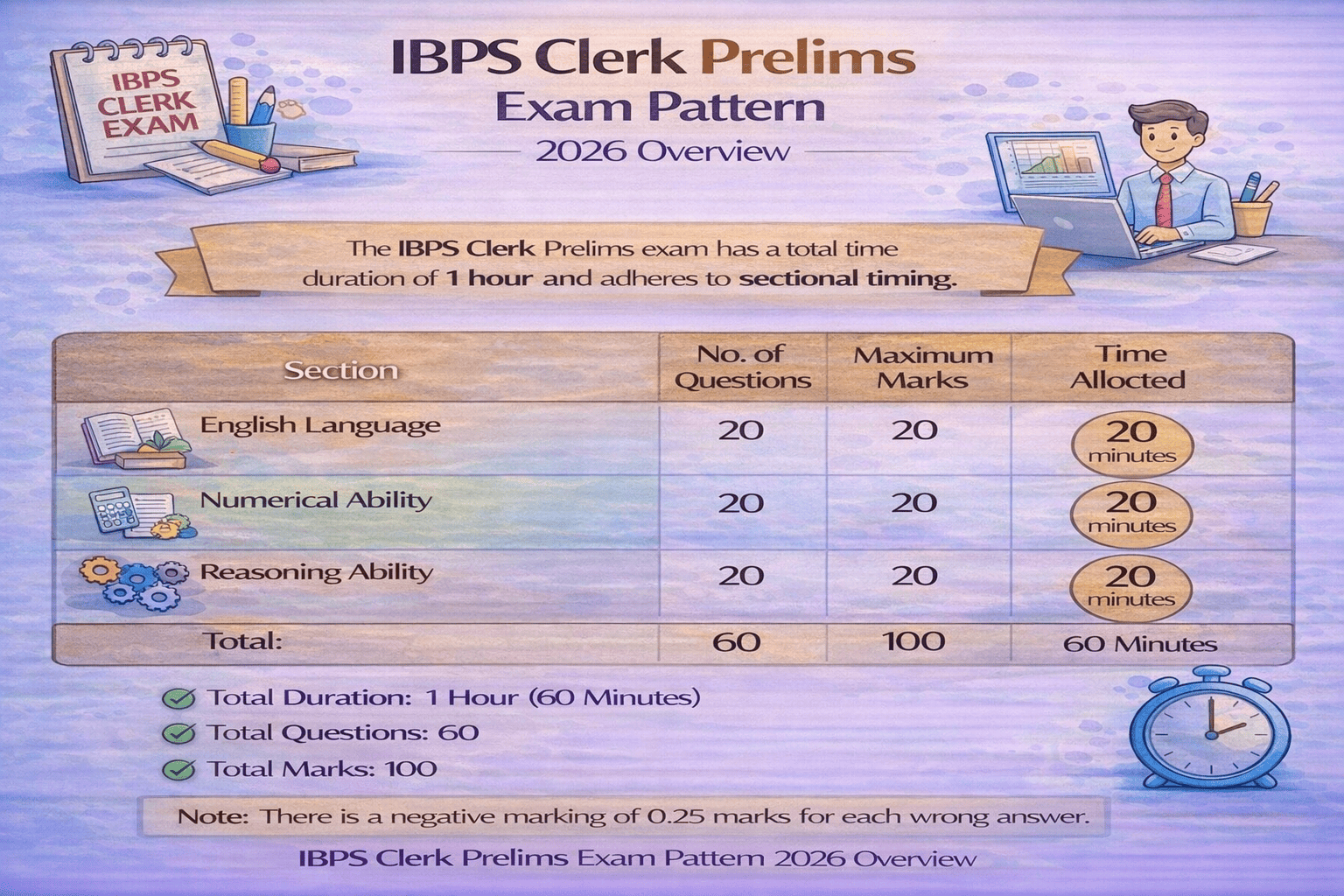
The IBPS Clerk Prelims examination consists of three sections with equal time allocation of 20 minutes each. Here’s the complete structural breakdown:
| Section | No. of Questions | Marks | Time Allocated |
|---|---|---|---|
| English Language | 30 | 30 | 20 minutes |
| Numerical Ability | 35 | 35 | 20 minutes |
| Reasoning Ability | 35 | 35 | 20 minutes |
| Total | 100 | 100 | 60 minutes |
- Sectional timing is mandatory – Each section has a fixed 20-minute window that cannot be extended or reduced
- No switching between sections – Once time expires, you cannot return to previous sections
- Objective-type online exam – All questions are Multiple Choice Questions (MCQs) with 4-5 options
- Negative marking applies: –0.25 marks deducted for each wrong answer
- Qualifying nature: Prelims marks are NOT counted in final merit; only Mains score matters
- Sectional cut-offs exist: You must clear minimum marks in each section individually
- Overall cut-off also applies: Your total score must exceed the overall qualifying threshold
Key Differences Between Prelims and Mains
Understanding the distinction between Prelims and Mains helps in strategic preparation:
| Aspect | Prelims | Mains |
|---|---|---|
| Number of Sections | 3 sections | 4 sections |
| Total Questions | 100 questions | 155 questions |
| Total Duration | 60 minutes | 120 minutes |
| Difficulty Level | Moderate | Moderate to Difficult |
| Role in Selection | Qualifying only | Merit determination (100% weightage) |
| Computer Aptitude | Not tested | Tested (combined with Reasoning) |
| General Awareness | Not tested | Tested (50 marks) |
Section-wise Exam Pattern & Weightage
Each section in IBPS Clerk Prelims tests specific skills relevant to banking operations. Let’s examine each section in detail with topic breakdowns and strategic insights.
1. English Language (30 Questions, 30 Marks)
Difficulty Level: Easy to Moderate
Time Allocated: 20 minutes
Focus Areas: Reading comprehension, grammar accuracy, vocabulary usage
The English Language section tests your ability to understand written text, identify grammatical errors, and apply vocabulary appropriately. This section is considered the most scoring section in Prelims for candidates with good English proficiency.
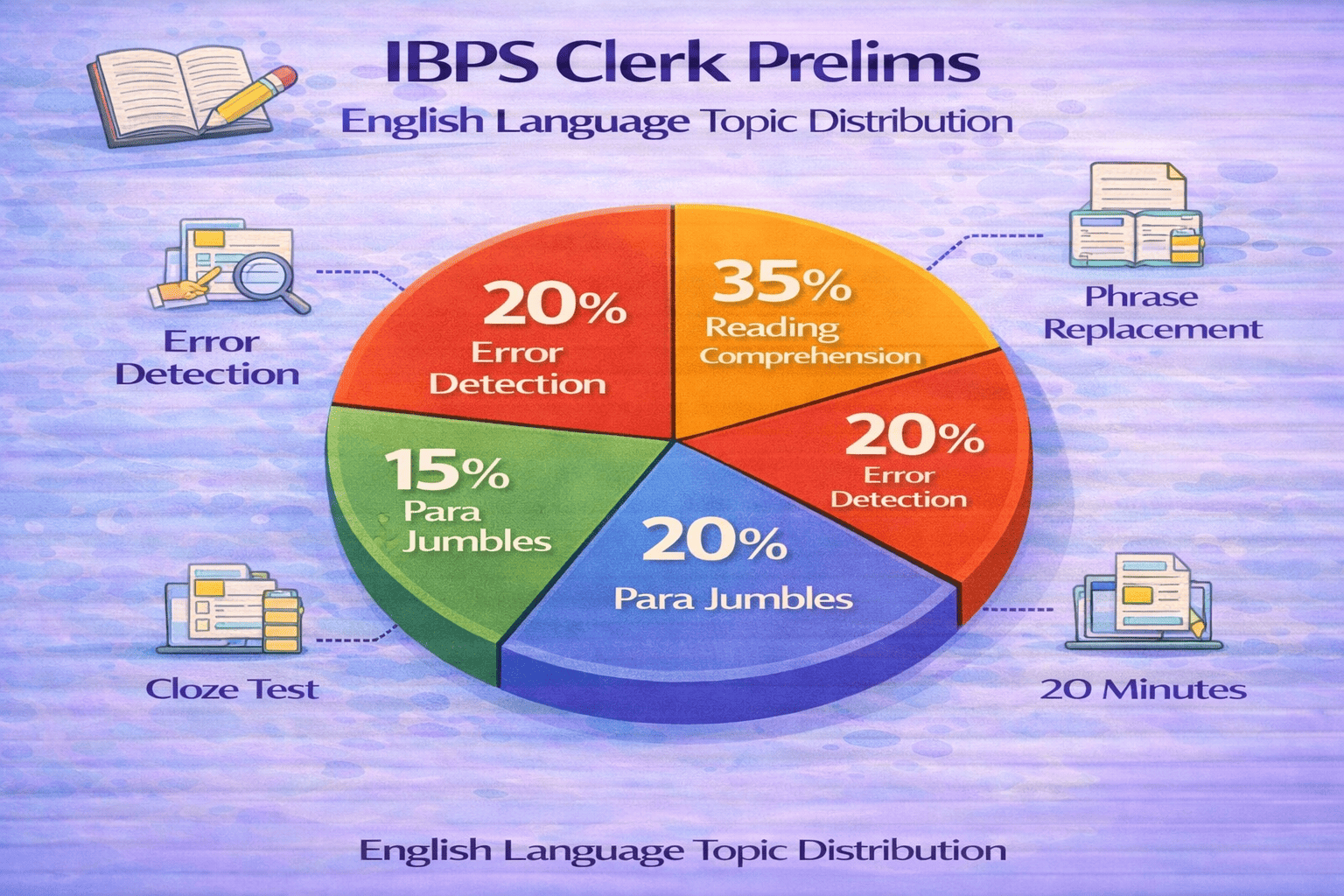
Topic-wise Weightage in English Language
| Topic | Expected Questions | Difficulty | Time Required |
|---|---|---|---|
| Reading Comprehension | 8–10 | Moderate | 8–10 minutes |
| Cloze Test | 5–6 | Easy → Moderate | 4–5 minutes |
| Error Detection / Sentence Correction | 4–5 | Easy | 3–4 minutes |
| Para Jumbles / Sentence Rearrangement | 4–5 | Moderate | 3–4 minutes |
| Fill in the Blanks | 3–4 | Easy | 2–3 minutes |
| Vocabulary (Synonyms/Antonyms) | 2–3 | Easy → Moderate | 1–2 minutes |
- Start with Error Detection and Fill in the Blanks – These are quickest and build confidence
- Attempt Reading Comprehension in the middle – Gives you focused time without rush
- Read RC passage once carefully – Scanning multiple times wastes time
- Skip vocabulary if unsure – No point in wild guessing with negative marking
- Target 22–26 correct attempts – Aiming for 85%+ accuracy
- Time management: Complete section in 18 minutes – Keep 2 minutes buffer for review
English Language Topic Distribution
2. Numerical Ability (35 Questions, 35 Marks)
Difficulty Level: Moderate
Time Allocated: 20 minutes
Focus Areas: Calculation speed, arithmetic clarity, data interpretation basics
Numerical Ability tests your mathematical proficiency and ability to solve quantitative problems quickly and accurately. This section is crucial because it has sectional cut-off, meaning you must score minimum marks here regardless of your performance in other sections.
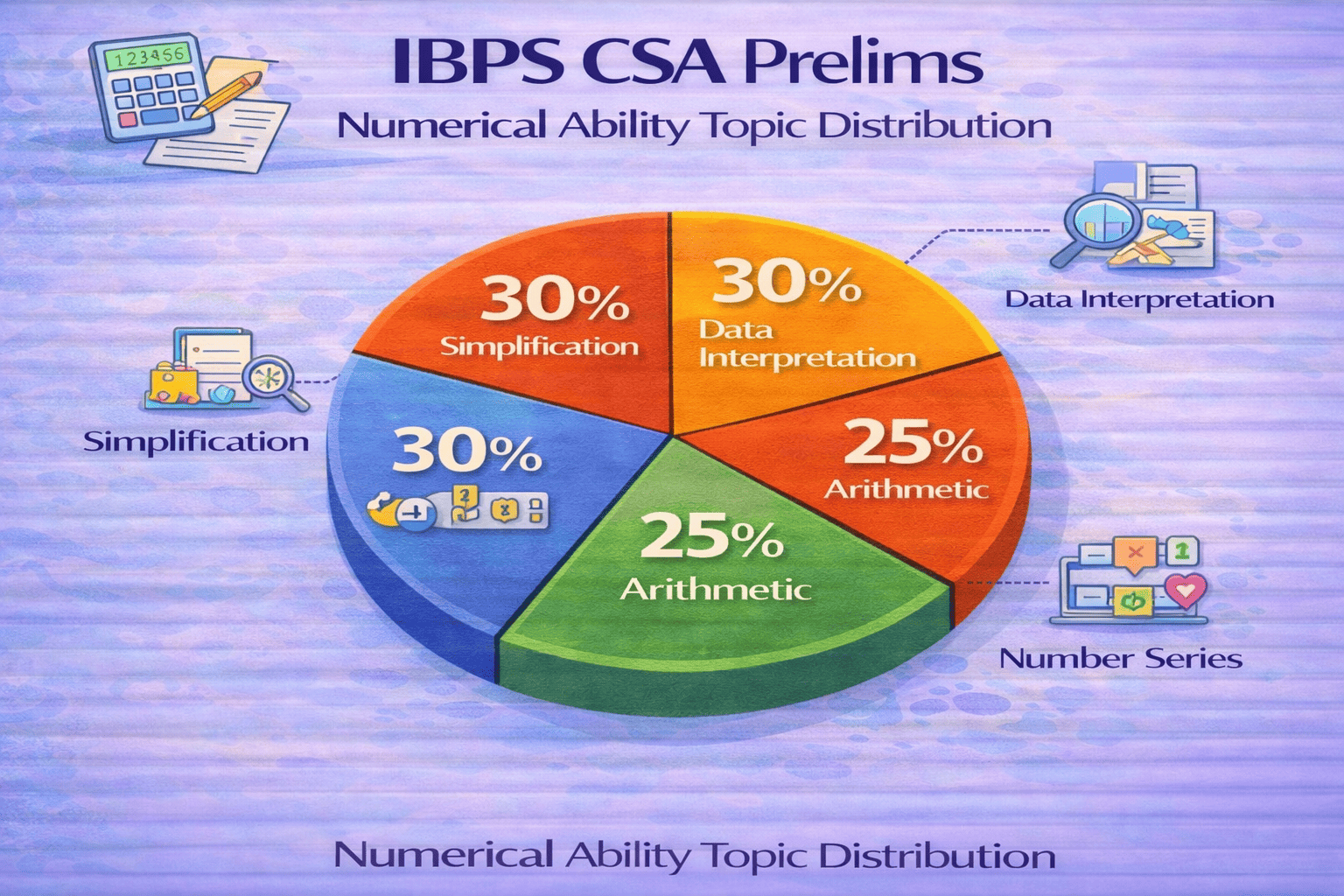
Topic-wise Weightage in Numerical Ability
| Topic | Expected Questions | Difficulty | Priority |
|---|---|---|---|
| Data Interpretation | 10–12 | Moderate | Very High |
| Arithmetic | 10–12 | Moderate | Very High |
| Simplification / Approximation | 5–7 | Easy → Moderate | High |
| Number Series | 4–5 | Moderate | High |
| Quadratic Equations | 3–5 | Easy | Moderate |
| Miscellaneous | 1–2 | Varies | Moderate |
Numerical Ability Topic Distribution
3. Reasoning Ability (35 Questions, 35 Marks)
Difficulty Level: Moderate to Difficult
Time Allocated: 20 minutes
Focus Areas: Logical thinking, puzzle-solving, pattern recognition, decision-making
Reasoning Ability is often considered the most challenging section in IBPS Clerk Prelims due to complex puzzle sets that can consume significant time. However, with the right strategy, this section can also be highly scoring.
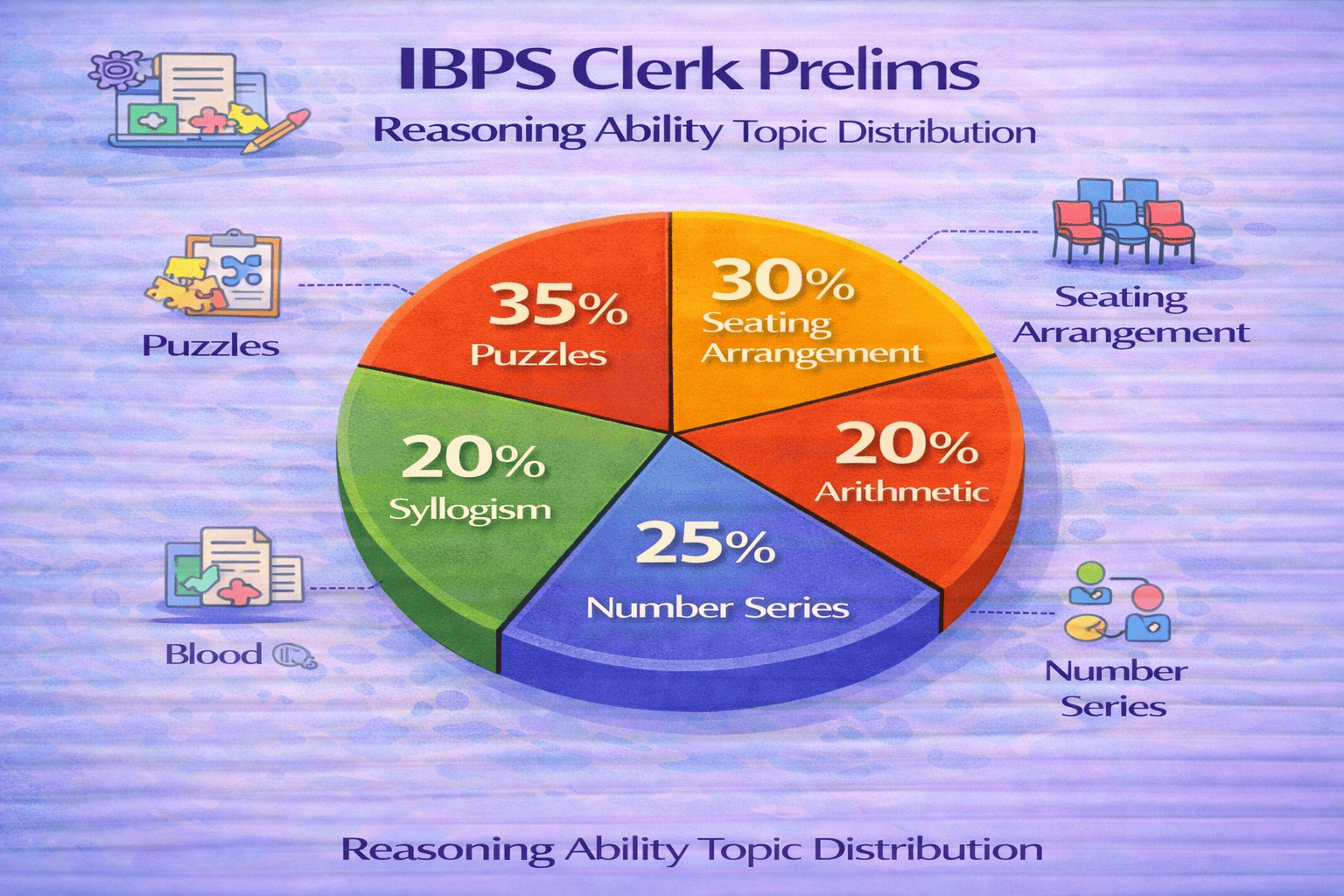
Topic-wise Weightage in Reasoning Ability
| Topic | Expected Questions | Difficulty | Time Investment |
|---|---|---|---|
| Puzzles & Seating Arrangement | 15–20 | Moderate → Difficult | 12–15 minutes |
| Inequality | 4–5 | Easy | 2–3 minutes |
| Syllogism | 4–5 | Easy → Moderate | 3–4 minutes |
| Alphanumeric / Number Series | 3–4 | Moderate | 2–3 minutes |
| Direction Sense | 2–3 | Easy → Moderate | 2–3 minutes |
| Blood Relation | 2–3 | Moderate | 2–3 minutes |
| Coding–Decoding | 1–2 | Easy → Moderate | 1–2 minutes |
- Start with Inequality & Syllogism (5–6 mins) – High accuracy, quick solving
- Scan all puzzle sets quickly (1–2 mins) – Identify the easiest-looking set
- Solve ONE complete puzzle set (6–8 mins) – Get 5 questions from this
- Attempt standalone questions (5–6 mins) – Direction, Blood Relation, Coding
- Skip complex puzzle sets entirely – Don’t fall into the time trap
- Target 18–23 correct attempts – Focus on high-certainty questions
Reasoning Ability Topic Distribution
Marking Scheme & Cut-off Rules
Understanding the marking scheme is crucial for developing your attempt strategy and managing risk during the exam.
Marking System
| Response Type | Marks Awarded | Impact on Score |
|---|---|---|
| Correct Answer | +1 mark | Positive contribution |
| Wrong Answer | –0.25 marks | Penalty deduction |
| Unattempted Question | 0 marks | No impact |
Understanding Net Score Calculation
Your net score in each section and overall is calculated as:
Net Score = (Correct Attempts × 1) – (Wrong Attempts × 0.25)
Example Calculation:
Let’s say in English Language section:
- You attempted 25 questions
- 22 were correct
- 3 were wrong
- 5 questions left unattempted
Your score = (22 × 1) – (3 × 0.25) = 22 – 0.75 = 21.25 marks
Cut-off Rules (Critical Understanding)
IBPS Clerk Prelims has a dual cut-off system that you must understand clearly:
| Cut-off Type | What It Means | Failure Impact |
|---|---|---|
| Sectional Cut-off | Minimum marks required in EACH section individually | If you fail to meet cut-off in even one section, you’re disqualified regardless of total score |
| Overall Cut-off | Minimum total marks required across all three sections | Even if you clear all sectional cut-offs, you must also meet overall cut-off to qualify |
State-wise Cut-off Variation
IBPS Clerk cut-offs are state-wise and category-wise, meaning the qualifying marks vary based on the state you’ve chosen (high competition states have higher cut-offs), your category (General/OBC/SC/ST/EWS have different benchmarks), overall exam difficulty in that particular year, and the number of vacancies and candidates in your state.
Approximate Cut-off Ranges (Based on Recent Trends)
| Category | Sectional Cut-off (Each Section) | Overall Cut-off (Total Score) |
|---|---|---|
| General / EWS | 5.5 – 7.5 marks | 70 – 82 marks |
| OBC | 5.0 – 6.5 marks | 65 – 75 marks |
| SC | 4.0 – 5.5 marks | 55 – 65 marks |
| ST | 3.5 – 5.0 marks | 48 – 58 marks |
Medium of Examination (Language Options – 2026 Update)
One of the most significant updates in the 2026 cycle is the expansion of language options for the exam. This makes IBPS Clerk more accessible to candidates from non-Hindi speaking states.
Language Availability by Section
| Section | Available Languages | Special Notes |
|---|---|---|
| English Language | English only | No bilingual option for this section |
| Numerical Ability | English, Hindi, + 13 Regional Languages | Questions and options available in chosen language |
| Reasoning Ability | English, Hindi, + 13 Regional Languages | Questions and options available in chosen language |
Complete List of Regional Languages (2026)
In addition to English and Hindi (available in all states), the following 13 regional languages are now supported:
| State / Region | Regional Language Options |
|---|---|
| Andhra Pradesh & Telangana | Telugu, Urdu |
| Karnataka | Kannada |
| Maharashtra & Goa | Marathi, Konkani |
| West Bengal | Bengali |
| Gujarat | Gujarati |
| Tamil Nadu | Tamil |
| Punjab | Punjabi |
| Assam | Assamese |
| Odisha | Odia |
| Kerala | Malayalam |
- You can choose your preferred language while registering for the exam
- The same language will apply to both Numerical Ability and Reasoning Ability sections
- You CANNOT change language during the exam once it starts
- English Language section will always be in English regardless of your preference
- Regional language option is beneficial if you’re more comfortable reading and understanding in your mother tongue
Transparency Reform: Response Sheets & Answer Keys
In line with transparency initiatives adopted by various government recruiting bodies, IBPS is expected to implement a response sheet and answer key publication system starting with the CRP-CSA-XVI (2026) cycle.
What This Reform Would Mean (If Implemented)
For Candidates:
- View your response sheet online — see exactly which options you marked for all 100 questions
- Access official answer keys — compare your answers against IBPS’s correct answer key
- Calculate probable scores — estimate your performance before official results
- Request answer key review — challenge answers you believe are incorrect with supporting evidence
- Better understanding of mistakes — analyze where you went wrong for future preparation
Benefits to the System:
- Increased transparency & trust in the examination process
- Reduced speculation about results and cut-offs
- Alignment with SSC, Railway, UPSC standards where this is already practiced
- Fairer evaluation system with accountability
Difficulty Level Trend (Based on PYQs)
Analyzing previous year question papers helps set realistic expectations and understand the evolving difficulty pattern. Here’s how the difficulty has trended over recent years:
| Section | Overall Difficulty Trend | Recent Pattern Changes |
|---|---|---|
| English Language | Easy → Moderate | RC passages getting slightly longer; Error detection patterns becoming trickier |
| Numerical Ability | Moderate | DI questions more calculation-intensive; Arithmetic requiring multi-step solutions |
| Reasoning Ability | Moderate → Difficult | Puzzles becoming more complex with multiple variables; Increased tricky conditions |
| Overall Exam | Moderate | Balanced difficulty but time pressure increasing |
Key Insights from PYQ Analysis
- English difficulty is most stable – Consistent preparation yields consistent scores
- Numerical DI complexity varies – Some years have easy tables, others have complex mixed charts
- Reasoning puzzles are unpredictable – Can range from moderate to very difficult
- Overall exam maintains balance – If one section is difficult, others are usually moderate
- Time management is the real challenge – Not the concepts but solving under time pressure
- Cut-offs adjust with difficulty – Harder exams have proportionally lower cut-offs
Result Sequencing & Recruitment Stability
To improve workforce stability in public sector banks and reduce frequent job switching, the Department of Financial Services (DFS) has issued structured guidelines regarding the order in which banking exam results are declared.
Starting from the 2026 recruitment cycle, all major banking recruitment bodies are expected to follow a fixed result declaration hierarchy. This ensures candidates make informed career decisions before accepting appointments.
Official Result Declaration Order (DFS Mandate)
| Priority Order | Recruitment Body | Reason |
|---|---|---|
| 1st | State Bank of India (SBI) | Largest PSU bank with independent recruitment cycle |
| 2nd | IBPS (PO, SO, Clerk/CSA) | Nationalized banks under IBPS umbrella |
| 3rd | IBPS RRB | Regional Rural Banks |
Why This Policy Matters
- Prevents candidates from joining one bank and resigning immediately after getting a better offer
- Allows candidates to compare SBI vs IBPS opportunities before acceptance
- Improves retention and training efficiency for banks
- Brings long-term stability to banking recruitment
Smart Attempt Strategy for Prelims
IBPS Clerk Prelims is not about attempting all 100 questions. It is about attempting the right questions correctly within strict sectional time limits.
A smart attempt strategy balances three factors: Speed, Accuracy, and Sectional cut-off safety.
Recommended Section-wise Attempt Plan
| Section | Safe Attempts | Accuracy Target | Ideal Time Usage |
|---|---|---|---|
| English Language | 22–26 | 85%+ | 18–19 minutes |
| Numerical Ability | 20–25 | 75–80% | 19–20 minutes |
| Reasoning Ability | 18–23 | 75–80% | 19–20 minutes |
Golden Rules for Prelims
- Do NOT chase 100 attempts – chasing accuracy wins Prelims
- Clear sectional cut-offs first, then aim for overall score
- Skip questions that take more than 60–90 seconds
- Guess only if you can eliminate at least two options
- Mock practice with sectional timers is mandatory
A candidate attempting 65–75 questions with high accuracy consistently has a better chance than someone attempting 85+ with low accuracy.
Frequently Asked Questions (FAQs) – IBPS Clerk Prelims Exam 2026
IBPS Clerk Prelims is strictly qualifying in nature. The marks scored in Prelims are not counted while preparing the final merit list. Only candidates who clear both sectional and overall cut-offs in Prelims are allowed to appear for the Mains exam, and only Mains marks decide final selection and bank allotment.
Yes, IBPS Clerk Prelims has sectional cut-offs for English Language, Numerical Ability, and Reasoning Ability. Candidates must clear the minimum qualifying marks in each section individually, along with the overall cut-off, to qualify for the Mains exam.
If you fail to clear the sectional cut-off in even one section, you will be disqualified, regardless of how high your overall score is. Clearing both sectional and overall cut-offs is mandatory.
A safe strategy is to attempt around 65–75 questions with high accuracy (75–85%). Attempting fewer questions with better accuracy is far more effective than attempting many questions with low confidence due to negative marking.
Reasoning Ability is generally considered the most difficult section due to complex puzzle sets that consume a lot of time. Numerical Ability is time-consuming due to calculations, while English Language is comparatively more scoring for most candidates.
No. IBPS Clerk Prelims follows mandatory sectional timing. Once the time allotted for a section is over, the system automatically moves to the next section, and you cannot return to the previous one.
Suggested Next Reads
Conclusion
The IBPS Clerk Prelims Exam 2026 (CRP-CSA-XVI) is a high-speed qualifying test designed to shortlist candidates for the Mains examination. While Prelims marks do not count toward final selection, failing to clear this stage ends the journey immediately.
Success in Prelims depends less on deep knowledge and more on smart question selection, high accuracy under time pressure, and strict adherence to sectional timing.
Candidates who understand the exam pattern, practice with full-length mocks, and follow a disciplined attempt strategy consistently outperform those who rely on brute-force attempts.
With expanded language options, improved transparency initiatives, and a stable recruitment framework, IBPS Clerk Prelims 2026 offers a fair and structured opportunity for aspirants across the country.
- Understand the Prelims pattern thoroughly before starting preparation
- Target accuracy, not just attempts
- Master sectional timing through mock tests
- Focus on high-weight topics for maximum ROI
- IBPS Clerk Prelims is achievable with the right strategy and consistent practice