
Last Updated: June 21, 2026
IBPS Customer Service Associate (CSA) Prelims Syllabus 2026 (CRP-CSA-XVI) — Topic-wise Syllabus for English, Numerical Ability & Reasoning
Before you start preparing for IBPS Clerk Prelims 2026, you need to know exactly what to study and what to skip. This guide breaks down the complete syllabus — topic by topic, with weightage and difficulty analysis — so you can plan your preparation strategically.
The IBPS Clerk Prelims exam is the first qualifying stage of the recruitment process under CRP-CSA-XVI (Customer Service Associate – XVI). While Prelims marks are not counted in the final merit list, clearing this stage is absolutely mandatory to appear for the Mains exam.
The Prelims syllabus is strategically designed to test three fundamental competencies that every banking professional needs: Speed, Accuracy, and Logical thinking under strict sectional timing constraints.
Because cut-offs have steadily increased in recent years (sometimes reaching 75-80+ marks out of 100), a topic-wise, weightage-based preparation strategy is the most reliable way to clear IBPS Clerk Prelims 2026 with a comfortable margin.
This comprehensive guide provides a complete, updated, and exam-oriented syllabus breakdown, supported by Previous Year Question (PYQ) trends, difficulty analysis, and strategic preparation tips to help you maximize your Prelims score.
📘 Table of Contents
- Introduction: Why Syllabus Awareness Matters for Clerk
- IBPS Clerk Prelims Syllabus 2026 – Overview
- Topic-Wise Syllabus
- English Language
- Numerical Ability
- Reasoning Ability
- Weightage: Topic-Wise Marks Distribution
- Most Important Topics (High-Weight Areas)
- Difficulty Level Overview (Recent Trend)
- What to Prioritize for IBPS Clerk Prelims 2026
- Common Mistakes to Avoid
- Frequently Asked Questions
- Suggested Next Reads
- Conclusion
⚡ Quick Summary — IBPS Clerk Prelims Syllabus 2026
- Sections: English Language, Numerical Ability, Reasoning Ability
- Total: 100 Questions | 100 Marks | 60 Minutes
- Sectional Timing: 20 minutes each (strict — cannot switch)
- High-weight topics: Reading Comprehension, Data Interpretation, Puzzles & Seating Arrangement
- Difficulty Level: English (Easy to Moderate), Numerical Ability (Moderate to Difficult), Reasoning (Moderate to Difficult)
- Best scoring areas: Simplification, Error Detection, Cloze Test, Syllogism, Inequality
- Strategy: Topic-wise mastery + speed building + mock analysis
- Negative Marking: 0.25 marks deducted for each wrong answer
Introduction: Why Understanding the Syllabus Matters Before You Start Preparing
The IBPS Clerk Prelims examination is the first hurdle in your banking career journey. Every year, over 15-20 lakh aspirants apply for approximately 12,000-18,000 positions across 11 public sector banks. The competition is fierce, and understanding the syllabus is your first strategic advantage.
Many candidates make the mistake of preparing without knowing what to focus on. They waste time on topics that rarely appear, ignore high-weight areas, and end up with poor scores. A smart aspirant studies the syllabus carefully, identifies the most important topics, and allocates preparation time accordingly.
One important distinction to note — unlike IBPS PO which has a separate Computer Aptitude section in Prelims, the IBPS Clerk Prelims syllabus does NOT include Computer Knowledge. Computer Aptitude appears only in the Mains exam as part of the Reasoning section.
This comprehensive guide covers the complete IBPS Clerk Prelims syllabus for 2026, including topic-wise breakdown, weightage analysis, difficulty trends, and strategic preparation tips. Whether you’re a first-time aspirant or appearing again, this structured approach will help you maximize your score within the 60-minute window.
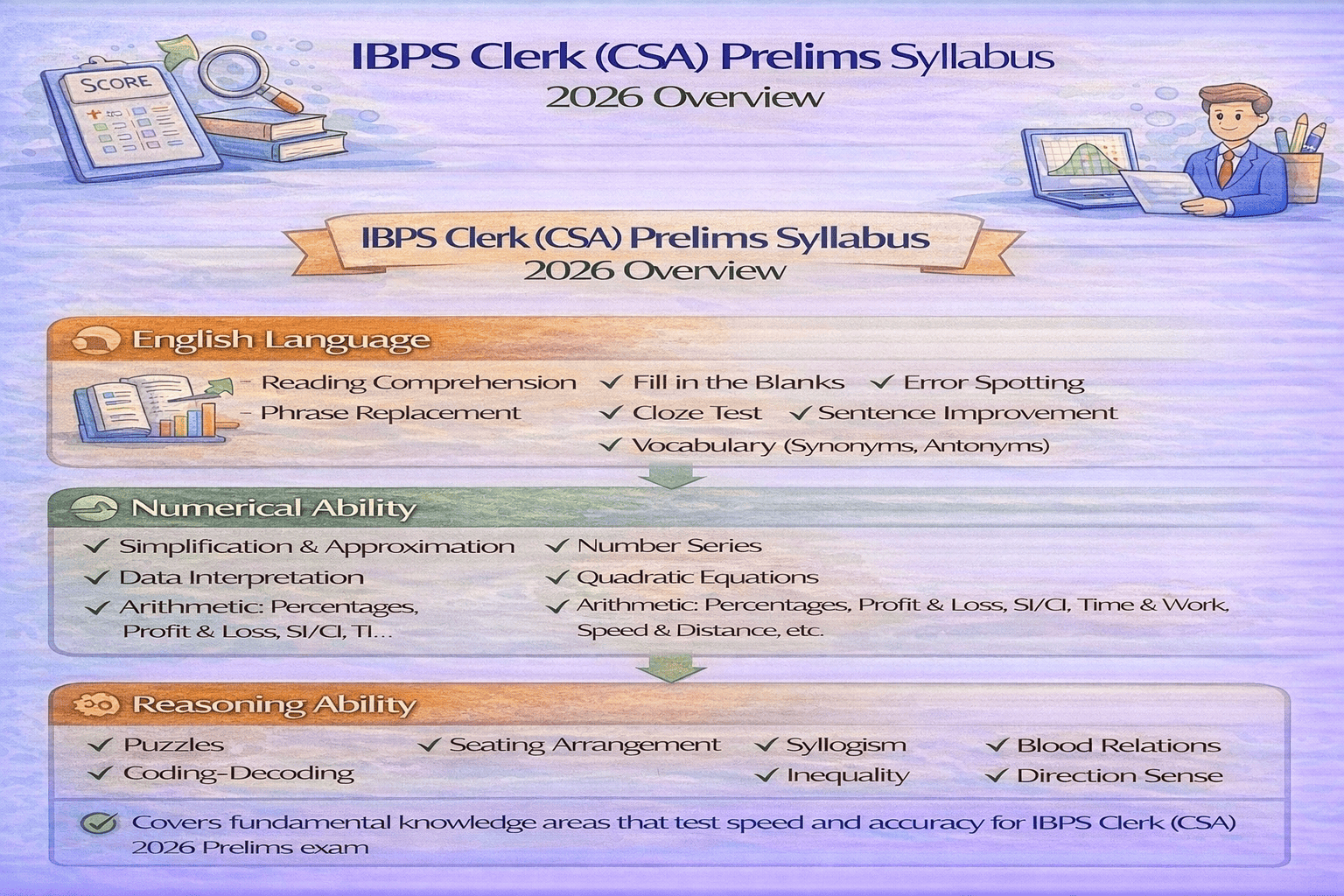
IBPS Clerk (CSA) Prelims Syllabus 2026 Overview
IBPS Clerk Prelims Syllabus 2026 – Overview
The IBPS Clerk Prelims exam follows a highly structured pattern with strict sectional timing that makes time management absolutely critical for success.
| Section | No. of Questions | Marks | Time Allocated |
|---|---|---|---|
| English Language | 30 | 30 | 20 minutes |
| Numerical Ability | 35 | 35 | 20 minutes |
| Reasoning Ability | 35 | 35 | 20 minutes |
| Total | 100 | 100 | 60 minutes |
- Sectional timing is compulsory — You cannot switch between sections during the exam
- Objective-type online exam — All questions are Multiple Choice Questions (MCQs)
- Negative marking: –0.25 marks deducted for each wrong answer
- No penalty for unattempted questions — Strategic skipping is important
- Sectional + overall cut-off applicable — Must clear both to qualify
- Qualifying nature — Marks NOT counted in final merit (Mains decides final selection)
- Language options: English & Hindi (except for English Language section)
Topic-Wise Syllabus
Understanding the detailed topic-wise breakdown is essential for creating an effective preparation strategy. Let’s explore each section comprehensively with PYQ trends and difficulty analysis.
1. English Language Syllabus (30 Questions)
Difficulty Level: Easy to Moderate
Exam Focus: Reading comprehension, grammar accuracy, vocabulary usage
The English Language section is often considered the easiest and most scoring section in IBPS Clerk Prelims, provided you have strong fundamentals in grammar and good reading habits.
| Topic Area | Sub-Topics | Expected Questions | PYQ Trend |
|---|---|---|---|
| Reading Comprehension | Fact-based, Inference, Vocabulary-in-context, Main idea | 8–10 | Always appears |
| Cloze Test | Grammar + contextual understanding, Fill in blanks | 5–6 | Frequent |
| Error Detection | SVA, Tenses, Articles, Prepositions, Word usage | 4–5 | Frequent |
| Para Jumbles / Sentence Rearrangement | Logical flow, context, coherence | 4–5 | Regular |
| Sentence Completion / Fillers | Single / Double fillers, contextual fit | 3–4 | Moderate |
| Vocabulary | Synonyms, Antonyms, Word usage, Spelling | 2–3 | Occasional |
High-Weight Topics in English Language
Based on recent exam trends, these topics consistently carry maximum weightage:
- Reading Comprehension – 8-10 questions (highest weightage)
- Cloze Test – 5-6 questions
- Error Detection – 4-5 questions
These three topics alone account for approximately 17-21 questions out of 30, making them absolutely critical for your preparation strategy.
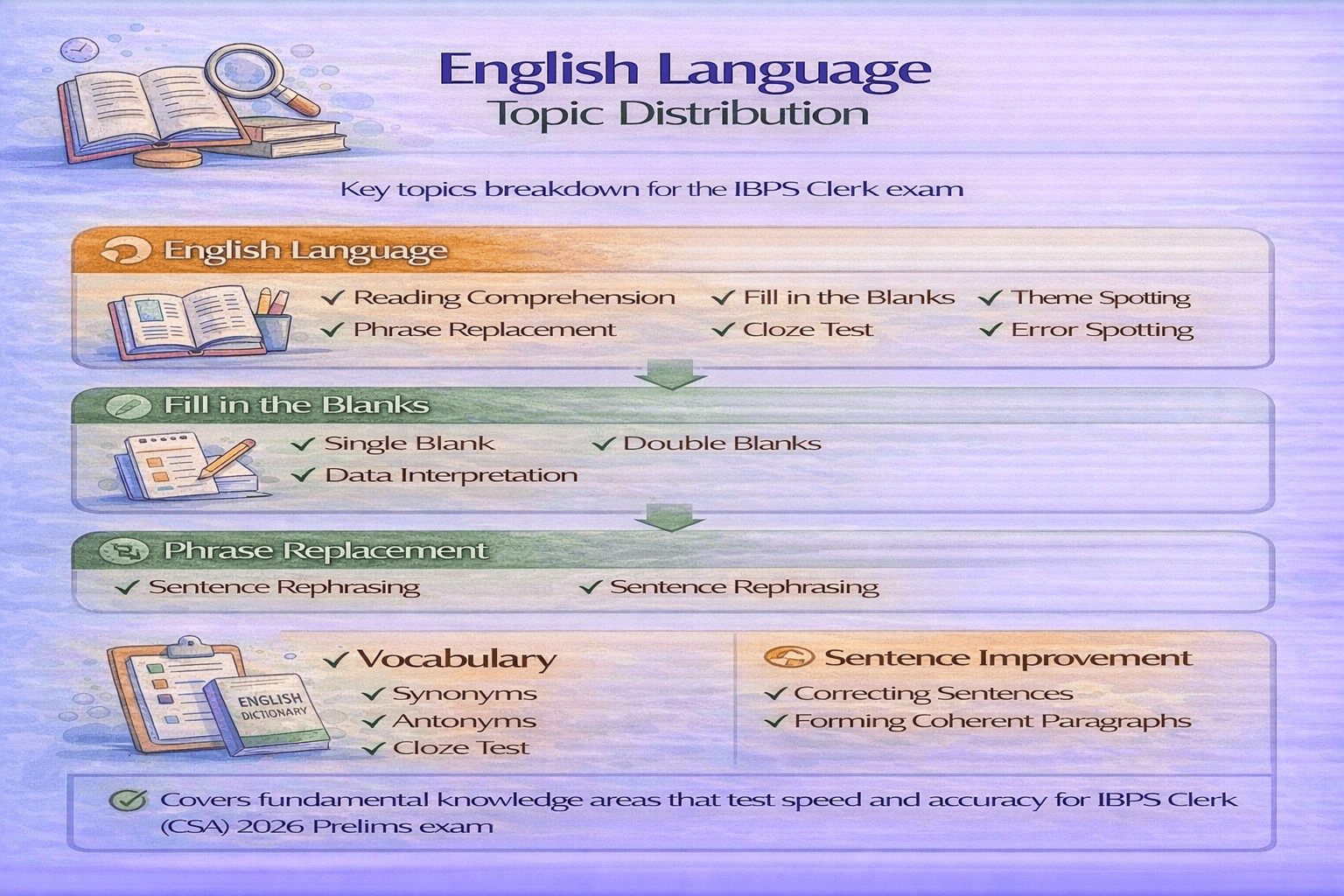
English Language Topic Distribution
2. Numerical Ability Syllabus (35 Questions)
Difficulty Level: Moderate to Difficult
Exam Focus: Calculation speed + arithmetic clarity + basic Data Interpretation
Numerical Ability is often the most challenging section in Prelims due to time constraints and calculation-intensive questions. However, with the right topic selection and practice, you can score well here.
| Topic | Sub-Topics Included | Expected Weightage | PYQ Trend |
|---|---|---|---|
| Data Interpretation (DI) | Table, Bar Chart, Line Graph, Pie Chart, Caselet | 10–12 | Very High |
| Arithmetic | Percentage, Ratio & Proportion, SI-CI, Time-Speed-Distance, Time & Work, Averages, Profit & Loss, Mixtures & Alligations | 10–12 | High |
| Simplification / Approximation | BODMAS, Square roots, Cube roots, Fractions, Decimals | 5–7 | Frequent |
| Number Series | Missing number, Wrong number | 4–5 | Consistent |
| Quadratic Equations | Comparing roots (x > y, x < y, x ≥ y, etc.) | 3–5 | Regular |
| Miscellaneous | Quantity comparison, Other topics | 1–2 | Occasional |
High-Weight Topics in Numerical Ability
- Data Interpretation (DI) – 10-12 questions
- Arithmetic – 10-12 questions
Together they account for 20–22 questions out of 35! This means focusing on DI and Arithmetic can secure you 60%+ marks in this section.
Detailed Arithmetic Sub-Topics
The Arithmetic section covers multiple fundamental topics. Here’s what you need to master:
- Percentage: Basic calculations, percentage increase/decrease, successive percentage changes
- Ratio & Proportion: Simple ratios, compound ratios, continued proportion
- Simple Interest & Compound Interest: Basic formulas, difference between SI & CI, effective rate
- Time, Speed & Distance: Relative speed, average speed, trains, boats & streams
- Time & Work: Work efficiency, pipes & cisterns, men-days-hours calculations
- Averages: Simple average, weighted average, replacement problems
- Profit & Loss: Cost price, selling price, discount, marked price
- Mixtures & Alligations: Weighted average method, replacement of mixtures
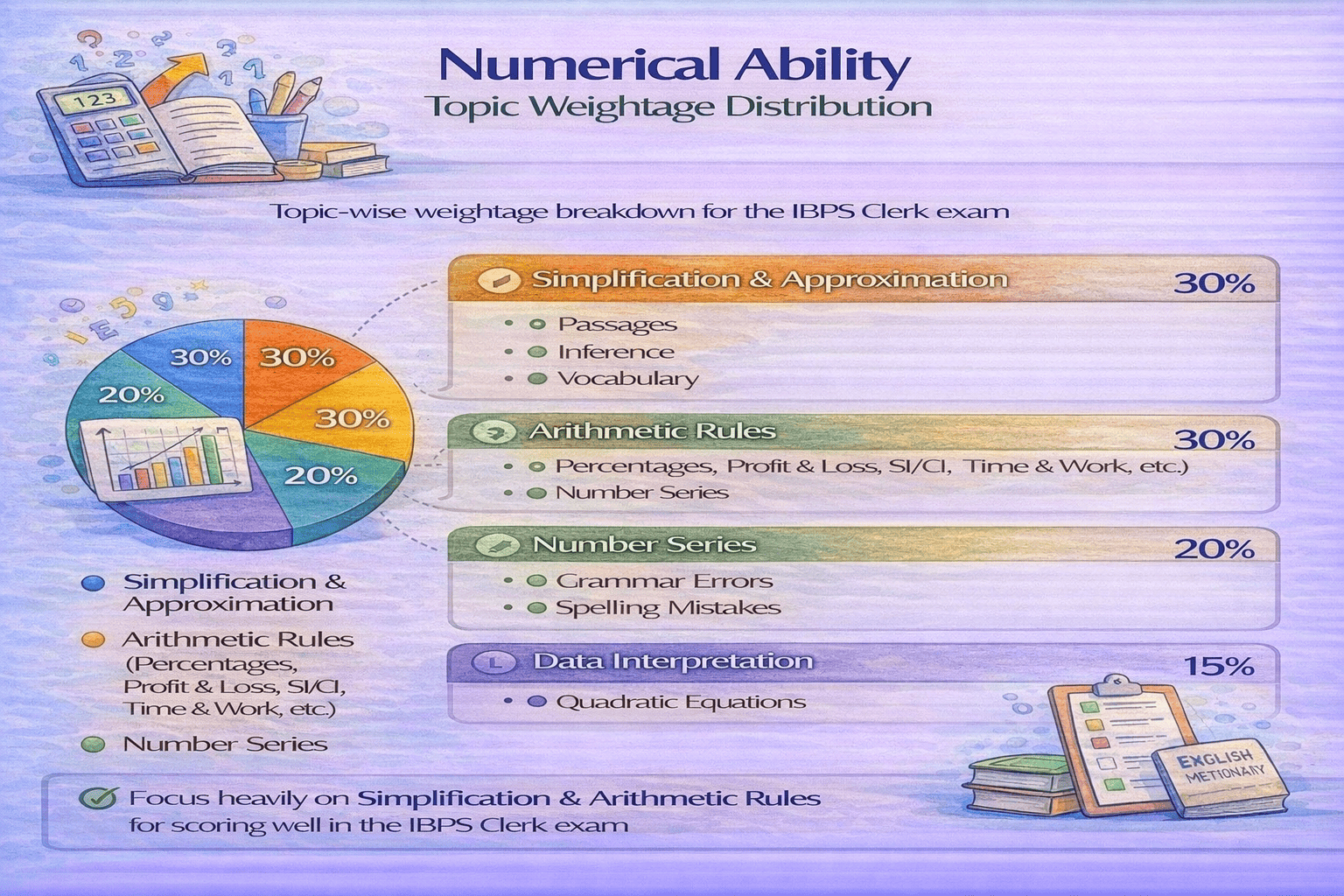
Numerical Ability Topic Weightage Distribution
3. Reasoning Ability Syllabus (35 Questions)
Difficulty Level: Moderate to Difficult
Exam Focus: Puzzles, seating arrangements, logical reasoning
Reasoning Ability is the section that can make or break your Prelims score. While it offers high-scoring opportunities through puzzles and seating arrangements, these questions can also consume significant time if you’re not well-practiced.
| Topic | Sub-Topics Included | Expected Weightage | PYQ Trend |
|---|---|---|---|
| Puzzles & Seating Arrangement | Linear Seating, Circular Seating, Floor-based Puzzle, Box-based Puzzle, Scheduling Puzzle, Month-based Puzzle | 16–20 | Dominant (50-60%) |
| Inequality | Direct inequality, Coded inequality | 4–5 | High |
| Syllogism | New-type syllogism, Classical syllogism (Venn diagrams) | 4–5 | Frequent |
| Series | Alphabetic series, Numeric series, Alphanumeric series | 3–4 | Regular |
| Direction Sense | Distance & direction calculations, shortest path | 2–3 | Moderate |
| Blood Relation | Direct blood relations, Coded blood relations, Family tree | 2–3 | Regular |
| Coding-Decoding | Letter coding, Number coding, New pattern coding | 1–2 | Occasional |
| Ranking & Order | Position from left/right, total persons in row | 1–2 | Occasional |
High-Weight Topics in Reasoning Ability
- Puzzles + Seating Arrangement – 16-20 questions (50-60% of entire section!)
This single topic category determines your success in the Reasoning section. If you can master puzzles and seating arrangements, you’ve essentially secured 50%+ marks in this section.
Understanding Puzzles & Seating Arrangements
This is the most important topic area in Reasoning. Let’s break down the different types:
- Linear Seating: People sitting in a row (single or double row), facing north/south
- Circular Seating: People sitting around a circular table, facing center/outward
- Floor-based Puzzle: People/items on different floors of a building
- Box-based Puzzle: Items stacked in boxes with conditions
- Scheduling Puzzle: Events scheduled across days/months with conditions
- Month-based Puzzle: Birthdays, meetings, events across different months
Other Important Reasoning Topics
After puzzles, focus on these high-accuracy topics:
- Inequality: Quick 30-second questions, high accuracy possible
- Syllogism: Formulaic approach, 100% accuracy achievable with practice
- Series: Pattern recognition, moderate difficulty
- Direction Sense: Diagram-based, good scoring potential
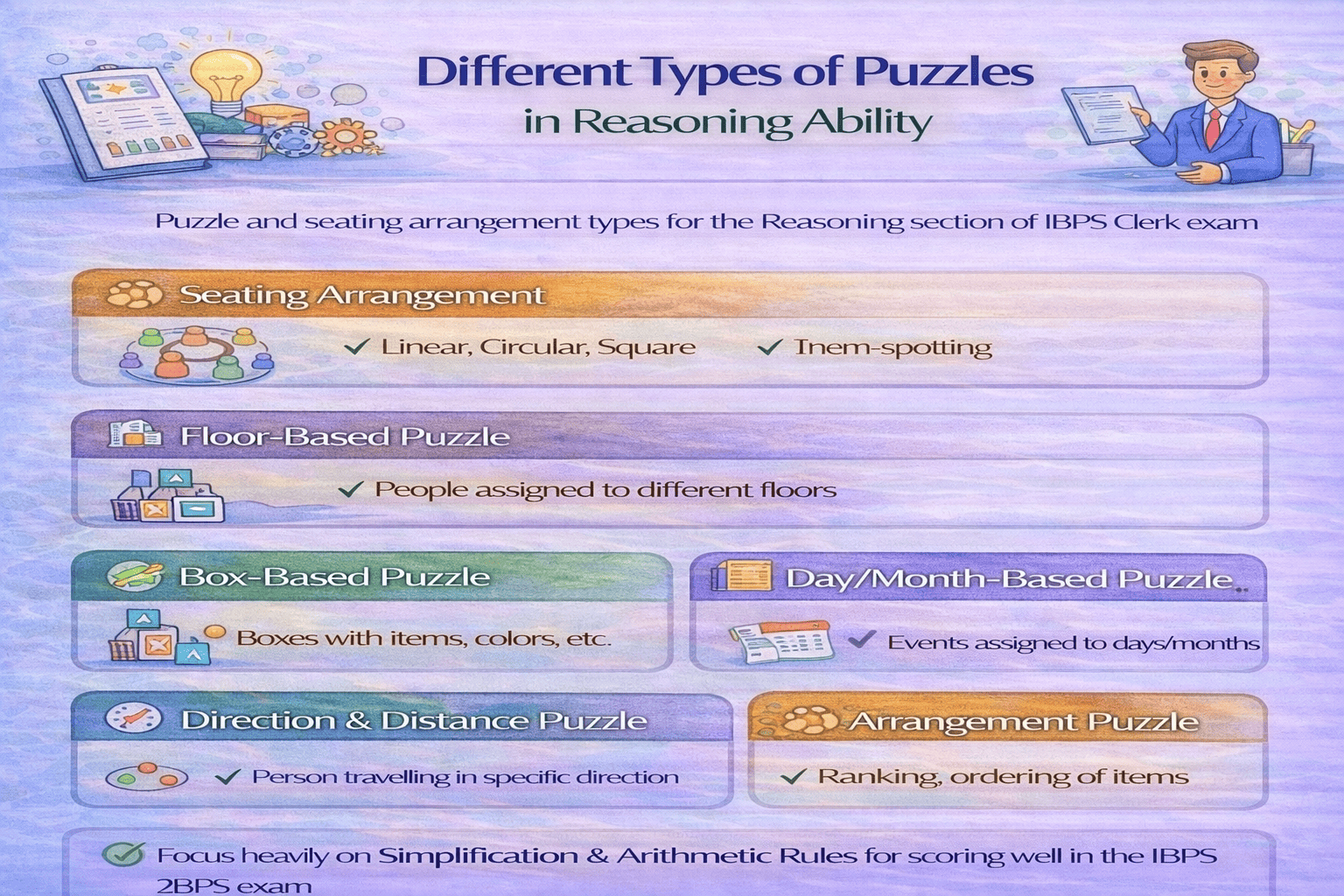
Different Types of Puzzles in Reasoning Ability
Weightage: Topic-Wise Marks Distribution
Understanding the exact weightage of each topic helps you allocate your preparation time wisely. Here’s a detailed breakdown based on recent year trends and PYQ analysis.
A. English Language — Topic Weightage
| Topic | Expected Questions | Percentage of Section | Preparation Priority |
|---|---|---|---|
| Reading Comprehension | 8–10 | 27-33% | Very High |
| Cloze Test | 5–7 | 17-23% | Very High |
| Error Detection | 4–5 | 13-17% | High |
| Para Jumbles | 4–5 | 13-17% | High |
| Fillers | 3–4 | 10-13% | Moderate |
| Vocabulary | 2–3 | 7-10% | Moderate |
B. Numerical Ability — Topic Weightage
| Topic | Expected Questions | Percentage of Section | Preparation Priority |
|---|---|---|---|
| Data Interpretation | 10–12 | 29-34% | Very High |
| Arithmetic | 10–12 | 29-34% | Very High |
| Simplification / Approximation | 5–7 | 14-20% | High |
| Number Series | 4–5 | 11-14% | High |
| Quadratic Equation | 3–5 | 9-14% | Moderate |
| Miscellaneous | 1–2 | 3-6% | Low |
C. Reasoning Ability — Topic Weightage
| Topic | Expected Questions | Percentage of Section | Preparation Priority |
|---|---|---|---|
| Puzzles + Seating | 16–18 | 46-51% | Very High |
| Inequality | 4–5 | 11-14% | High |
| Syllogism | 4–5 | 11-14% | High |
| Series | 3–4 | 9-11% | Moderate |
| Direction Sense | 2–3 | 6-9% | Moderate |
| Blood Relation | 2–3 | 6-9% | Moderate |
| Coding-Decoding | 1–2 | 3-6% | Low |
Most Important Topics (High-Weight Areas)
If you’re short on time or looking for the most efficient preparation strategy, focus on these high-impact topics that consistently appear in every IBPS Clerk Prelims exam.
| Section | Priority Topics | Why Important | Expected Marks |
|---|---|---|---|
| English Language | Reading Comprehension, Cloze Test, Error Detection | Accuracy-based, predictable patterns, covers 60%+ section | 18-22 out of 30 |
| Numerical Ability | Data Interpretation, Arithmetic, Simplification | Covers ~60-70% of questions, formula-based | 22-28 out of 35 |
| Reasoning Ability | Puzzles, Seating Arrangement, Inequality, Syllogism | High scoring + dominant weightage | 24-28 out of 35 |
The 80/20 Rule for IBPS Clerk Prelims
Following the Pareto Principle, 20% of topics contribute to 80% of your score. Here are the absolute must-master topics:
- English: Reading Comprehension (8-10) + Cloze Test (5-6) = 13-16 marks
- Numerical Ability: Data Interpretation (10-12) + Arithmetic (8-10) + Simplification (5-6) = 23-28 marks
- Reasoning: Puzzles & Seating (12-15 attempted with high accuracy) + Inequality (4-5) + Syllogism (4-5) = 20-25 marks
Total from core topics alone: 56-69 marks
Add moderate-scoring topics, and you easily cross 75-80 marks!
Topic-Wise Preparation Strategy
For English Language
- Reading Comprehension: Read 2-3 articles daily from The Hindu, Indian Express (editorials). Practice identifying main ideas, tone, and inference
- Cloze Test: Master basic grammar rules (tenses, prepositions, conjunctions). Solve 5 cloze tests weekly
- Error Detection: Create a grammar error log. Revise Subject-Verb Agreement, Articles, Tenses daily
For Numerical Ability
- Data Interpretation: Practice 3-4 DI sets daily. Master table reading, bar chart interpretation, and quick calculation techniques
- Arithmetic: Memorize all formulas. Solve 10-15 arithmetic questions daily covering all sub-topics in rotation
- Simplification: Speed drills! Solve 20 questions in 10 minutes. Focus on BODMAS and approximation techniques
For Reasoning Ability
- Puzzles & Seating: Solve 2 puzzle sets daily with timer (8-10 minutes per set). Practice different types in rotation
- Inequality: Master the basic rules. Practice 10 inequality questions daily (should take 5 minutes max)
- Syllogism: Learn Venn diagram method + possibility cases. Practice 10 questions daily
Difficulty Level Overview (Recent Trend)
Understanding the difficulty trend helps you set realistic expectations and prepare accordingly. Here’s how the difficulty has evolved in recent IBPS Clerk Prelims exams:
| Section | Difficulty Trend | Time Pressure | Scoring Potential |
|---|---|---|---|
| English Language | Easy → Moderate | Low to Moderate | Very High (22-28/30 possible) |
| Numerical Ability | Moderate → Difficult | High | Moderate (20-26/35 realistic) |
| Reasoning Ability | Moderate → Difficult | Very High | High (24-30/35 if puzzles solved) |
Section-Wise Difficulty Analysis
English Language — Easy to Moderate
English has consistently been the most scoring and time-friendly section in IBPS Clerk Prelims. Most candidates find it manageable and can attempt 25-28 questions with good accuracy.
Numerical Ability — Moderate to Difficult
This section has seen increasing difficulty in recent years. Time management is the biggest challenge here. Simplification and Basic Arithmetic are easy scoring areas, while complex DI sets can be time-consuming.
Reasoning Ability — Moderate to Difficult
Reasoning difficulty heavily depends on the complexity of puzzles. A difficult exam can have 3-4 very complex puzzle sets. One difficult puzzle can consume 12-15 minutes, so strategic selection is crucial.
What to Prioritize for IBPS Clerk Prelims 2026
With limited preparation time and vast syllabus, prioritization is key to success. Here’s your strategic action plan:
Phase 1: Foundation Building (Weeks 1-4)
- Master all arithmetic formulas (write them 10 times each)
- Learn basic grammar rules for English (tenses, SVA, articles)
- Understand puzzle-solving frameworks (how to make tables, use options)
- Practice calculation speed (tables 1-30, squares 1-30, cubes 1-20)
- Build reading habit (30 minutes daily newspaper reading)
Phase 2: Topic-Wise Mastery (Weeks 5-8)
- Solve 100+ DI questions with timer
- Complete 50+ puzzle sets (all types)
- Master high-weight English topics (RC, Cloze, Error)
- Practice topic-wise quizzes daily
- Maintain an error log for mistakes
Phase 3: Speed Building & Mock Tests (Weeks 9-12)
- Take 20-25 full-length mocks in exam conditions
- Analyze every mock thoroughly (2 hours analysis per mock)
- Work on sectional timing (practice completing sections in 18 minutes)
- Revise weak topics identified from mocks
- Practice accuracy improvement techniques
Daily Study Schedule (Recommendation)
For candidates preparing alongside college/job:
| Time Slot | Activity | Duration |
|---|---|---|
| Morning (6:00-7:30 AM) | Numerical Ability practice (DI + Arithmetic) | 90 minutes |
| Afternoon (2:00-3:00 PM) | English Language (RC + Grammar) | 60 minutes |
| Evening (6:00-8:00 PM) | Reasoning Ability (Puzzles + Other topics) | 120 minutes |
| Night (9:00-10:00 PM) | Revision + Error log + Formula practice | 60 minutes |
Common Mistakes to Avoid
Learning from others’ mistakes can save you valuable time and marks. Here are the most common errors IBPS Clerk aspirants make:
Strategic Mistakes
- Starting with DI without warming up – Always begin Numerical Ability with Simplification questions to build momentum
- Spending too long on one difficult puzzle – Set a 7-minute limit; if unsolved, move on
- Attempting all questions blindly – Quality over quantity! 70 correct attempts beat 85 attempts with many errors
- Ignoring sectional cut-offs – Scoring 80/100 but failing in one section still means disqualification
- Not managing time in each section – Practice finishing sections in 18 minutes, leaving 2 minutes buffer
Preparation Mistakes
- Skipping vocabulary & grammar basics – English is the easiest scoring section; don’t neglect it
- Not revising arithmetic formulas regularly – Formulas forgotten = questions unsolvable
- Solving puzzles without timer – Speed building requires timed practice
- Taking mocks without analysis – Mock without 2-hour analysis = wasted effort
Exam Day Mistakes
- Panicking if first section is tough – All three sections are independent; bad English doesn’t mean bad Quant
- Blind guesswork due to negative marking – Only guess if you can eliminate 2+ options
- Changing answers in last 2 minutes – First instinct is usually correct; avoid last-minute changes
- Leaving easy questions for later – Solve easy ones first, they’re guaranteed marks
Frequently Asked Questions (FAQs) — IBPS Clerk Prelims Syllabus 2026
The syllabus itself is not difficult — it covers basic topics. However, the time pressure (20 minutes per section) and increasing competition make it moderately challenging. With consistent practice over 2-3 months, most candidates can score well.
No. The core topics remain the same year after year. However, question patterns, difficulty levels, and the way questions are framed may evolve slightly. IBPS occasionally introduces new question types within existing topics.
This varies by individual strengths, but generally: Numerical Ability is toughest for arts/commerce students due to calculation requirements. Reasoning Ability can be toughest when puzzle difficulty is high. English is usually the easiest for most candidates.
It depends on the exam difficulty and your category. Generally, attempting 70-75 questions with 75-80% accuracy (net score 52-60) gives you a good chance of clearing cut-offs for most categories. General category may need 65-75 marks in competitive years.
Technically yes, but it’s not recommended. Puzzles carry 16-20 questions (nearly 50% of Reasoning section). Skipping them means you must score exceptionally well in other sections to compensate. Better strategy: Master at least 2-3 types of puzzles for selective attempting.
Both are equally important, but develop them in sequence: First build accuracy (Weeks 1-6), then work on speed (Weeks 7-12). Attempting fast with low accuracy is worse than attempting fewer with high accuracy due to negative marking.
Suggested Next Reads
Conclusion
The IBPS Clerk Prelims Syllabus 2026 (CRP-CSA-XVI) is well-defined, predictable, and highly scoring if approached with the right strategy. While the syllabus itself is not vast, the real challenge lies in managing time, maintaining accuracy, and clearing sectional cut-offs under strict exam conditions.
To succeed in IBPS Clerk Prelims, aspirants must focus on mastering high-weight topics like Reading Comprehension, Data Interpretation, and Puzzles, developing speed with accuracy through regular timed practice, following a topic-wise, weightage-based study plan, practicing mock tests consistently and analyzing mistakes deeply, and ensuring sectional cut-offs are never ignored.
Remember, Prelims is a qualifying stage, but clearing it comfortably boosts confidence and sets a strong foundation for Mains preparation. A disciplined 2–3 month preparation window, combined with smart topic prioritization, is more than enough to crack this stage.
- Focus on accuracy first, speed later
- Don’t chase all questions — select smartly
- Revise formulas, grammar rules, and puzzle approaches regularly
- Use mock tests as a learning tool, not just an assessment
- Stay consistent — small daily improvements compound massively