
Last Updated: June 21, 2026
IBPS Customer Service Associate (CSA) Mains Syllabus 2026 (CRP-CSA-XVI) – Topic-wise Syllabus, Weightage, Exam Pattern & Preparation Strategy
Before you start preparing for IBPS Clerk Mains 2026, you need to know exactly what to study and where to focus. This guide breaks down the complete Mains syllabus — section by section, topic by topic, with weightage analysis and preparation strategy — so you can plan your preparation intelligently.
The IBPS CSA Mains examination is the final and most decisive stage of the recruitment process under CRP-CSA-XVI. Unlike the Prelims exam which is purely qualifying, your Mains score directly determines your final merit ranking, bank allotment, and state posting.
This is the stage where your preparation depth, strategic planning, and execution under pressure come together to shape your banking career. With no interview round in the IBPS CSA selection process, the Mains exam carries 100% weightage for final selection.
The exam tests four critical competency areas essential for modern banking operations: General & Financial Awareness, English Language, Reasoning Ability & Computer Aptitude, and Quantitative Aptitude.
This comprehensive guide provides everything you need to master the IBPS CSA Mains Syllabus 2026, including detailed topic-wise breakdowns, expected weightage patterns, difficulty analysis, strategic preparation approaches, and the latest updates on exam pattern.
📘 Table of Contents
- Introduction: Why Mains is the Decisive Stage
- IBPS CSA Mains Exam Overview
- IBPS CSA Mains Exam Pattern 2026
- IBPS CSA Mains Syllabus – Topic-wise & Section-wise
- General / Financial Awareness
- English Language
- Reasoning Ability & Computer Aptitude
- Quantitative Aptitude
- Topic-wise Weightage Analysis
- Difficulty Level & PYQ Trends
- High-Weight & Scoring Topics
- Section-wise Preparation Strategy
- Common Mistakes to Avoid
- Frequently Asked Questions
- Suggested Next Reads
- Conclusion
⚡ Quick Summary — IBPS CSA Mains Syllabus 2026
- Total Questions: 155
- Total Marks: 200
- Duration: 120 minutes (2 hours) with sectional timing
- Sections: 4 (General Awareness, English, Reasoning + Computer, Quantitative Aptitude)
- Negative Marking: –0.25 per wrong answer
- Nature: Merit-based (100% weightage for final selection)
- Interview: No interview for IBPS CSA
- Key Focus Areas: General Awareness, Puzzles, Data Interpretation, Banking Awareness
Introduction: Why Mains is the Decisive Stage of Your IBPS Clerk Journey
The IBPS Clerk Mains examination is not just another test — it’s the stage that determines your entire banking career. Unlike Prelims which is purely qualifying, your Mains score carries 100% weightage in the final selection process. There is no interview for the Customer Service Associate position, which means your written exam performance alone decides your bank allotment and posting state.
Every year, thousands of candidates who clear Prelims with ease find themselves struggling in Mains because they underestimate the jump in difficulty and syllabus breadth. The Mains exam tests deeper conceptual understanding, broader knowledge areas, and better time management skills.
This comprehensive guide covers the complete IBPS CSA Mains syllabus for 2026, including section-wise topic breakdown, weightage analysis, difficulty trends, and strategic preparation tips to help you maximize your score and secure a top rank.
IBPS CSA Mains Exam Overview
Before diving into the detailed syllabus, let’s understand the fundamental characteristics of the IBPS CSA Mains examination:
Key Examination Characteristics
| Aspect | Details |
|---|---|
| Exam Mode | Online Computer-Based Test (CBT) |
| Question Type | Objective Multiple Choice Questions (MCQs) |
| Timing System | Sectional timing strictly enforced (cannot switch between sections) |
| Language Options | English, Hindi, and 13 regional languages (except English Language section) |
| Selection Impact | 100% weightage – Mains score alone determines final merit |
| Interview Round | No interview for IBPS CSA position |
Why Mains is More Challenging Than Prelims
| Factor | Prelims | Mains |
|---|---|---|
| Sections Tested | 3 sections | 4 sections |
| Syllabus Breadth | Limited topics | Comprehensive coverage with deeper concepts |
| General Awareness | Not tested | 50 marks (highest individual weightage) |
| Computer Knowledge | Not tested | Tested within Reasoning section |
| Difficulty Level | Moderate | Moderate to Difficult |
- General Awareness mastery is non-negotiable – It’s the highest-scoring section and easiest to prepare with consistent reading
- Computer Aptitude cannot be ignored – Basic but scoring; quick revision topic
- Sectional balance is crucial – Weakness in any one section can pull down overall merit
- Current affairs window is 6 months – Focus on banking, economic, and significant national/international events
- Mock test analysis is more important than quantity – Quality practice with detailed review beats random attempts
IBPS CSA Mains Exam Pattern 2026
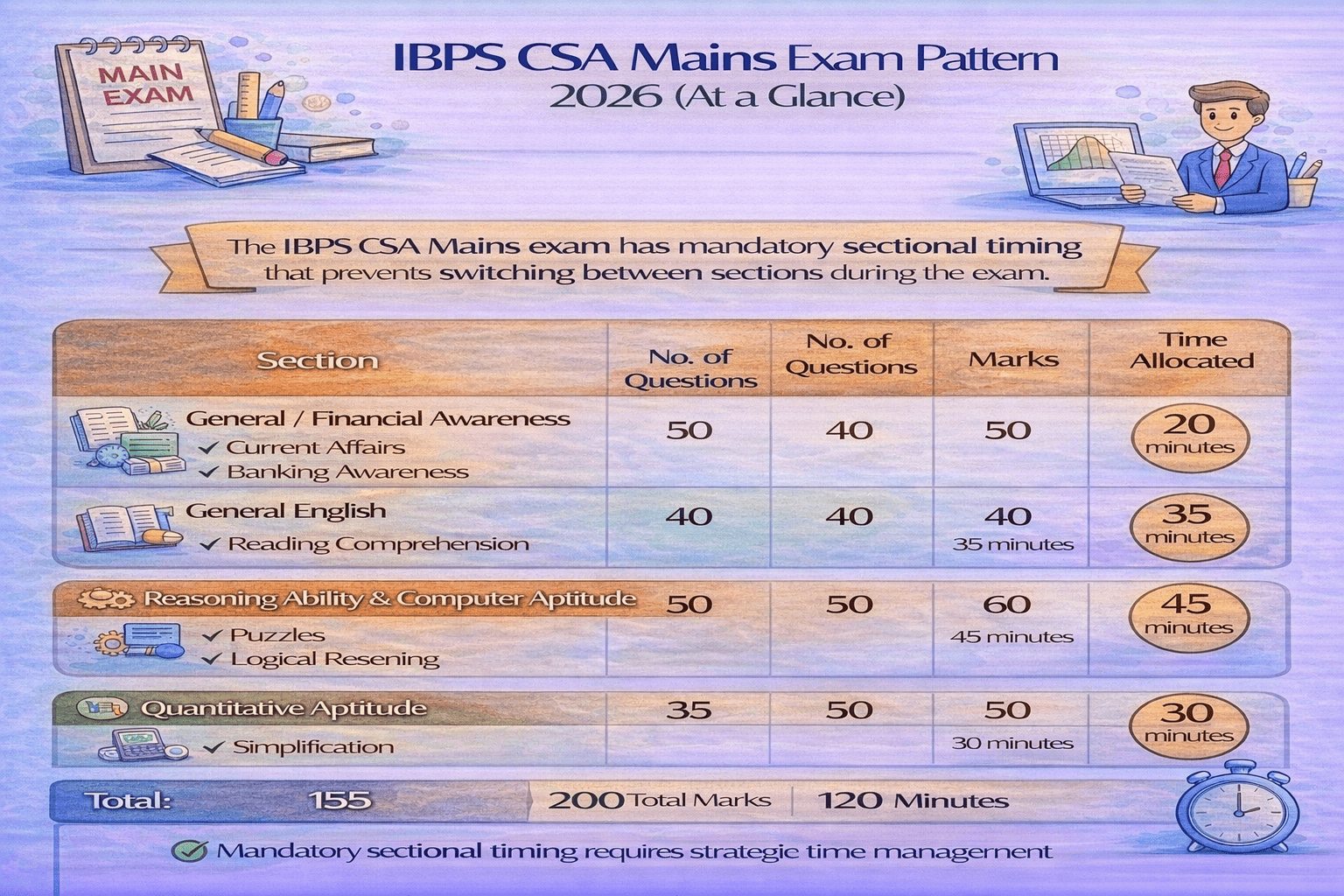
The IBPS CSA Mains exam follows a structured pattern with four distinct sections, each with designated timing and marking scheme. Understanding this pattern is the foundation of smart preparation.
Complete Exam Pattern Structure
| Section | No. of Questions | Maximum Marks | Time Allocated |
|---|---|---|---|
| General / Financial Awareness | 40 | 50 | 20 minutes |
| English Language | 40 | 40 | 35 minutes |
| Reasoning Ability & Computer Aptitude | 40 | 60 | 35 minutes |
| Quantitative Aptitude | 35 | 50 | 30 minutes |
| Total | 155 | 200 | 120 minutes |
Understanding the Marks Distribution
Notice that the number of questions and marks are NOT equal in all sections. This is strategically designed:
| Section | Marks per Question | Observation |
|---|---|---|
| General Awareness | 1.25 marks | Highest per-question weightage – Most valuable section |
| Reasoning & Computer | 1.5 marks | Highest overall weightage (60 marks total) |
| Quantitative Aptitude | ~1.43 marks | High value per question |
| English Language | 1 mark | Standard marking (1 mark = 1 question) |
Marking Scheme Details
| Response Type | Marks Impact | Strategic Consideration |
|---|---|---|
| Correct Answer | +1 to +1.5 marks (section-dependent) | Focus on high-weightage sections for maximum gain |
| Wrong Answer | –0.25 marks | Same penalty across all sections – random guessing not advisable |
| Unattempted | 0 marks | Better to skip than guess blindly |
Sectional Timing Enforcement
Similar to Prelims, Mains follows mandatory sectional timing with these specific rules:
- Each section has a fixed time allocation that starts automatically
- You CANNOT move to the next section before your current section’s time expires
- You CANNOT return to previous sections once their time ends
- The system auto-submits and locks each section when time runs out
- General Awareness (20 mins for 40 Qs): 30 seconds per question – Fastest section if prepared well
- English Language (35 mins for 40 Qs): ~52 seconds per question – Comfortable for most candidates
- Reasoning & Computer (35 mins for 40 Qs): ~52 seconds per question – Puzzles need 5-7 minutes, balance for others
- Quantitative Aptitude (30 mins for 35 Qs): ~51 seconds per question – Most time-pressured section
IBPS CSA Mains Exam Pattern 2026
IBPS CSA Mains Syllabus – Topic-wise & Section-wise
Now let’s dive deep into each section’s syllabus with comprehensive topic coverage, expected weightage, difficulty analysis, and preparation priorities.
1. General / Financial Awareness (40 Questions | 50 Marks)
Difficulty Level: Easy to Moderate
Time Allocated: 20 minutes
Focus Areas: Banking awareness + Current affairs of last 6 months
Per Question Marks: 1.25 (highest individual weightage)
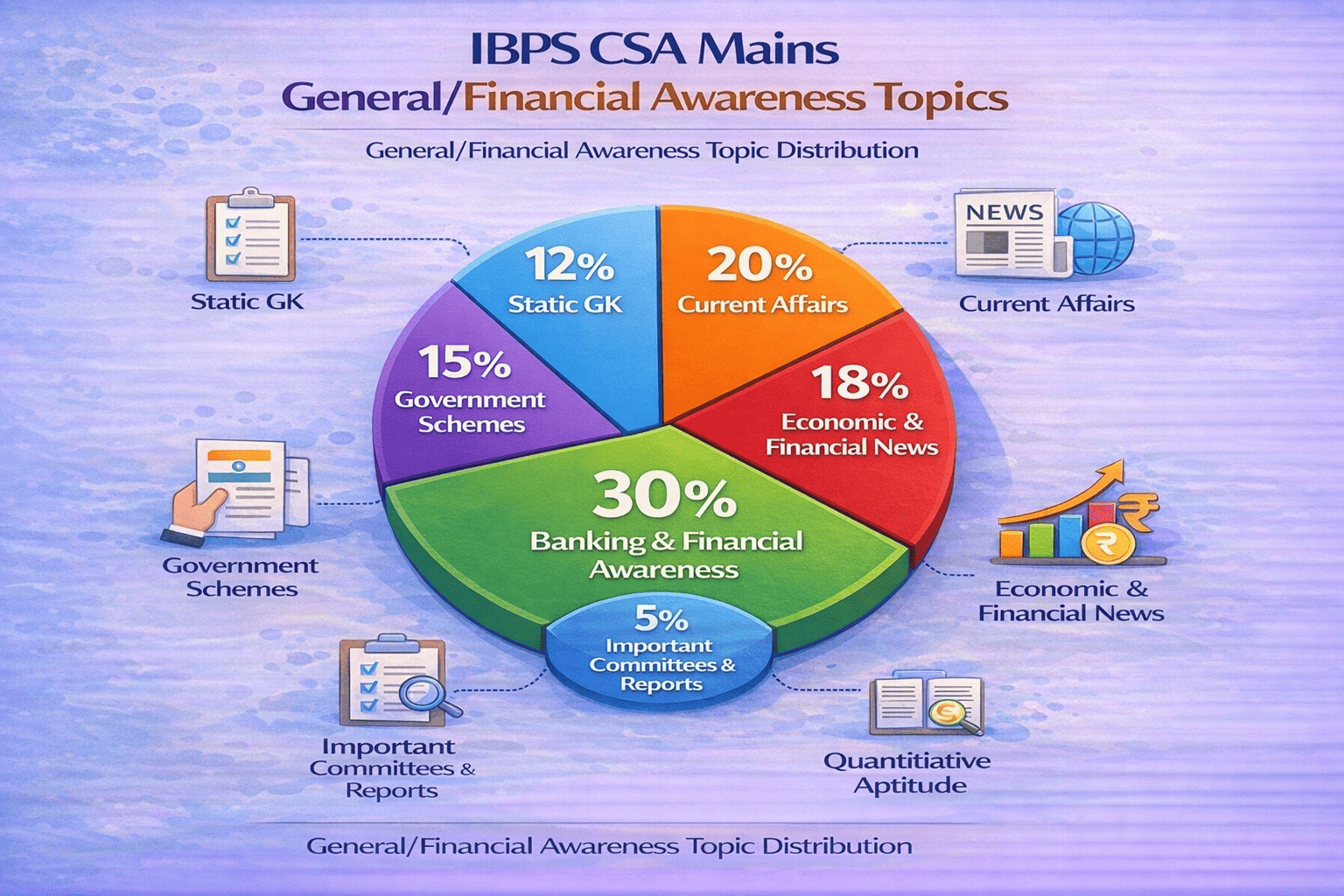
General Awareness is the most scoring section in IBPS CSA Mains and often becomes the differentiator between selected and non-selected candidates at similar score levels. This section tests your awareness of current national and international events, banking sector developments and policies, financial and economic terminology, government initiatives and schemes, and static general knowledge relevant to banking.
Complete Topic-wise Syllabus
| Topic Category | Specific Coverage | Expected Questions |
|---|---|---|
| Current Affairs | National news and events, International developments, Sports achievements, Awards and honors, Books and authors, Appointments and resignations, Important dates and days | 20–22 |
| Banking & Financial Awareness | RBI policies and announcements, Monetary Policy decisions, Repo rate, CRR, SLR changes, Banking sector reforms, Digital banking initiatives, Payment systems (UPI, RTGS, NEFT, IMPS), Banking regulations, Merger and acquisition news, NPAs and asset quality trends | 12–14 |
| Budget & Economic Survey | Union Budget highlights, Economic Survey key findings, GDP growth estimates, Inflation trends, Fiscal deficit targets | 3–4 |
| Government Schemes | Welfare schemes, Subsidy programs, Skill development initiatives, Digital India programs, Financial inclusion schemes | 3–4 |
| Financial Institutions | RBI, SEBI, IRDAI, NABARD, SIDBI, EXIM Bank functions | 2–3 |
| Static Banking GK | Types of banks, Banking terminology (CASA, MCLR, Base Rate), Loan types, Priority sector lending, Banking committees | 2–3 |
- Daily habit: Spend 30-40 minutes daily reading financial newspapers
- Banking focus: Subscribe to RBI’s press releases and monetary policy statements
- Monthly consolidation: Use monthly current affairs PDFs from reliable sources
- Static GK integration: While reading current events, note related static facts
- Target 35-38 correct attempts: This section should be your highest accuracy zone (85-90%)
General Awareness Topic Distribution
2. English Language (40 Questions | 40 Marks)
Difficulty Level: Easy to Moderate
Time Allocated: 35 minutes
Focus Areas: Reading comprehension + Grammar accuracy + Vocabulary
Per Question Marks: 1.0
The English Language section in Mains is more comprehensive than Prelims, with longer reading passages and more nuanced grammar questions. However, it remains one of the more predictable sections where consistent practice yields consistent scores.
Complete Topic-wise Syllabus
| Topic | Question Types | Expected Questions | Difficulty |
|---|---|---|---|
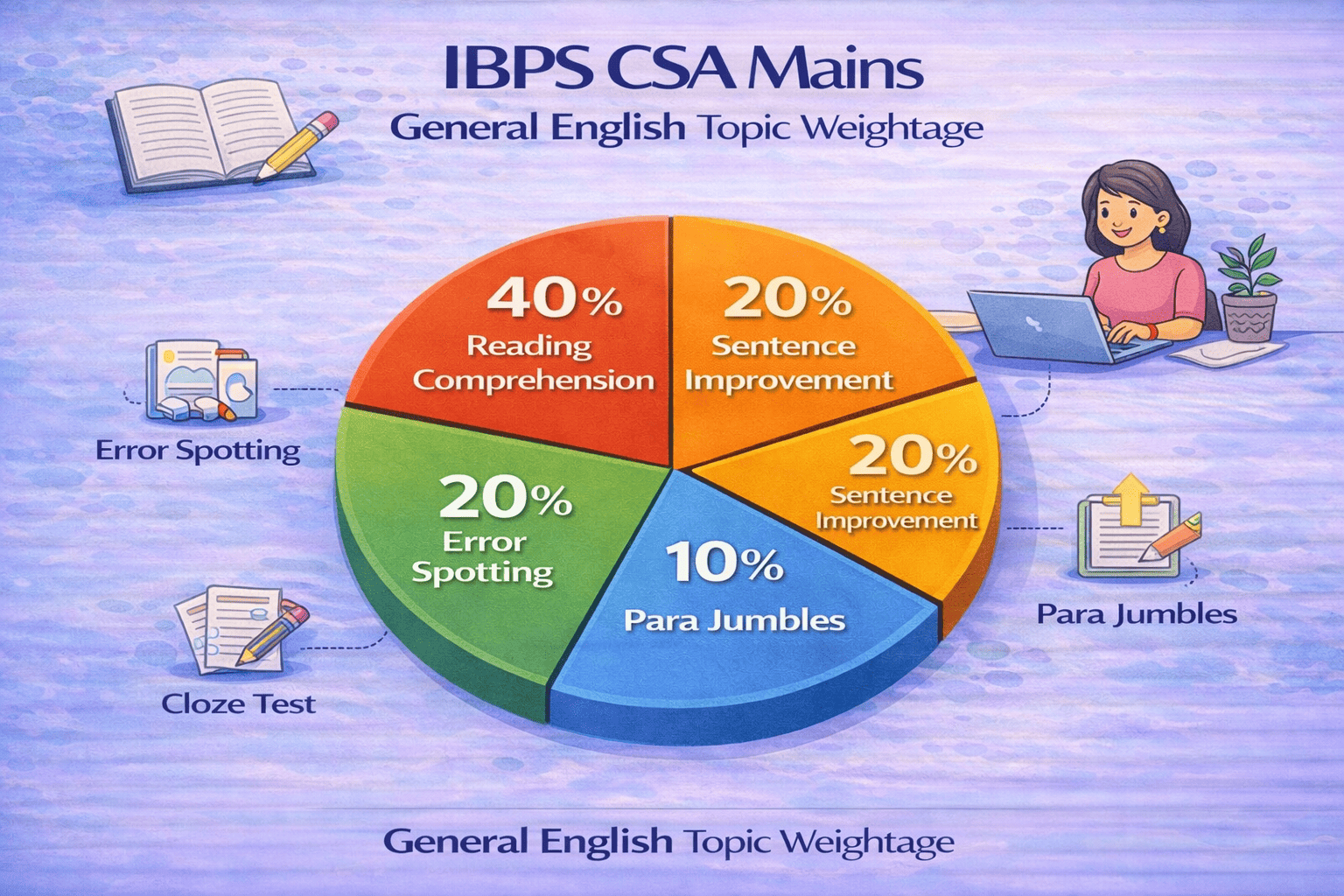
| Reading Comprehension | Main idea/theme identification, Inference questions, Author’s tone, Vocabulary in context, Fact-based questions | 8–10 | Moderate |
| Cloze Test | Context-based word selection, Grammar-appropriate fills, Logical flow maintenance | 6–8 | Easy → Moderate |
| Error Detection / Sentence Correction | Subject-verb agreement, Tense consistency, Preposition errors, Article usage, Pronoun errors | 5–7 | Easy → Moderate |
| Para Jumbles | Logical sequence identification, Connector word recognition, Coherent paragraph formation | 4–5 | Moderate |
| Sentence Improvement | Replace underlined portion, Better phrasing options, Grammatical correction | 3–4 | Moderate |
| Fill in the Blanks | Single blank (grammar/vocabulary), Double blanks, Phrase replacement | 4–5 | Easy → Moderate |
| Vocabulary | Synonyms, Antonyms, Idioms and phrases, Word usage | 3–4 | Easy → Moderate |
- Start with Error Detection (5 mins): Quick scoring, builds confidence
- Attempt RC in the middle (10-12 mins): When you’re most focused
- Cloze Test next (6-7 mins): Context-based, manageable if RC done well
- Para Jumbles (4-5 mins): Identify opening/closing sentences first
- Target 32-36 correct attempts: 80-90% accuracy achievable with practice
English Language Topic Distribution
3. Reasoning Ability & Computer Aptitude (40 Questions | 60 Marks)
Difficulty Level: Moderate to Difficult
Time Allocated: 35 minutes
Focus Areas: Complex puzzles + Computer fundamentals
Per Question Marks: 1.5 (highest total section weightage)
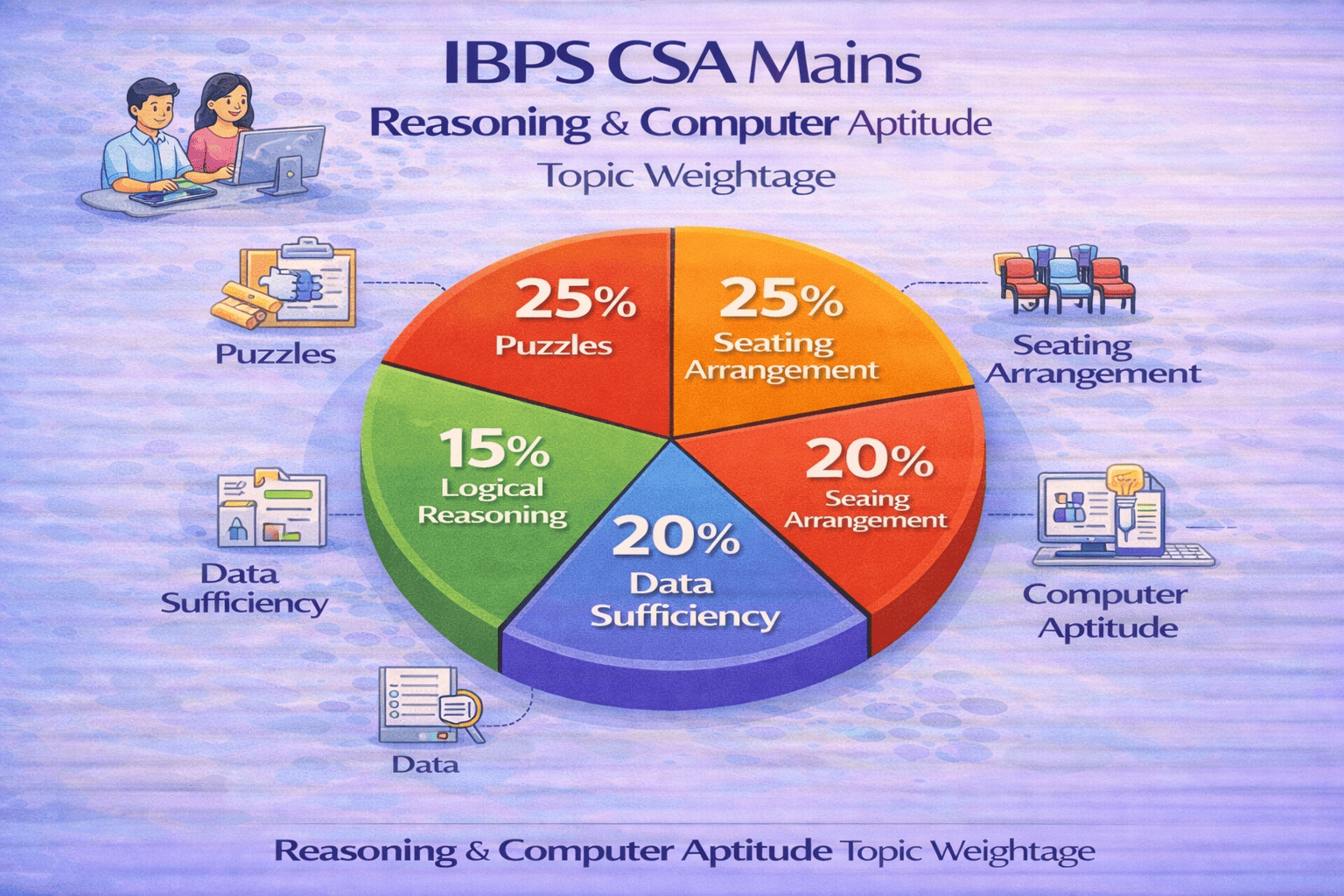
This is the highest-scoring section by total marks (60 marks), making it critically important for final merit. However, it’s also time-intensive due to complex puzzle sets.
Complete Reasoning Topics Syllabus
| Reasoning Topic | Sub-topics / Question Types | Expected Questions | Difficulty |
|---|---|---|---|
| Puzzles & Seating Arrangement | Linear seating, Circular seating, Floor-based puzzles, Box-based arrangements, Scheduling puzzles, Mixed variable puzzles | 18–20 | Moderate → Difficult |
| Syllogism | Statement-conclusion based, All/Some/No patterns, Either-or cases, Possibility-based conclusions | 4–5 | Easy → Moderate |
| Inequality | Coded inequality, Direct conclusions, Combined statements | 3–4 | Easy |
| Input-Output | Number arrangement patterns, Word + number rearrangement, Step-wise operations | 3–5 | Moderate |
| Blood Relations | Direct relationship identification, Coded relationships, Generation-based questions | 2–3 | Moderate |
| Direction Sense | Finding final direction, Shortest distance calculation, Turning-based questions | 2–3 | Easy → Moderate |
| Coding-Decoding | Letter shifting patterns, Number codes, Mixed coding | 1–2 | Easy → Moderate |
Complete Computer Aptitude Topics Syllabus
| Computer Topic | Coverage Areas | Expected Questions |
|---|---|---|
| Basics of Computer System | Input, output, processing units, Primary vs secondary memory, RAM, ROM, Storage devices | 1–2 |
| Internet & Networking | Internet basics, Email protocols, Network types (LAN, WAN, MAN), IP addresses, Cloud computing basics | 1–2 |
| MS Office | MS Word features, MS Excel formulas, MS PowerPoint basics, File formats | 1 |
| Cyber Security & Digital Banking | Virus, malware, phishing, Encryption, Two-factor authentication, UPI, RTGS, NEFT, IMPS, Mobile banking security | 1–2 |
| Number Systems | Binary, octal, hexadecimal, Conversions between systems | 0–1 |
- Start with Syllogism & Inequality (5-6 mins): Formula-based, high accuracy
- Computer Aptitude next (3-4 mins): Factual recall, quick scoring
- Scan all puzzle sets (2 mins): Identify which looks easiest
- Solve ONE complete puzzle set (7-8 mins): Get 5 questions from this
- Target 25-30 correct attempts: Don’t chase all 40 questions
- Never spend more than 8 minutes on any single puzzle: Time discipline is critical
Reasoning & Computer Aptitude Topic Distribution
4. Quantitative Aptitude (35 Questions | 50 Marks)
Difficulty Level: Moderate
Time Allocated: 30 minutes
Focus Areas: Data Interpretation + Arithmetic
Per Question Marks: ~1.43
Quantitative Aptitude in Mains has higher conceptual depth compared to Prelims Numerical Ability. Questions are designed to test both calculation speed and conceptual understanding.
Complete Topic-wise Syllabus
| Topic | Sub-topics | Expected Questions | Priority |
|---|---|---|---|
| Data Interpretation | Table DI, Bar Graph, Line Chart, Pie Chart, Mixed Charts, Caselet DI | 12–14 | Very High |
| Arithmetic | Percentage, Profit & Loss, Simple & Compound Interest, Time-Speed-Distance, Time & Work, Ratio & Proportion, Averages, Mixture & Alligation | 10–12 | Very High |
| Simplification / Approximation | BODMAS calculations, Square roots and cube roots, Approximation techniques | 5–6 | High |
| Number Series | Missing number identification, Wrong number identification, Pattern recognition | 4–5 | High |
| Quadratic Equations | Solving quadratic equations, Comparison of roots | 2–3 | Moderate |
- Start with Simplification (4-5 mins): Build confidence, quick scoring
- Quadratic Equations next (2-3 mins): Formula-based, high accuracy
- Attempt ONE DI set completely (6-7 mins): Choose the easier-looking set
- Number Series (3-4 mins): If pattern is visible, solve; else skip
- Target 22-28 correct attempts: 65-80% accuracy is realistic
- Use approximation aggressively: Exact calculation wastes time
Topic-wise Weightage Summary
Here’s a consolidated view of high-weightage topics across all sections that should be your preparation priorities:
| Section | High-Weight Topics (Priority 1) | Medium-Weight Topics (Priority 2) |
|---|---|---|
| General Awareness | Current Affairs (Last 6 months), Banking & Financial Awareness, RBI Policies | Government Schemes, Static Banking GK, Budget & Economic Survey |
| English Language | Reading Comprehension, Cloze Test, Error Detection | Para Jumbles, Fill in the Blanks, Vocabulary |
| Reasoning & Computer | Puzzles & Seating Arrangement, Syllogism, Inequality | Input-Output, Computer Basics, Blood Relations |
| Quantitative Aptitude | Data Interpretation, Arithmetic, Simplification | Number Series, Quadratic Equations |
Difficulty Level & PYQ Trends
Analyzing previous year question patterns is essential to understand how the IBPS CSA Mains exam has evolved. While the overall structure remains stable, the depth of questions and focus areas have gradually shifted toward analytical thinking and banking relevance.
| Section | Overall Difficulty | Trend Observed | Key Insight |
|---|---|---|---|
| General Awareness | Easy → Moderate | Banking-focused CA increasing | Pure static GK declining, current banking news dominant |
| English Language | Moderate | RC length increasing | Vocabulary is contextual rather than direct |
| Reasoning & Computer | Moderate → Difficult | Complex puzzles rising | 1 hard puzzle can consume 10+ minutes |
| Quantitative Aptitude | Moderate | DI more calculation-heavy | Arithmetic is multi-concept based |
High-Weight & Scoring Topics
Focusing on high-weight topics significantly improves your chances of scoring well in IBPS CSA Mains. These areas consistently contribute 60–70% of total marks.
| Section | Most Scoring Topics | Why Important |
|---|---|---|
| General Awareness | Banking CA, RBI Updates, Current Affairs | Direct questions, fastest to attempt |
| English | Reading Comprehension, Cloze Test | Predictable pattern, high accuracy |
| Reasoning | Puzzles, Syllogism, Inequality | High marks per question |
| Quantitative Aptitude | DI, Arithmetic, Simplification | High return if attempted selectively |
Section-wise Preparation Strategy
General Awareness
- Revise last 6 months of current affairs daily
- Focus heavily on banking & financial news
- Attempt GA quizzes weekly
English Language
- Read editorials daily (economy & banking focused)
- Practice RC under timed conditions
- Revise grammar rules weekly
Reasoning & Computer
- Practice 1–2 puzzle sets daily
- Revise syllogism & inequality formulas
- Study digital banking & cyber security basics
Quantitative Aptitude
- Strengthen arithmetic fundamentals
- Practice DI with approximation
- Focus on speed, not perfection
Common Mistakes to Avoid
- Ignoring General Awareness till the last moment
- Attempting all puzzle sets blindly
- Over-attempting Quant with low accuracy
- Not analyzing mock tests
- Underestimating Computer Aptitude
- Failing sectional cut-offs due to imbalance
Frequently Asked Questions (FAQs) – IBPS CSA Mains Syllabus 2026
Yes. IBPS CSA Mains is the final and decisive stage of the recruitment process. There is no interview for the Customer Service Associate post. Your final selection, bank allotment, and state posting are based entirely on your Mains score.
Reasoning Ability & Computer Aptitude carries the highest total weightage of 60 marks. However, General Awareness is often considered the most scoring section due to direct questions and faster attempt speed.
Candidates should prepare at least the last 6 months of current affairs, with special focus on banking, economy, RBI notifications, government schemes, and financial news relevant to the exam year.
Yes. IBPS CSA Mains has both sectional cut-offs and an overall cut-off. You must clear the minimum qualifying marks in each section as well as the total score cut-off to be considered for final selection.
No. Computer questions are generally basic and practical in nature. Topics like digital banking, cyber security, internet basics, MS Office, and payment systems are commonly asked and can be scored easily with focused revision.
The Quant section is moderately difficult and time-consuming. It focuses heavily on Data Interpretation and multi-step arithmetic problems. Speed, approximation skills, and smart question selection are crucial.
Suggested Next Reads
Conclusion
IBPS CSA Mains 2026 is a high-stakes, merit-based examination where strategy matters as much as knowledge. With no interview stage, your Mains score alone defines your banking career entry.
Success lies in mastering General Awareness, selecting puzzles wisely, managing time in Quant, and maintaining balance across all sections. Focus on high-return topics, analyze mocks deeply, and stay consistent.
With disciplined preparation and smart execution, IBPS CSA Mains can be cracked — even in the first attempt.
- Understand the Mains syllabus thoroughly before starting preparation
- Prioritize high-weight topics — General Awareness, Puzzles, DI, and Banking Awareness
- Master sectional timing through mock tests
- Computer Aptitude is scoring — don’t neglect it
- IBPS CSA Mains is achievable with the right strategy and consistent effort