
Last Updated: June 21, 2026
IBPS Clerk(CSA) Selection Process 2026: Prelims → Mains → Language Test (No Interview)
Before you start preparing for IBPS Clerk 2026, you need to understand the complete selection process. This guide breaks down every stage — Prelims, Mains, Language Proficiency Test, normalisation, and final allotment — so you know exactly what to expect at each step.
The IBPS Clerk exam, officially renamed as Customer Service Associate (CSA) recruitment, is one of the most popular government bank exams in India. With lakhs of aspirants competing every year for clerical positions in public sector banks, understanding the selection process is absolutely critical for success.
What makes IBPS Clerk highly attractive for aspirants is that there is no interview stage — purely exam-based selection, transparent merit-based recruitment process, entry-level role with stable salary and fixed working hours, nationwide recruitment across 11 Public Sector Banks, and excellent career growth opportunities.
The IBPS Clerk Selection Process 2026 follows a two-exam + qualifying language test system. Unlike other government exams, there is absolutely no personality test or interview involved — making it one of the most straightforward recruitment processes in the banking sector.
This comprehensive article explains each stage clearly — from Prelims to final selection — using the latest 2026 exam updates, including the revised Mains exam pattern and expected transparency reforms.
📘 Table of Contents
- Introduction: Why Understanding the Selection Process Matters
- IBPS Clerk Selection Process Overview
- Stage 1: IBPS Clerk Prelims Exam
- Exam Pattern
- Marking Scheme
- Cut-off Rules
- Stage 2: IBPS Clerk Mains Exam (Updated Pattern – 2026)
- Exam Pattern
- Marking Scheme
- Cut-off Rules
- Local Language Proficiency Test (LPT)
- Normalisation Process in IBPS Clerk Exam
- Transparency Reforms (New Update for 2026)
- Documents Required During Final Verification
- Frequently Asked Questions
- Suggested Next Reads
- Conclusion
⚡ Quick Summary — IBPS Clerk Selection Process 2026
- IBPS Clerk selection has NO interview
- Selection stages: Prelims → Mains → Language Proficiency Test (if applicable)
- Prelims is qualifying only – marks not counted in final merit
- Final merit is based on Mains marks only
- Mains exam pattern revised in 2026 (155 questions, 200 marks)
- Normalisation applies due to multiple shifts
- Local Language Proficiency Test (LPT) is mandatory if you didn’t study the local language in Class 10/12
- Expected response sheets & answer keys to be released for transparency
Introduction: Why Understanding the Selection Process Matters Before You Start Preparing
The IBPS Clerk exam is one of India’s most popular government bank recruitment exams, with over 15-20 lakh aspirants applying for approximately 12,000-18,000 positions each year. The selection process is designed to be fair, transparent, and merit-based. Unlike PO recruitment which includes an interview, the Clerk selection is purely examination-based.
Many candidates make the mistake of preparing without understanding the selection process fully. They focus only on Prelims, assuming that clearing it is enough. But the reality is that Prelims is just the first filter — your final selection depends almost entirely on your Mains performance.
This comprehensive guide covers the complete IBPS Clerk selection process for 2026, including detailed exam patterns, marking schemes, sectional timing rules, cut-off requirements, normalisation process, language proficiency test, and document verification. Whether you’re a first-time aspirant or a repeater, understanding the selection process will help you prepare strategically and maximize your chances of success.
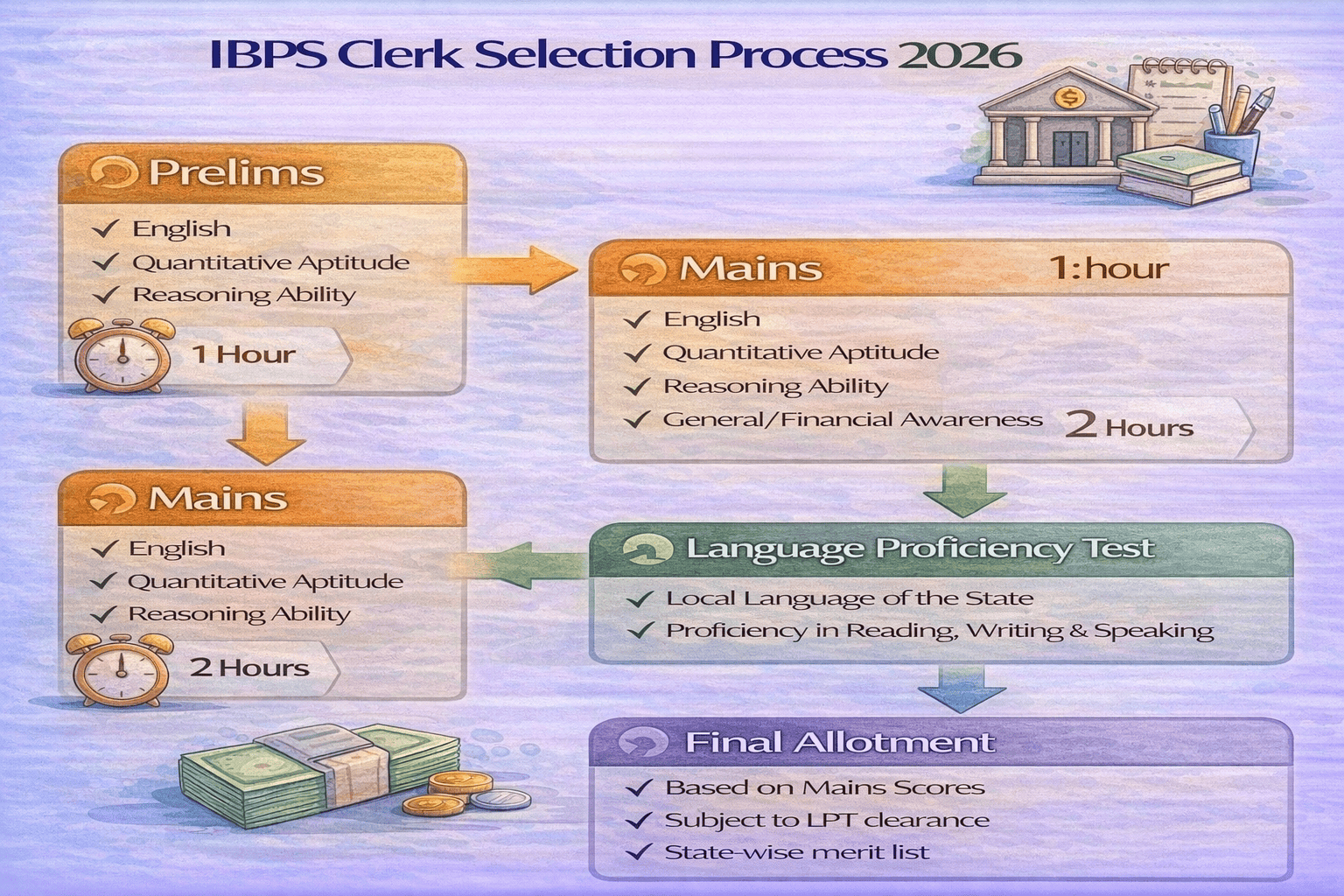
IBPS CSA Clerk Selection Process 2026
IBPS Clerk Selection Process Overview
The IBPS Clerk selection process is designed to be fair, transparent, and merit-based. Unlike PO recruitment which includes an interview, the Clerk selection is purely examination-based.
- Prelims marks are NOT counted in the final merit list
- The Prelims exam is only a screening/qualifying test
- Your final selection depends entirely on your Mains exam performance
Complete Selection Timeline
| Stage | Purpose | Impact on Final Selection |
|---|---|---|
| Prelims Exam | Screening test to shortlist candidates for Mains | Qualifying only (marks NOT counted) |
| Mains Exam | Decides final merit & bank allotment | 100% weightage for final merit |
| Local Language Proficiency Test (LPT) | Qualifying (only if applicable) | Must pass (marks not counted) |
| Final Selection | Based on Mains score only | Merit list prepared |
How Selection Works – Step by Step
Here’s how the complete process flows:
- Apply Online → Fill application form, pay fees, upload documents
- Appear for Prelims → Qualify sectional & overall cut-offs
- Shortlisted for Mains → Based on Prelims performance
- Appear for Mains → This score decides your final rank
- LPT (if required) → Qualifying language test
- Provisional Allotment → Bank allocation based on merit & preference
- Document Verification → Submit all required documents
- Final Appointment → Joining letter issued by the allotted bank
Stage 1 — IBPS Clerk Prelims Exam
The Prelims exam acts as a qualifying filter. Its primary purpose is to screen candidates and reduce the number of applicants who will appear for the Mains exam. Remember: Prelims marks are NOT added to your final result.
1. IBPS Clerk Prelims Exam Pattern
The Prelims exam is conducted online (computer-based test) and has sectional timing, meaning you cannot switch between sections during the exam.
| Section | Questions | Marks | Time Allocated |
|---|---|---|---|
| English Language | 30 | 30 | 20 minutes |
| Numerical Ability | 35 | 35 | 20 minutes |
| Reasoning Ability | 35 | 35 | 20 minutes |
| Total | 100 | 100 | 60 minutes |
- Sectional timing is mandatory – you get exactly 20 minutes for each section
- No switching between sections – once time for a section is over, you move to the next
- All questions are MCQs (Multiple Choice Questions)
- Conducted in multiple shifts across different dates
- Language options: English & Hindi (except for English Language section)
2. Marking Scheme (Prelims)
Understanding the marking scheme is crucial for exam strategy:
- +1 mark for each correct answer
- –0.25 mark for each wrong answer (negative marking)
- No penalty for unattempted questions
3. Cut-off Rules (Prelims)
To qualify for the Mains exam, candidates must clear two types of cut-offs:
- Sectional Cut-off: Minimum marks required in each individual section
- Overall Cut-off: Minimum total marks required across all sections
Both cut-offs must be cleared simultaneously. Even if you score very high overall but fail to meet the sectional cut-off in one section, you will not qualify for Mains.
How Many Candidates Qualify for Mains?
IBPS shortlists candidates for Mains exam in the ratio of approximately 10-20 times the number of vacancies (varies by state/category). For example, if 1000 vacancies exist, around 10,000-20,000 candidates may be called for Mains.
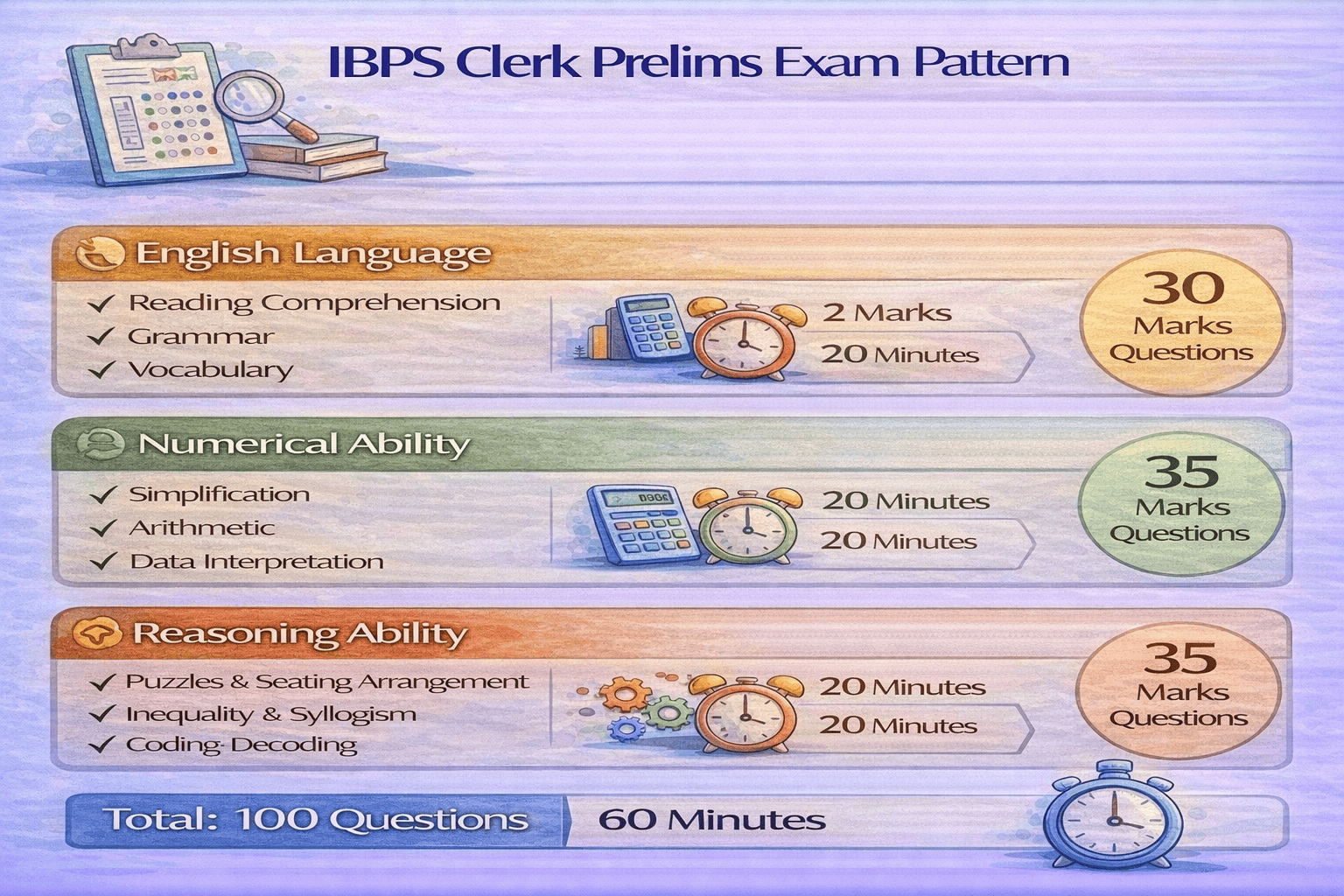
IBPS CSA Clerk Prelims Exam Pattern
Stage 2 — IBPS Clerk Mains Exam (Updated Pattern – 2026)
The Mains exam is the most important stage of IBPS Clerk selection, as it alone determines your final merit list ranking and bank allotment. Your performance here decides whether you get selected and which bank you’re allocated to.
2026 Update: Revised Mains Exam Pattern (CRP-CSA-XVI)
IBPS has made significant changes to the Mains exam pattern for 2026. The total number of questions has been reduced from 190 to 155 to improve exam efficiency and reduce candidate fatigue.
| Section | Questions | Marks | Time Allocated |
|---|---|---|---|
| General / Financial Awareness | 40 | 50 | 25 minutes |
| General English | 40 | 40 | 35 minutes |
| Reasoning Ability & Computer Aptitude | 40 | 60 | 35 minutes |
| Quantitative Aptitude | 35 | 50 | 30 minutes |
| Total | 155 | 200 | 160 mins (2h 40m) |
Key Changes in IBPS Clerk Mains 2026
- No Descriptive Paper – Unlike previous years, there’s no essay/letter writing section
- Reduced exam duration – From 190 questions to 155 questions
- Increased focus on GA & Reasoning – Higher marks allocation
- Computer Aptitude merged with Reasoning – Combined section
- All objective questions – No typing required
Comparison: Old vs New Mains Pattern
| Feature | Old Pattern (Till 2025) | New Pattern (2026) |
|---|---|---|
| Total Questions | 190 | 155 |
| Total Marks | 200 | 200 |
| Descriptive Paper | Yes (Letter + Essay) | No |
| Duration | 160 minutes + 30 mins (Descriptive) | 160 minutes |
Marking Scheme (Mains)
The marking pattern for Mains exam is:
- Objective questions only – All MCQ format
- –0.25 negative marking for wrong answers
- Normalisation applied due to multiple shifts
- No minimum sectional marks required (may vary year-wise)
Cut-off Rules (Mains)
Candidates must clear the overall cut-off to be considered for final selection. Unlike Prelims, sectional cut-offs may or may not be applicable in Mains (IBPS decides this based on the year).
How Final Merit List is Prepared
The final selection process works as follows:
- Candidates are ranked based on Mains exam scores only
- Category-wise merit lists are prepared (General, SC, ST, OBC, EWS, PwBD)
- State-wise allocation is done based on your merit rank, your state/bank preferences, and vacancy availability
- Provisional allotment letters are issued
- Document verification is conducted
- Final appointment letters are issued by respective banks

IBPS CSA Clerk Mains Exam Pattern 2026
Local Language Proficiency Test (LPT)
Although IBPS Clerk recruitment has no interview, a Language Proficiency Test (LPT) is mandatory for certain candidates. This is a qualifying test that doesn’t contribute to your final score but must be cleared to complete the selection process.
What is Local Language Proficiency Test?
LPT is a test conducted to verify that the candidate can read, write, and speak the official language of the state/union territory where they have applied for posting. Since clerical positions involve direct customer interaction, language proficiency is essential.
Who Must Appear for LPT?
Language Proficiency Test is mandatory ONLY for candidates who did not study the local/official language of the applied State/UT in Class 10 or Class 12.
- If you studied the state language as a subject in Class 10 OR Class 12
- If your school marksheet shows the language clearly
- If you have official proof of language study
LPT Exam Details
| Aspect | Details |
|---|---|
| When Conducted | After Mains exam results are declared |
| Test Components | Reading, Writing, and Speaking in local language |
| Nature of Test | Qualifying (Pass/Fail only) |
| Marks Counted? | No – only qualifying nature |
| Failure Impact | Leads to disqualification, even after clearing Mains |
What Happens in LPT?
The Language Proficiency Test typically includes:
- Reading Test: Reading a passage in the local language
- Writing Test: Writing a short paragraph or answering questions
- Speaking Test: Conversing with the examiner in the local language
State-Wise Official Languages
Here are some examples of official/local languages for major states:
| State/UT | Official/Local Language |
|---|---|
| Maharashtra | Marathi |
| Tamil Nadu | Tamil |
| Karnataka | Kannada |
| West Bengal | Bengali |
| Gujarat | Gujarati |
| Rajasthan | Hindi |
| Punjab | Punjabi |
| Kerala | Malayalam |
Normalisation Process in IBPS Clerk Exam
One of the most misunderstood aspects of IBPS exams is the normalisation process. Since IBPS conducts exams in multiple shifts over different days, normalisation ensures fairness among all candidates.
Why is Normalisation Required?
IBPS Clerk exam (both Prelims and Mains) is conducted in multiple shifts. The difficulty level of questions may vary slightly between different shifts, even though IBPS maintains strict quality control. To ensure no candidate is advantaged or disadvantaged due to shift allocation, normalisation is applied.
- Applied to both Prelims and Mains exams
- Uses the Equi-percentile Method
- Adjusts scores based on relative difficulty of each shift
- You cannot choose your exam shift – it’s randomly allocated
- Normalised scores may be slightly higher or lower than raw scores
How Does Normalisation Work?
The Equi-percentile Normalisation Method is used by IBPS. In simple terms:
- Your raw score in your shift is calculated
- Your percentile rank in your shift is determined
- This percentile is mapped to the base shift (easiest or hardest reference shift)
- Your normalised score is calculated based on this mapping
What Normalisation Means for You
- Focus on your preparation – not on which shift you get
- Don’t worry about difficulty variations – normalisation handles it
- Your relative performance in your shift matters most
- Cut-offs are based on normalised scores – not raw scores
Transparency Reforms (New Update for 2026)
In a major positive development for aspirants, IBPS is expected to introduce several transparency measures in 2026, similar to other government exam conducting bodies like SSC and Railway Recruitment Boards.
Expected Transparency Measures for 2026
- Candidate Response Sheets: View your attempted answers after the exam
- Official Answer Keys: Released for both Prelims and Mains
- Score Calculation Transparency: Understanding how marks are computed
- Objection Window: Raise concerns about answer keys (may include fee)
- Detailed Scorecards: Section-wise performance breakdown
Benefits for Aspirants
These transparency reforms will significantly benefit candidates:
- Verify your answers — compare your responses with official keys
- Understand mistakes — identify weak areas for improvement
- Trust the system — increased confidence in the selection process
- Calculate expected scores — before official results
- Challenge errors — if you believe an answer key is wrong
- Better preparation for next attempt — learn from your performance
How to Access Response Sheets (When Available)
Once IBPS implements this feature, the process will likely be:
- Visit the official IBPS website
- Navigate to “IBPS Clerk” section
- Click on “View Response Sheet” or “Answer Key” link
- Login using registration number and password
- Download your response sheet PDF
- Compare with official answer keys
Documents Required During Final Verification
Candidates who successfully clear the Mains exam and LPT (if applicable) will be called for Document Verification. This is the final step before appointment, and any discrepancy can lead to disqualification even after clearing all exams.
Mandatory Documents List
You must produce original documents along with self-attested photocopies of the following:
Essential Documents for All Candidates
- IBPS Call Letter for Document Verification
- Online Application Form (Printout with photograph affixed)
- Proof of Date of Birth: Birth Certificate / Class 10 Marksheet / School Leaving Certificate
- Educational Qualification Certificates: Graduation Degree Certificate or Provisional Certificate, all semester/year mark sheets, Class 10 and Class 12 Certificates & Mark Sheets
- Valid Photo Identity Proof: Aadhaar Card, PAN Card, Passport, Voter ID Card, or Driving License
- Recent Passport Size Photographs (same as uploaded in application)
- Signature Specimen (on white paper, same as uploaded)
Category-Specific Documents
| Category | Required Certificate | Important Notes |
|---|---|---|
| SC/ST | Valid Caste Certificate | Issued by competent authority as per format |
| OBC | OBC Non-Creamy Layer Certificate | Must be issued in current financial year |
| EWS | Income & Asset Certificate | Issued in current financial year |
| PwBD | Disability Certificate | Issued by Medical Board (minimum 40% disability) |
| Ex-Servicemen | Discharge Certificate / Service Book | With details of service period |
Additional Documents (If Applicable)
- Experience Certificate (if any work experience claimed)
- Local Language Certificate: Class 10/12 marksheet showing local language as a subject (for LPT exemption)
- Domicile Certificate (if required by specific state)
- Character Certificate (from college or competent authority)
- Any mismatch in name, date of birth, category, or qualification leads to immediate disqualification
- Documents must be in the prescribed format – self-made formats may be rejected
- Certificates in regional languages must have proper English translation
- Candidates must bring both originals and photocopies
- Missing even one document may result in rejection
Common Document Mistakes to Avoid
- Name mismatch between application and certificates
- Using Creamy Layer OBC certificate instead of Non-Creamy Layer
- Old/expired EWS or OBC certificates
- Incomplete set of mark sheets (missing any semester)
- Poor quality photocopies that are not clearly readable
- Not getting photocopies self-attested
- Bringing provisional degree without final degree promise letter
Frequently Asked Questions (FAQs) – IBPS Clerk Selection Process 2026
There are two exam stages (Prelims and Mains) plus a qualifying Language Proficiency Test (LPT) if applicable. There is no interview for IBPS Clerk recruitment.
No. IBPS Clerk (Customer Service Associate) selection is purely exam-based. There is no interview or personality test stage, making it completely objective and merit-based.
No. Prelims exam is only qualifying in nature. Your Prelims marks are NOT counted in the final merit list. Only Mains exam marks determine your final rank and selection.
No. LPT is mandatory only if you did not study the local/official language of the state in Class 10 or Class 12. If your marksheet shows the language as a subject, you are exempted from LPT.
Yes. The new pattern has 155 questions (200 marks) instead of the previous 190 questions. The Descriptive Paper (Letter + Essay) has been removed completely.
Normalisation is a statistical process to ensure fairness when exams are held in multiple shifts. It adjusts scores based on difficulty levels using the equi-percentile method. You don’t need to worry about which shift you get – normalisation handles fairness automatically.
Suggested Next Reads
Conclusion
The IBPS Clerk (Customer Service Associate) Selection Process 2026 is one of the most transparent and aspirant-friendly recruitment systems among government exams in India.
With its key features — no interview stage, completely exam-based merit system, clear objective evaluation with no subjective bias, revised Mains pattern that’s more efficient and focused, language qualification instead of personality testing, expected transparency reforms with response sheets and answer keys, and fair normalisation process ensuring equity across shifts — IBPS Clerk remains a top choice for graduates seeking a stable banking career with government job security in 2026.
- Focus on Mains preparation – it’s the only exam that counts for final selection
- Clear Prelims with good margin – to ensure comfortable qualification
- Verify language requirements – choose states wisely based on your language skills
- Prepare documents early – avoid last-minute panic during verification
- Practice with accuracy – negative marking is significant
- Stay updated – check IBPS website regularly for notifications