
Last Updated: June 27, 2026
SBI Clerk Mains Syllabus 2026 – Complete Topic-wise Syllabus, Weightage, Exam Pattern & Preparation Strategy
Before you start preparing for SBI Clerk Mains 2026, you need to know exactly what to study and where to focus. This guide breaks down the complete Mains syllabus — section by section, topic by topic, with weightage analysis and preparation strategy — so you can plan your preparation intelligently.
The SBI Clerk Mains examination is the decisive second stage of the SBI Junior Associate recruitment process. Unlike Prelims which is qualifying, your Mains score determines your final merit ranking and posting location in India’s largest public sector bank.
This stage tests not just your academic knowledge but also your ability to handle pressure, manage time effectively, and demonstrate practical awareness of banking operations. With SBI’s reputation for higher difficulty levels compared to other banking exams, strategic preparation becomes paramount.
The exam assesses four critical competency areas: General & Financial Awareness — Banking sector knowledge and current affairs, General English — Communication and comprehension skills, Quantitative Aptitude — Numerical and analytical abilities, and Reasoning Ability & Computer Aptitude — Logical thinking and technical knowledge.
This comprehensive guide provides everything you need to master the SBI Clerk Mains Syllabus 2026, including detailed topic-wise breakdowns, expected weightage patterns, difficulty analysis, strategic preparation approaches, and the latest updates on exam pattern and language test requirements.
📘 Table of Contents
- Introduction: Why Mains is the Decisive Stage
- SBI Clerk Mains Exam Overview
- SBI Clerk Mains Exam Pattern 2026
- SBI Clerk Mains Syllabus – Topic-wise & Section-wise
- General / Financial Awareness
- General English
- Quantitative Aptitude
- Reasoning Ability & Computer Aptitude
- Topic-wise Weightage Analysis
- Difficulty Level & PYQ Trends
- High-Weight & Scoring Topics
- Section-wise Preparation Strategy
- Local Language Test — Format & Preparation
- Common Mistakes to Avoid
- Frequently Asked Questions
- Suggested Next Reads
- Conclusion
⚡ Quick Summary – SBI Clerk Mains Syllabus 2026
- Total Questions: 190
- Total Marks: 200
- Duration: 160 minutes (2 hours 40 minutes) with sectional timing
- Sections: 4 (General Awareness, English, Quantitative Aptitude, Reasoning + Computer)
- Negative Marking: –0.25 per wrong answer
- Additional Stage: Local Language Test (Qualifying)
- Key Focus Areas: Data Interpretation, Complex Puzzles, Banking Awareness
- Difficulty Level: Moderate to High
Introduction: Why Mains is the Decisive Stage of Your SBI Clerk Journey
The SBI Clerk Mains examination is not just another test — it’s the stage that determines your entire banking career. Unlike Prelims which is purely qualifying, your Mains score carries 100% weightage in the final selection process. There is no interview for the Junior Associate position, which means your written exam performance alone decides your bank allotment and posting state.
Every year, thousands of candidates who clear Prelims with ease find themselves struggling in Mains because they underestimate the jump in difficulty and syllabus breadth. The Mains exam tests deeper conceptual understanding, broader knowledge areas, and better time management skills.
This comprehensive guide covers the complete SBI Clerk Mains syllabus for 2026, including section-wise topic breakdown, weightage analysis, difficulty trends, and strategic preparation tips to help you maximize your score and secure a top rank.
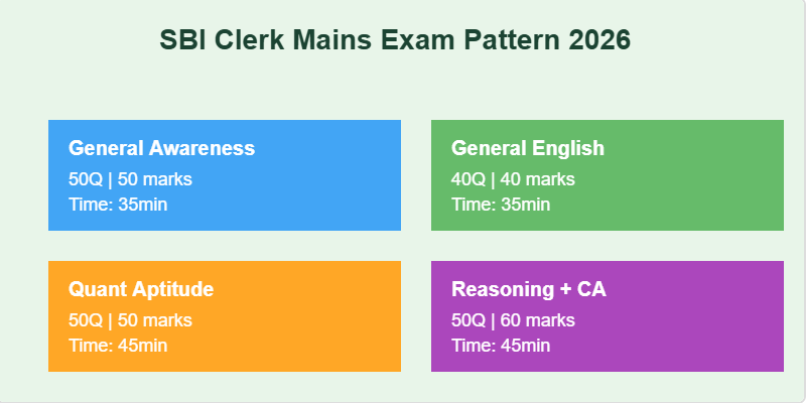
SBI Clerk Mains Exam Pattern Overview
SBI Clerk Mains Exam Overview
Before diving into the detailed syllabus, understanding the SBI Clerk Mains examination’s unique characteristics is essential:
Key Examination Characteristics
| Aspect | Details |
|---|---|
| Exam Mode | Online Computer-Based Test (CBT) |
| Question Type | Objective Multiple Choice Questions (MCQs) |
| Timing System | Sectional timing strictly enforced (cannot switch between sections) |
| Language Options | English & Hindi (except English Language section) |
| Selection Impact | 100% weightage — Mains score alone determines final merit |
| Interview Round | No interview for SBI Clerk position |
| Additional Stage | Local Language Test (qualifying only) |
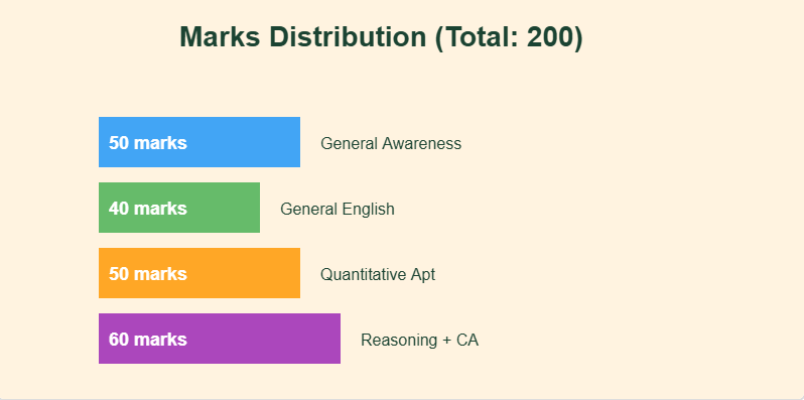
Marks Distribution — 200 Total Marks Across Sections
SBI Clerk Mains Exam Pattern 2026
The SBI Clerk Mains exam has a distinctive pattern with four sections of varying difficulty and question distribution. Understanding this pattern is crucial for effective preparation strategy.
Complete Exam Pattern Structure
| Section | No. of Questions | Maximum Marks | Time Allocated |
|---|---|---|---|
| General/Financial Awareness | 50 | 50 | 35 minutes |
| General English | 40 | 40 | 35 minutes |
| Quantitative Aptitude | 50 | 50 | 45 minutes |
| Reasoning Ability & Computer Aptitude | 50 | 60 | 45 minutes |
| Total | 190 | 200 | 160 minutes |
- Sectional Timing is Mandatory: You must complete each section within allocated time
- No Section Switching: Cannot go back to previous section after time expires
- Negative Marking Applies: 0.25 marks deduction for wrong answers
- Objective Type: All questions are Multiple Choice Questions (MCQs)
- Online Mode: Computer-based test (CBT) at designated centers
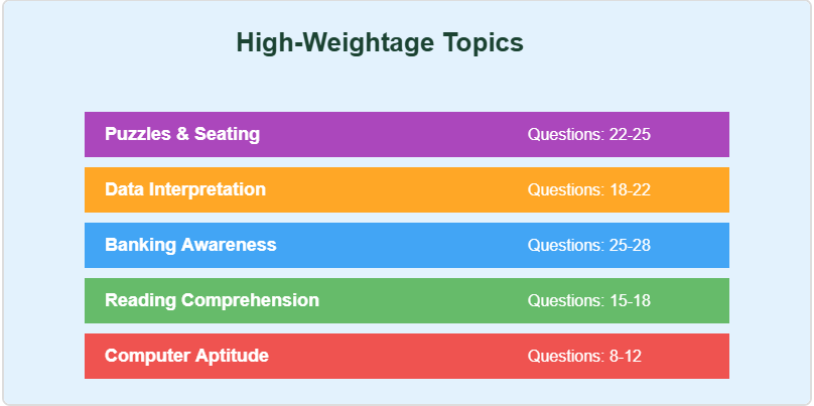
High-Weightage Topics — Top 5 Scoring Topics
SBI Clerk Mains Syllabus – Topic-wise & Section-wise
Now let’s examine each section’s syllabus comprehensively, with topic coverage, expected weightage, and preparation priorities.
1. General / Financial Awareness (50 Questions | 50 Marks)
Difficulty Level: Easy to Moderate
Time Allocated: 35 minutes
Focus Areas: Banking awareness + Current affairs (6 months)
Per Question Marks: 1.0
Target Accuracy: 85-90%
General Awareness is the most scoring section in SBI Clerk Mains. SBI typically asks more banking-focused questions compared to other exams. This section tests comprehensive awareness of banking policies, current affairs, and financial knowledge.
Complete Topic-wise Syllabus
| Topic Category | Specific Coverage | Expected Questions |
|---|---|---|
| Banking & Financial Awareness | RBI policies and monetary policy committee decisions, Banking regulations (Basel norms, NPA management), Digital banking initiatives (UPI, AEPS, BHIM), Financial inclusion schemes (PMJDY, PMJJBY), Payment systems (RTGS, NEFT, IMPS, SWIFT), Banking terminology (CASA, NIM, CDR, SARFAESI), Recent banking mergers and acquisitions, Bank headquarters and chairpersons | 25–28 |
| Current Affairs | National and international events (last 6 months), Economic surveys and union budget highlights, Government schemes and initiatives, Important appointments and resignations, Sports events and achievements, Awards and honors (national and international), Books and authors (especially finance/banking), Important summits and conferences | 15–18 |
| Static Banking Knowledge | Functions of RBI, SEBI, IRDAI, PFRDA, Types of banks (PSU, Private, RRB, Payment Banks), Financial markets and instruments, Credit rating agencies in India, Important committees and their recommendations, Priority sector lending categories | 5–7 |
SBI-Specific Focus Areas
- SBI’s digital initiatives: YONO, SBI Buddy, SBI Card offerings
- SBI mergers: Recent mergers with associate banks
- SBI international presence: Overseas branches and subsidiaries
- SBI awards and recognition: Banking technology awards
- SBI financial results: Quarterly performance highlights
- Daily reading: Economic Times/Business Standard (30 minutes daily)
- Banking focus: Read RBI Bulletin and Financial Express banking section
- SBI-specific knowledge: Follow SBI’s official website for updates
- Monthly consolidation: Use monthly banking awareness compilations
- Practice sets: Daily 50-question GA quiz for speed and accuracy
- Target: 42-45 correct attempts out of 50
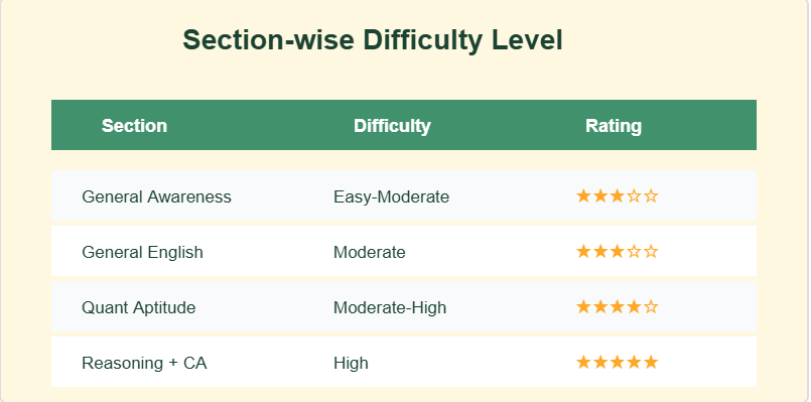
Difficulty Level — Section-wise Analysis
2. General English (40 Questions | 40 Marks)
Difficulty Level: Moderate
Time Allocated: 35 minutes
Focus Areas: Reading comprehension + Grammar + Vocabulary
Per Question Marks: 1.0
Target Accuracy: 80-85%
The English section in SBI Clerk Mains is more comprehensive than Prelims, with emphasis on comprehension and contextual understanding rather than rote learning.
Complete Topic-wise Syllabus
| Topic | Question Types | Expected Questions |
|---|---|---|
| Reading Comprehension | Long passages (500-700 words), Inference and deduction questions, Vocabulary in context, Author’s tone and purpose, Central idea and title selection | 15–18 |
| Cloze Test | Single passage with 8-10 blanks, Context-based word selection, Grammar and vocabulary combination | 8–10 |
| Error Detection | Sentence correction, Spot the error (4-5 parts), Grammar rules application | 5–7 |
| Para Jumbles / Sentence Rearrangement | 5-6 sentence rearrangement, Logical sequence identification, Opening and concluding sentences | 4–6 |
| Fill in the Blanks | Single/double blanks, Vocabulary and grammar based, Phrase replacement | 3–5 |
| Vocabulary | Synonyms/Antonyms, Idioms and phrases, One-word substitution, Spelling correction | 2–4 |
SBI English Section Characteristics
- RC passages: Often from economic/banking/financial topics
- Vocabulary: Banking and economic terminology frequently tested
- Grammar: Focus on practical usage rather than theoretical rules
- Difficulty: Higher than IBPS but manageable with practice
- Start with Error Detection (5 mins): Quick confidence builder
- Attempt RC (12-15 mins): When concentration is highest
- Cloze Test (8-10 mins): Context understanding crucial
- Para Jumbles (5-7 mins): Identify connectors and logical flow
- Vocabulary (3-4 mins): Skip if unfamiliar
- Target: 32-35 correct attempts out of 40
3. Quantitative Aptitude (50 Questions | 50 Marks)
Difficulty Level: Moderate to High
Time Allocated: 45 minutes
Focus Areas: Data Interpretation + Arithmetic
Per Question Marks: 1.0
Target Accuracy: 70-75%
Quantitative Aptitude in SBI Clerk Mains is calculation-intensive and time-pressured. The emphasis is on Data Interpretation and application-based arithmetic problems.
Complete Topic-wise Syllabus
| Topic | Sub-topics | Expected Questions |
|---|---|---|
| Data Interpretation | Table DI (complex multi-table), Bar Graphs (stacked, grouped), Line Charts (multiple lines), Pie Charts (multiple charts), Caselet DI (paragraph-based), Mixed Graphs (combination) | 18–22 |
| Arithmetic | Percentage, Profit & Loss, Simple & Compound Interest, Ratio & Proportion, Partnership, Time-Speed-Distance, Time & Work, Pipes & Cisterns, Ages, Averages, Mixtures | 15–18 |
| Number Series | Missing number pattern, Wrong number identification, Complex patterns (combination operations) | 5–7 |
| Quadratic Equations | Solving equations, Comparing roots, Sign-based questions | 4–6 |
| Simplification | BODMAS rules, Approximation, Decimal calculations | 3–5 |
SBI Quant Section Characteristics
- DI sets: Typically 3-4 sets with 5 questions each
- Calculation intensity: Higher than IBPS, requires approximation skills
- Arithmetic problems: Multi-step, real-life banking scenarios
- Time pressure: 54 seconds per question is challenging
- Start with Simplification (5 mins): Quick scoring
- Quadratic Equations (4-5 mins): Formula-based, high accuracy
- Number Series (5-6 mins): If pattern visible, else skip
- Select DI sets (15-18 mins): Attempt 2 sets completely
- Arithmetic selection (10-12 mins): Choose familiar topics
- Target: 35-40 correct attempts out of 50
- Key strategy: Quality over quantity, accuracy over attempts
4. Reasoning Ability & Computer Aptitude (50 Questions | 60 Marks)
Difficulty Level: High
Time Allocated: 45 minutes
Focus Areas: Complex puzzles + Computer fundamentals
Per Question Marks: 1.2
Target Accuracy: 70-75%
This is the highest-scoring section by total marks (60) and also the most time-consuming due to complex puzzle sets. SBI is known for innovative and challenging reasoning questions.
Complete Reasoning Topics Syllabus
| Reasoning Topic | Sub-topics / Question Types | Expected Questions |
|---|---|---|
| Puzzles & Seating Arrangement | Linear arrangement (uni/bi-directional), Circular arrangement (facing center/outside), Floor-based puzzles (multiple variables), Box-based arrangements, Scheduling (day/month/time), Blood relation based puzzles, Mixed puzzles (combination of types) | 22–25 |
| Syllogism | Statement-conclusion based, Possibility cases, Either-or conditions, Coded syllogism | 4–6 |
| Inequality | Direct inequality, Coded inequality, Combined statements | 3–5 |
| Blood Relations | Family tree problems, Coded relations, Generation-based questions | 3–4 |
| Direction Sense | Complex direction problems, Distance and direction combination, Shadow-based directions | 2–3 |
| Coding-Decoding | Letter shifting patterns, Number coding, Conditional coding | 2–3 |
| Alphanumeric Series | Missing term identification, Wrong term finding, Complex patterns | 2–3 |
Complete Computer Aptitude Topics Syllabus
| Computer Topic | Coverage Areas | Expected Questions |
|---|---|---|
| Computer Fundamentals | Hardware and software basics, Memory types and storage devices, Input/output devices, Computer generations and types | 2–3 |
| Operating Systems | Windows basics, Linux fundamentals, Mobile operating systems | 1–2 |
| Networking & Internet | Network types (LAN, WAN, MAN), Internet protocols (TCP/IP, HTTP, FTP), Email protocols (SMTP, POP3, IMAP), Cloud computing basics | 2–3 |
| MS Office | MS Word features and functions, MS Excel formulas and charts, MS PowerPoint basics, Keyboard shortcuts | 1–2 |
| Cyber Security & Banking Tech | Malware types (virus, worm, trojan), Phishing and hacking prevention, Digital banking security, Blockchain and cryptocurrency basics, UPI and digital payment systems | 2–3 |
- Start with Computer Aptitude (5 mins): Factual recall, quick scoring
- Attempt Syllogism & Inequality (6-8 mins): Formula-based accuracy
- Scan all puzzle sets (3 mins): Identify easiest set first
- Solve ONE complete puzzle set (8-10 mins): Get 5 questions correct
- Individual questions (10-12 mins): Blood relation, direction, coding
- Attempt another puzzle if time permits (8-10 mins)
- Target: 35-40 correct attempts out of 50
- Golden rule: Never spend more than 10 minutes on any puzzle set
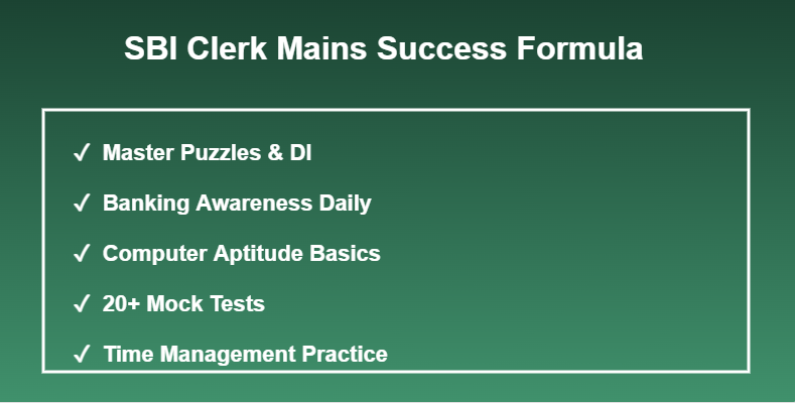
Success Formula — Key Preparation Strategies
Topic-wise Weightage Summary
Here’s a consolidated view of high-weightage topics that should be your preparation priorities:
| Section | High-Weight Topics (Priority 1) | Medium-Weight Topics (Priority 2) |
|---|---|---|
| General Awareness | Banking & Financial Awareness, Current Affairs (6 months), RBI Policies & Updates | Static Banking Knowledge, Government Schemes, Economic Survey & Budget |
| General English | Reading Comprehension, Cloze Test, Error Detection | Para Jumbles, Fill in the Blanks, Vocabulary |
| Quantitative Aptitude | Data Interpretation, Arithmetic (all topics), Number Series | Quadratic Equations, Simplification |
| Reasoning & Computer | Puzzles & Seating Arrangement, Computer Fundamentals, Syllogism & Inequality | Blood Relations, Direction Sense, Cyber Security |
Difficulty Level & PYQ Trends
Analyzing previous year SBI Clerk Mains papers reveals important trends for 2026 preparation:
| Section | 2024 Difficulty | 2025 Difficulty | 2026 Expected |
|---|---|---|---|
| General Awareness | Moderate | Easy-Moderate | Moderate |
| General English | Moderate | Moderate | Moderate |
| Quantitative Aptitude | Moderate-Difficult | Moderate | Moderate-Difficult |
| Reasoning & Computer | Difficult | Moderate-Difficult | Difficult |
- Increasing puzzle complexity: Multi-variable puzzles becoming standard
- Banking-focused GA: More questions on digital banking and RBI policies
- Practical computer questions: Less theory, more application-based
- DI complexity: Multiple chart combinations increasing
- Time pressure: Consistently the biggest challenge for candidates
High-Weight & Scoring Topics
Focus on these topics for maximum score improvement:
| Section | Most Scoring Topics | Expected Marks Contribution |
|---|---|---|
| General Awareness | Banking Awareness, Current Affairs | 40-45 marks |
| General English | Reading Comprehension, Error Detection | 25-30 marks |
| Quantitative Aptitude | Data Interpretation, Arithmetic | 30-35 marks |
| Reasoning & Computer | Puzzles, Computer Fundamentals | 35-40 marks |
Section-wise Preparation Strategy
General Awareness Strategy
- Daily 30-minute reading of financial newspapers
- Weekly revision of banking terminology
- Monthly current affairs consolidation
- Practice 50-question quizzes daily
General English Strategy
- Daily RC practice (2 passages)
- Weekly grammar rule revision
- Vocabulary building from economic articles
- Mock test analysis for time management
Quantitative Aptitude Strategy
- Daily DI practice (2 sets)
- Formula memorization and application
- Approximation techniques mastery
- Selective question attempt strategy
Reasoning & Computer Strategy
- Daily puzzle solving (2-3 sets)
- Computer fundamentals weekly revision
- Mock tests with strict timing
- Puzzle selection strategy development
Local Language Test — Format & Preparation
After qualifying Mains, candidates need to clear a local language test for states where they don’t have the local language as a subject in 10th/12th standard.
| Aspect | Details |
|---|---|
| Test Format | Basic proficiency test (reading, writing, speaking) |
| Duration | 15-20 minutes |
| Qualifying Nature | Marks not added to final merit |
| Exemption | If studied local language up to 10th/12th standard |
| Preparation | Basic grammar, common banking terms, simple conversations |
Common Mistakes to Avoid
- Underestimating General Awareness preparation time
- Spending excessive time on difficult puzzles
- Attempting all DI questions without selection
- Ignoring computer aptitude until last minute
- Not practicing with sectional timers
- Neglecting local language requirements
- Failing to analyze mock test performance
Frequently Asked Questions (FAQs) – SBI Clerk Mains Syllabus 2026
SBI Clerk Mains is the final written examination stage. After Mains, there’s a Local Language Test (qualifying only) for candidates without local language proficiency. The final selection is based solely on Mains marks.
SBI Clerk Mains has more questions (190 vs 155), longer duration (160 vs 120 minutes), higher puzzle complexity, and generally higher difficulty level. The competition is also more intense for SBI.
Reasoning Ability & Computer Aptitude carries 60 marks (highest total), followed by General Awareness and Quantitative Aptitude with 50 marks each, and General English with 40 marks.
Prepare at least 6 months of current affairs, with special focus on banking and economic developments. SBI often asks questions about recent banking reforms and digital initiatives.
Computer Aptitude questions are generally basic to moderate. Focus areas include computer fundamentals, networking, MS Office, cyber security, and digital banking concepts.
Candidates applying for a state where they haven’t studied the local language up to 10th/12th standard need to clear a basic proficiency test after qualifying Mains.
Suggested Next Reads
Conclusion
Mastering SBI Clerk Mains 2026 requires a comprehensive understanding of the syllabus, strategic preparation approach, and disciplined execution. With 190 questions across four sections in 160 minutes, time management and question selection become as important as subject knowledge.
Focus on high-weightage topics, develop puzzle-solving speed, maintain daily current affairs revision, and practice with realistic mock tests. Remember that SBI Clerk Mains is more challenging than IBPS, requiring deeper conceptual understanding and faster execution.
With consistent effort, smart strategy, and proper guidance, cracking SBI Clerk Mains 2026 is an achievable goal that opens doors to a rewarding career in India’s largest bank.
- Understand the Mains syllabus thoroughly before starting preparation
- Prioritize high-weight topics — GA, Puzzles, DI, and Banking Awareness
- Master sectional timing through mock tests
- Computer Aptitude is scoring — don’t neglect it
- SBI Clerk Mains is achievable with the right strategy and consistent effort
📌 For the latest updates and official notification, visit SBI Careers — sbi.co.in/careers