
Last Updated: June 27, 2026
SBI Clerk Prelims Syllabus 2026 — Complete Topic-wise Syllabus with Weightage & Strategy
Before you start preparing for SBI Clerk Prelims 2026, you need to know exactly what to study and what to skip. This guide breaks down the complete syllabus — topic by topic, with weightage and difficulty analysis — so you can plan your preparation strategically.
The SBI Clerk Prelims examination is the first stage of the selection process for one of India’s most coveted banking jobs. As the largest public sector bank, State Bank of India attracts millions of applicants annually, making the competition exceptionally fierce.
Unlike IBPS exams, SBI Clerk has its unique question pattern, difficulty level, and emphasis areas. The Prelims exam serves as a screening test to filter candidates for the Mains examination, where final selection takes place.
This comprehensive guide covers the complete SBI Clerk Prelims syllabus for 2026, including topic-wise breakdown, weightage analysis, difficulty trends, and strategic preparation tips. Whether you’re a first-time aspirant or appearing again, this structured approach will help you maximize your score within the 60-minute window.
📘 Table of Contents
- Introduction: Why SBI Clerk Syllabus is Unique
- SBI Clerk Prelims 2026 Exam Pattern
- Topic-Wise Syllabus Breakdown
- English Language
- Numerical Ability
- Reasoning Ability
- Weightage Analysis & PYQ Trends
- Difficulty Level & Recent Trends
- 90-Day Preparation Strategy
- Most Important Topics (Priority-wise)
- Common Mistakes to Avoid
- Frequently Asked Questions
- Suggested Next Reads
- Conclusion
⚡ Quick Summary – SBI Clerk Prelims Syllabus 2026
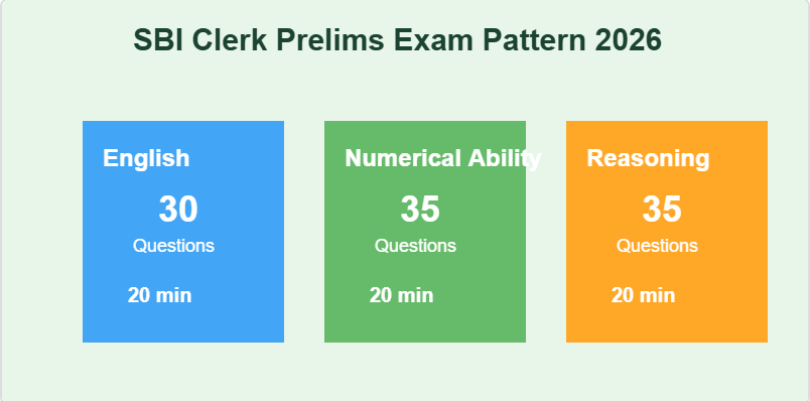
- Total Questions: 100 | Total Marks: 100 | Duration: 60 minutes
- Sections: English (30), Numerical Ability (35), Reasoning (35)
- Sectional Timing: 20 minutes each (cannot switch sections)
- High-Weight Topics: Puzzles, Data Interpretation, Reading Comprehension
- Difficulty: Moderate (higher than IBPS Clerk)
- Cut-off Trend: General category: 68-75/100 (varies yearly)
- Best Strategy: Accuracy + Speed + Smart Attempts
Introduction: Why SBI Clerk Syllabus is Unique from Other Bank Clerk Exams
Before we dive into the detailed syllabus, let’s understand what makes SBI Clerk Prelims unique. State Bank of India is not just any bank — it’s the country’s largest public sector bank with over 22,000 branches. The Prelims syllabus reflects this prestige by being slightly more challenging and competitive than other bank clerk exams.
The SBI Clerk Prelims syllabus follows a similar structure to IBPS Clerk but with key differences — the competition is more intense (SBI is the most sought-after bank), the difficulty level is generally higher, and the cut-offs are typically higher across all categories. SBI also emphasizes certain topics more heavily than IBPS.
This guide covers everything you need to know about the SBI Clerk Prelims syllabus for 2026, with practical examples and strategic insights to help you maximize your score within the 60-minute window.
SBI Clerk Prelims Syllabus Overview
SBI Clerk Prelims 2026 Exam Pattern
Understanding the exam pattern is crucial before diving into the syllabus. SBI Clerk Prelims follows a standardized pattern with minor variations in difficulty each year.
| Section | No. of Questions | Maximum Marks | Duration | Language |
|---|---|---|---|---|
| English Language | 30 | 30 | 20 minutes | English Only |
| Numerical Ability | 35 | 35 | 20 minutes | English & Hindi |
| Reasoning Ability | 35 | 35 | 20 minutes | English & Hindi |
| Total | 100 | 100 | 60 minutes | – |
- Sectional Timing is Mandatory: You cannot move to next section before 20 minutes or go back to previous section
- Negative Marking: 0.25 marks deducted for each wrong answer
- Sectional Cut-off: Must clear each section’s cut-off individually
- Overall Cut-off: Must clear overall cut-off based on category
High-Weightage Topics — Top 5 Scoring Topics
Topic-Wise Syllabus Breakdown
The SBI Clerk Prelims syllabus is comprehensive but predictable. Here’s the detailed breakdown based on previous years’ question papers and official notifications.
1. English Language Syllabus (30 Questions)
Difficulty Level: Easy to Moderate
Focus Areas: Reading Comprehension, Grammar, Vocabulary
| Topic | Sub-Topics Covered | Expected Questions | Importance Level |
|---|---|---|---|
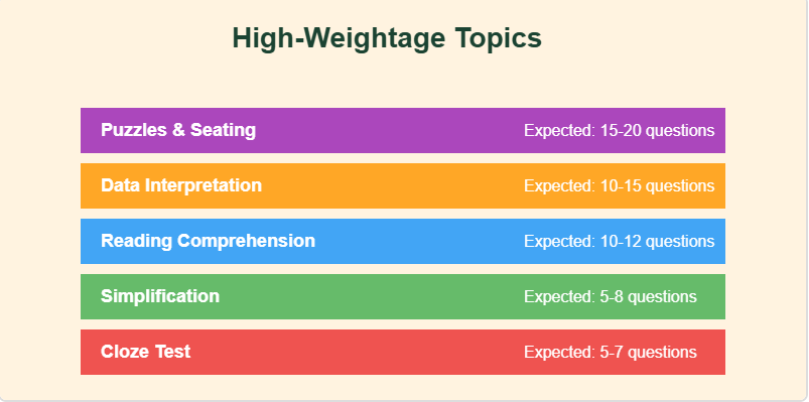
| Reading Comprehension | Passages (2-3), Fact/Inference, Theme, Vocabulary in context | 10-12 | Very High |
| Cloze Test | Single passage with 5-10 blanks, contextual grammar | 5-7 | Very High |
| Error Detection | Spotting errors in sentences, grammar rules application | 5-6 | High |
| Para Jumbles | Sentence rearrangement, logical flow | 4-5 | High |
| Fill in the Blanks | Single/double blanks, vocabulary-based | 3-4 | Moderate |
| Vocabulary | Synonyms, Antonyms, Spellings, Word usage | 2-3 | Moderate |
- Start with RC: Attempt Reading Comprehension first (8-10 minutes)
- Then Cloze Test: Usually quick to solve if grammar basics are clear
- Error Detection: High accuracy possible with practice
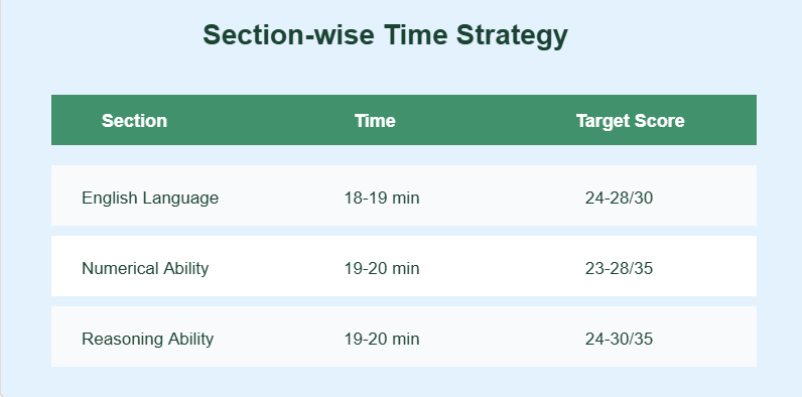
- Time Allocation: 18-19 minutes maximum, keep 1-2 minutes for review
2. Numerical Ability Syllabus (35 Questions)
Difficulty Level: Moderate to Difficult
Focus Areas: Speed + Accuracy + Approximation Skills
| Topic | Sub-Topics Covered | Expected Questions | Importance Level |
|---|---|---|---|
| Data Interpretation | Tables, Bar Graphs, Line Graphs, Pie Charts, Caselets | 10-15 | Very High |
| Simplification & Approximation | BODMAS, Decimals, Fractions, Square/Cube roots | 5-8 | Very High |
| Number Series | Missing Number, Wrong Number, Pattern-based | 5-6 | High |
| Arithmetic Problems | Percentage, Ratio, Profit/Loss, SI/CI, Time & Work, Speed & Distance | 8-10 | High |
| Quadratic Equations | Comparing roots (x>y, x| 4-5 |
Moderate |
|
| Miscellaneous | Probability, Mensuration, Average, Mixtures | 2-3 | Low |
3. Reasoning Ability Syllabus (35 Questions)
Difficulty Level: Moderate to Difficult
Focus Areas: Puzzles, Logical Reasoning, Analytical Skills
| Topic | Sub-Topics Covered | Expected Questions | Importance Level |
|---|---|---|---|
| Puzzles & Seating Arrangement | Linear, Circular, Square, Floor, Box, Scheduling, Month-based | 15-20 | Very High |
| Inequality | Direct, Coded, Combined inequalities | 4-5 | High |
| Syllogism | Venn diagrams, Possibility cases, New pattern | 4-5 | High |
| Blood Relations | Family tree, Coded relations | 3-4 | Moderate |
| Direction Sense | Distance-based, Shadow-based | 2-3 | Moderate |
| Coding-Decoding | Letter coding, Number coding, New pattern | 2-3 | Moderate |
| Alphanumeric Series | Mixed series, Missing term | 3-4 | Moderate |
| Miscellaneous | Order/Ranking, Input-Output, Data Sufficiency | 2-3 | Low |
- Puzzles First: Start with easier puzzles (floor-based, linear)
- Time Limit: Maximum 8 minutes per puzzle set (5 questions)
- Quick Topics: Inequality & Syllogism should take 4-5 minutes total
- Avoid Time Traps: If a puzzle looks too complex, skip and return later
Time Strategy — Section-wise Time Management
Weightage Analysis & PYQ Trends
Based on analysis of SBI Clerk Prelims 2019-2025 papers, here’s the detailed weightage distribution:
Section-wise Weightage Distribution
| Section | Total Questions | High-Weight Topics | Marks Contribution | Time Recommended |
|---|---|---|---|---|
| English Language | 30 | RC (10-12), Cloze (5-7), Error (5-6) | 20-25 marks | 18-19 minutes |
| Numerical Ability | 35 | DI (10-15), Arithmetic (8-10), Simplification (5-8) | 23-33 marks | 19-20 minutes |
| Reasoning Ability | 35 | Puzzles (15-20), Inequality (4-5), Syllogism (4-5) | 23-30 marks | 19-20 minutes |
Difficulty Level & Recent Trends
SBI Clerk Prelims difficulty has shown a consistent pattern over the years. Here’s what to expect in 2026:
| Section | Difficulty Trend | Time Pressure | Scoring Potential | Key Challenges |
|---|---|---|---|---|
| English Language | Easy-Moderate | Low | High (24-28/30) | Tricky RC questions, vocabulary traps |
| Numerical Ability | Moderate-Difficult | High | Moderate (20-26/35) | Calculation speed, DI interpretation |
| Reasoning Ability | Moderate-Difficult | Very High | Moderate-High (22-28/35) | Complex puzzles, time management |
Year-wise Difficulty Comparison
- 2020: Moderate across all sections
- 2021: English easy, Quant moderate, Reasoning difficult
- 2022: All sections moderate
- 2023: Quant difficult, others moderate
- 2024: Balanced difficulty, emphasis on speed
- 2025: Slightly easier than previous years
- 2026 Prediction: Moderate difficulty with emphasis on application
90-Day Preparation Timeline
90-Day Preparation Strategy for SBI Clerk Prelims 2026
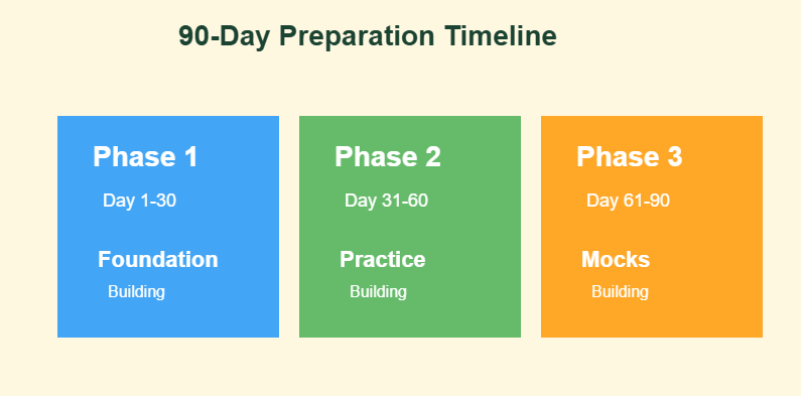
A structured 90-day plan can help you cover the entire syllabus systematically. Here’s a phase-wise approach:
Phase 1: Foundation Building (Days 1-30)
- Complete basic concepts of all topics
- Learn all formulas (Quant) and rules (Reasoning, English)
- Develop reading habit (30 mins daily newspaper)
- Solve 50+ topic-wise questions daily
- Maintain error log and formula notebook
Phase 2: Practice & Speed Building (Days 31-60)
- Solve 75-100 questions daily with timer
- Take 15-20 sectional tests weekly
- Focus on high-weight topics (Puzzles, DI, RC)
- Work on calculation shortcuts
- Revise weak areas identified in tests
Phase 3: Mock Tests & Revision (Days 61-90)
- Take 25-30 full-length mock tests
- Analyze each mock thoroughly (2-3 hours analysis per mock)
- Work on time management strategies
- Revise formulas, rules, shortcuts
- Focus on accuracy improvement
- Morning (2 hours): Numerical Ability practice
- Afternoon (1.5 hours): English Language + Reading
- Evening (2 hours): Reasoning Ability practice
- Night (1 hour): Revision + Mock test analysis
- Total: 6.5 hours focused study daily
Most Important Topics (Priority-wise)
If you have limited time, focus on these high-yield topics that give maximum marks:
Tier 1: Must-Master Topics (70% of marks)
- Reasoning: Puzzles & Seating Arrangement (15-20 questions)
- Numerical Ability: Data Interpretation (10-15 questions)
- Numerical Ability: Simplification & Approximation (5-8 questions)
- English: Reading Comprehension (10-12 questions)
- English: Cloze Test (5-7 questions)
Tier 2: High-Scoring Topics (20% of marks)
- Reasoning: Inequality (4-5 questions)
- Reasoning: Syllogism (4-5 questions)
- Numerical Ability: Number Series (5-6 questions)
- Numerical Ability: Quadratic Equations (4-5 questions)
- English: Error Detection (5-6 questions)
Tier 3: Bonus Topics (10% of marks)
- Reasoning: Blood Relations, Direction Sense
- Numerical Ability: Arithmetic Word Problems
- English: Para Jumbles, Fill in the Blanks
- Mastering Tier 1 topics alone can get you 60-70 marks
- Adding Tier 2 topics can take you to 75-85 marks
- Tier 3 topics are for topping up if time permits
- Strategy: Perfect Tier 1 → Master Tier 2 → Polish Tier 3
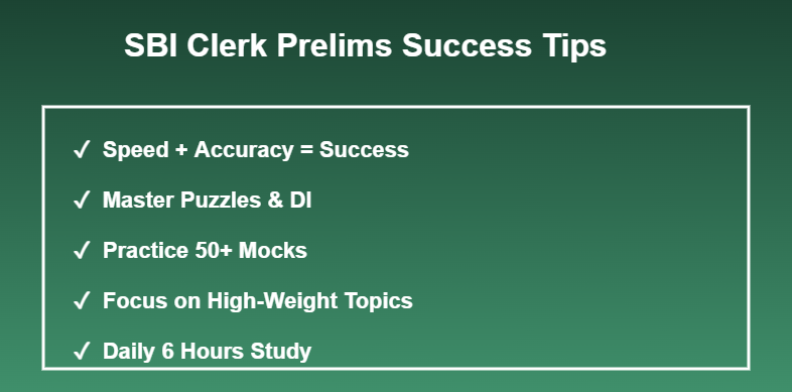
Success Tips — Key Preparation Checklist
Common Mistakes to Avoid
Learning from others’ mistakes can save you valuable marks. Here are the most common errors SBI Clerk aspirants make:
Preparation Phase Mistakes
- Ignoring English section — It’s the easiest to score but often neglected
- Solving without timer — Speed is as important as accuracy
- Not analyzing mock tests — Taking mocks without analysis is wasted effort
- Overlooking basics — Weak fundamentals fail under time pressure
- Chasing all topics equally — Focus on high-weight topics first
Exam Day Mistakes
- Starting with difficult questions — Begin with easy ones to build confidence
- Spending too long on one question — Set time limits for each question type
- Not using rough paper effectively — Organize your work for puzzles and DI
- Panicking in tough sections — Stay calm, everyone faces the same paper
- Changing answers last minute — First instinct is usually correct
Frequently Asked Questions (FAQs) – SBI Clerk Prelims Syllabus 2026
Yes, generally SBI Clerk Prelims is considered slightly tougher than IBPS Clerk, especially in Reasoning and Quantitative Aptitude sections. The competition is also higher for SBI due to the bank’s prestige and better salary package.
It varies by category and year. Generally: General — 70-75+, OBC — 65-70+, SC — 60-65+, ST — 55-60+. These are approximate figures based on previous years’ cut-offs and should be used as guidance.
No. Calculators or any electronic devices are strictly prohibited. An on-screen calculator may be provided for Numerical Ability, but reliance on it slows you down. Practice mental calculations for speed.
Extremely difficult. Puzzles constitute 15-20 questions (43-57% of Reasoning section). Skipping them would require near-perfect scores in other sections, which is practically impossible given time constraints.
Major pattern changes are unlikely. SBI maintains consistency in exam pattern. Minor tweaks in question types or difficulty level may occur based on previous year’s analysis.
For beginners: 4-5 months of dedicated preparation. For those with basic knowledge: 2-3 months of focused study. Consistent daily practice of 5-6 hours is recommended for good results.
Suggested Next Reads
Conclusion
The SBI Clerk Prelims 2026 is a challenging but crackable examination with the right strategy. The key to success lies in understanding the syllabus thoroughly and focusing on high-weight topics, developing speed and accuracy through regular timed practice, mastering shortcuts and tricks for calculations and problem-solving, taking regular mock tests and analyzing performance meticulously, and managing time effectively during both preparation and examination.
Remember that SBI Clerk Prelims is just the first step. Clearing it comfortably gives you psychological advantage and ample time to prepare for the Mains examination, where the real battle for final selection happens.
- Complete all high-weight topics with proficiency
- Solve 50+ mock tests with detailed analysis
- Revise all formulas, rules, and shortcuts weekly
- Improve reading speed for English section
- Practice mental calculations for Numerical Ability
- Develop puzzle-solving frameworks for Reasoning
📌 For the latest updates and official notification, visit SBI Careers — sbi.co.in/careers