
Last Updated: June 27, 2026
SBI Clerk (Junior Associate) Selection Process 2026: Complete Guide
Before you start preparing for SBI Clerk 2026, you need to understand the complete selection process. This guide breaks down every stage — Prelims, Mains, Local Language Test, normalisation, and final allotment — so you know exactly what to expect at each step.
The SBI Clerk (Junior Associate) examination is one of the most prestigious and sought-after banking recruitment exams in India. As the largest public sector bank, State Bank of India offers excellent career opportunities, job security, and attractive benefits through its Clerk recruitment.
What makes SBI Clerk highly attractive for aspirants is the highest salary package among all bank clerks, excellent career progression opportunities, prestige of working with India’s largest bank, comprehensive benefits and job security, and pan-India presence with diverse posting locations.
The SBI Clerk Selection Process 2026 follows a two-tier examination system consisting of Preliminary and Mains exams, followed by a local language test and document verification. Unlike SBI PO, there is no interview for Clerk positions.
This comprehensive guide covers the complete SBI Clerk selection process for 2026, including detailed exam patterns, marking schemes, sectional timing rules, cut-off requirements, normalisation process, language proficiency test, and document verification. Whether you’re a first-time aspirant or a repeater, understanding the selection process will help you prepare strategically and maximize your chances of success.
📘 Table of Contents
- Introduction: Why Understanding the Selection Process Matters
- SBI Clerk Selection Process Overview
- Stage 1: SBI Clerk Prelims Exam
- Exam Pattern
- Marking Scheme
- Cut-off Rules
- Stage 2: SBI Clerk Mains Exam
- Exam Pattern
- Marking Scheme
- Cut-off Rules
- Final Selection Process
- Local Language Proficiency Test
- Normalisation Process
- Documents Required for Verification
- Frequently Asked Questions
- Suggested Next Reads
- Conclusion
⚡ Quick Summary – SBI Clerk Selection Process 2026
- Two exam stages: Prelims → Mains → Final Merit
- No interview for SBI Clerk positions
- Prelims is qualifying only – marks not counted in final merit
- Final merit based on Mains marks only
- Local Language Test is mandatory (qualifying only)
- Normalisation applies to both Prelims and Mains
- Provisional selection followed by document verification
Introduction: Why Understanding the Selection Process Matters Before You Start Preparing
The SBI Clerk exam is one of India’s most prestigious banking recruitment exams, with over 20-25 lakh aspirants applying for approximately 8,000-10,000 positions each year. The selection process is designed to be fair, transparent, and merit-based. Unlike PO recruitment which includes an interview, the Clerk selection is purely examination-based.
Many candidates make the mistake of preparing without understanding the selection process fully. They focus only on Prelims, assuming that clearing it is enough. But the reality is that Prelims is just the first filter — your final selection depends almost entirely on your Mains performance.
This comprehensive guide covers the complete SBI Clerk selection process for 2026, including detailed exam patterns, marking schemes, sectional timing rules, cut-off requirements, normalisation process, language proficiency test, and document verification. Whether you’re a first-time aspirant or a repeater, understanding the selection process will help you prepare strategically and maximize your chances of success.
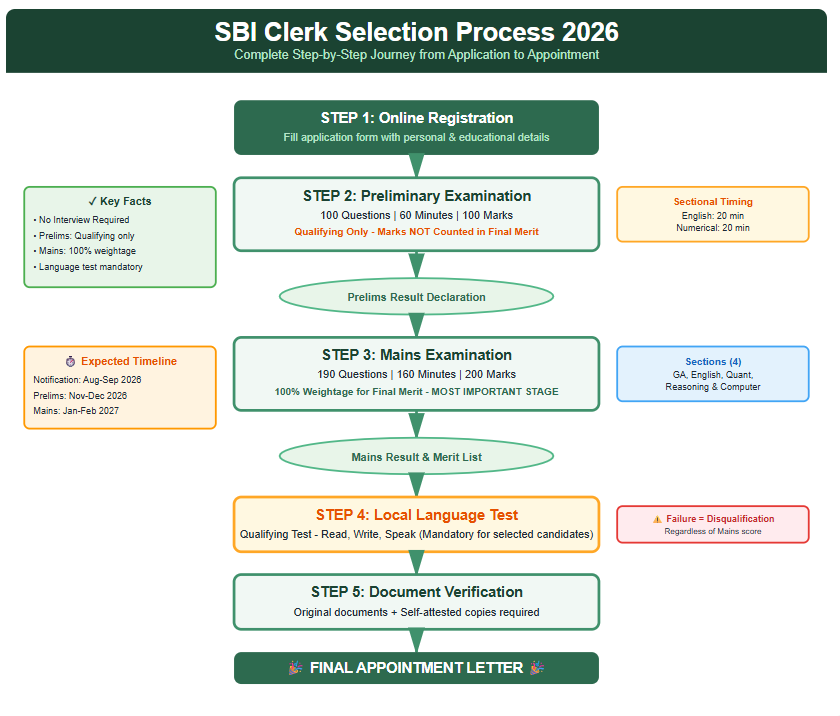
SBI Clerk Selection Process 2026 — Complete Flowchart
SBI Clerk Selection Process Overview
The SBI Clerk selection process is designed to be comprehensive yet fair, focusing on assessing candidates’ aptitude, reasoning abilities, and banking awareness. The entire process is completed in multiple stages with clear cut-offs at each level.
- Prelims marks are NOT counted in final merit
- Only Mains exam marks determine final ranking
- Local Language Test is qualifying in nature
Complete Selection Timeline
| Stage | Purpose | Impact on Final Selection |
|---|---|---|
| Preliminary Exam | Screening test to shortlist for Mains | Qualifying only (marks NOT counted) |
| Mains Exam | Determines final merit ranking | 100% weightage for final merit |
| Local Language Test | Verification of local language proficiency | Qualifying (must pass to proceed) |
| Document Verification | Verification of eligibility documents | Mandatory final step |
| Final Allotment | Branch/state allocation based on merit | Based on Mains score and preferences |
Step-by-Step Selection Process
- Online Registration → Fill application form with personal/educational details
- Preliminary Exam → Clear sectional and overall cut-offs
- Mains Exam Admit Card → Released for qualified candidates
- Mains Exam → Performance here decides final rank
- Provisional Selection List → Based on Mains merit
- Local Language Test → Qualifying test for selected candidates
- Document Verification → Submission of original documents
- Final Appointment → Joining letter from SBI
Stage 1 — SBI Clerk Preliminary Exam
The Preliminary Exam serves as a screening test. Its purpose is to filter candidates for the Mains exam. Remember: Prelims marks have NO impact on your final selection.
1. SBI Clerk Prelims Exam Pattern
The Prelims exam is conducted online with sectional timing. You cannot move between sections during the allocated time.
| Section | Questions | Marks | Time Allocated |
|---|---|---|---|
| English Language | 30 | 30 | 20 minutes |
| Numerical Ability | 35 | 35 | 20 minutes |
| Reasoning Ability | 35 | 35 | 20 minutes |
| Total | 100 | 100 | 60 minutes |
- Sectional timing is strict – 20 minutes per section
- No backward navigation within sections
- All questions are MCQs with four options
- Conducted in multiple shifts over several days
- Language: English and Hindi (except English section)
2. Marking Scheme (Prelims)
Understanding the marking scheme is crucial for strategy:
- +1 mark for each correct answer
- –0.25 mark for each wrong answer
- No penalty for unattempted questions
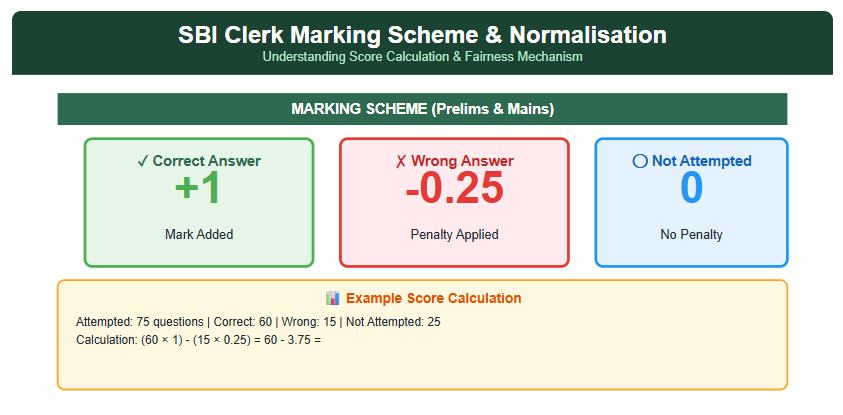
Marking Scheme & Normalisation Process
3. Cut-off Rules (Prelims)
To qualify for Mains, candidates must clear:
- Sectional Cut-off: Minimum marks in each section
- Overall Cut-off: Minimum total marks
Both cut-offs must be cleared. Even with high overall marks, failing one sectional cut-off leads to disqualification.
Qualification Ratio for Mains
SBI typically shortlists 10-15 candidates per vacancy for the Mains exam. This means if there are 5,000 vacancies, approximately 50,000-75,000 candidates will be called for Mains.
Stage 2 — SBI Clerk Mains Exam
The Mains exam is the most critical stage of SBI Clerk selection. Your performance here alone determines your final ranking and branch allotment.
1. SBI Clerk Mains Exam Pattern
| Section | Questions | Marks | Time Allocated |
|---|---|---|---|
| General/Financial Awareness | 50 | 50 | 35 minutes |
| General English | 40 | 40 | 35 minutes |
| Quantitative Aptitude | 50 | 50 | 45 minutes |
| Reasoning Ability & Computer Aptitude | 50 | 60 | 45 minutes |
| Total | 190 | 200 | 160 minutes |
- No descriptive paper – all objective questions
- Sectional timing for each section
- Computer Aptitude included in Reasoning section
- Higher difficulty level than Prelims
- Normalisation applied due to multiple shifts
2. Marking Scheme (Mains)
- +1 mark for each correct answer
- –0.25 mark for each wrong answer
- No penalty for unattempted questions
- Normalisation applied to final scores
3. Cut-off Rules (Mains)
Candidates must clear the overall cut-off to be considered for final selection. Sectional cut-offs may or may not apply depending on SBI’s decision for that year.
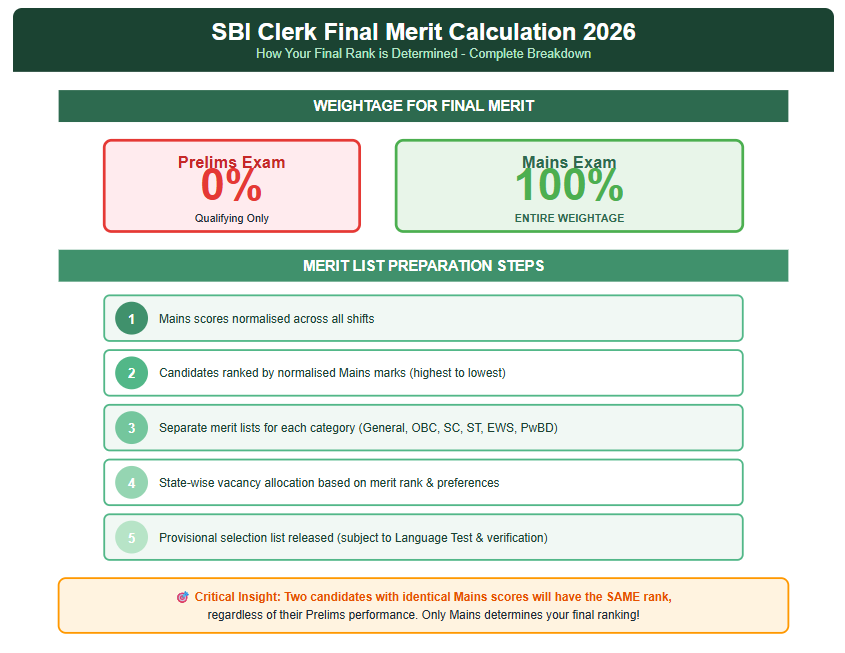
Final Merit Calculation & Selection
Final Merit List Preparation
- Candidates ranked based on Mains exam scores only
- Category-wise merit lists prepared
- State-wise and category-wise vacancies filled
- Provisional allotment based on merit rank, state preferences, vacancy availability, and category reservation
- Local Language Test conducted
- Document verification completed
- Final appointment letters issued
Final Selection Process
After the Mains exam results are declared, SBI follows a systematic final selection process:
1. Provisional Selection List
SBI releases a provisional selection list based on Mains exam scores (normalised), category-wise merit, state-wise vacancies, and reservation norms.
2. Local Language Test (LLT)
All provisionally selected candidates must undergo a Local Language Test. This is a qualifying test and failure leads to cancellation of candidature.
3. Document Verification
Candidates must produce original documents for verification. Any discrepancy leads to disqualification.
4. Medical Examination
Selected candidates undergo a basic medical examination to ensure fitness for the job.
5. Final Allotment
Based on successful completion of all above stages, final allotment letters are issued with designated branch, joining date, reporting instructions, and required documents for joining.
Local Language Proficiency Test
The Local Language Test (LLT) is a mandatory qualifying test for SBI Clerk recruitment. Unlike other stages, this is not an online exam but a face-to-face evaluation.
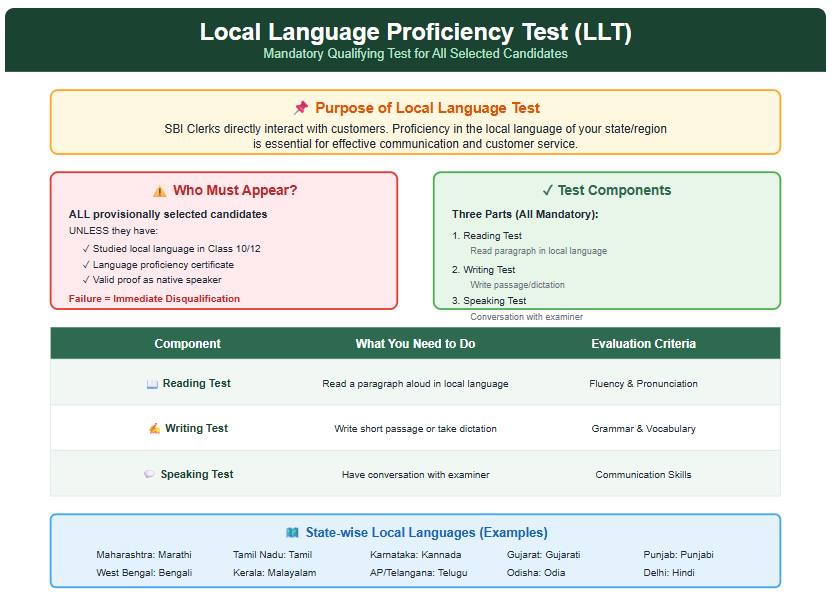
Local Language Test (LLT) — Requirements & Process
Purpose of LLT
Since SBI Clerks directly interact with customers, proficiency in the local language of the state/region is essential. The test ensures candidates can effectively communicate in the local language.
Who Must Appear for LLT?
All provisionally selected candidates must appear for LLT unless they have studied the local language in Class 10 or 12 (as per marksheet) or have a certificate of proficiency in the local language.
- Formal study of local language up to Class 10 or above
- Certificate from recognized institution
- Native language speakers (with proof)
LLT Format
| Component | Description | Evaluation |
|---|---|---|
| Reading Test | Read a paragraph in local language | Fluency and pronunciation |
| Writing Test | Write a short passage/dictation | Grammar and vocabulary |
| Speaking Test | Conversation with examiner | Communication skills |
State-wise Local Languages
| State/UT | Local Language(s) |
|---|---|
| Maharashtra | Marathi |
| Tamil Nadu | Tamil |
| West Bengal | Bengali |
| Karnataka | Kannada |
| Gujarat | Gujarati |
| Punjab | Punjabi |
| Kerala | Malayalam |
| Andhra Pradesh | Telugu |
Normalisation Process
SBI applies a normalisation process to ensure fairness since exams are conducted in multiple shifts with possible difficulty variations.
Why Normalisation?
With multiple exam shifts, slight variations in question difficulty can occur. Normalisation ensures no candidate is advantaged or disadvantaged by their shift allocation.
- Applied to both Prelims and Mains
- Uses statistical methods for fairness
- Adjusts scores based on shift difficulty
- Final scores shown are normalised scores
Normalisation Method
SBI typically uses the Equipercentile Method:
- Raw scores calculated for each shift
- Percentile ranks determined within each shift
- Scores mapped to a common scale
- Normalised scores computed
Documents Required for Verification
Candidates must produce the following original documents with self-attested photocopies:
Essential Documents
- SBI Call Letter for document verification
- Online Application Form printout
- Photo Identity Proof: Aadhaar, PAN, Passport, Voter ID, Driving License
- Date of Birth Proof: Class 10 certificate/birth certificate
- Educational Certificates: Graduation degree/provisional certificate, all mark sheets (graduation), Class 10 and 12 certificates
- Caste Certificate (if applicable)
- Income & Asset Certificate (for EWS)
- Disability Certificate (for PwBD)
- Ex-Servicemen Certificate (if applicable)
- Recent Photographs
- All documents must be in prescribed format
- Name consistency across documents is crucial
- Certificates must be valid (not expired)
- Bring both originals and photocopies
Frequently Asked Questions (FAQs) – SBI Clerk Selection Process 2026
There are two exam stages (Prelims and Mains) followed by Local Language Test and document verification. There is no interview for SBI Clerk positions.
No. SBI Clerk selection is purely exam-based with no interview component. This makes the process completely objective and merit-based.
No. Prelims is only qualifying. Final merit is based solely on Mains exam marks. Your Prelims score has zero impact on your final rank.
Yes, for all selected candidates unless they have proof of studying the language in Class 10/12. Failure leads to disqualification regardless of Mains score.
Yes, 0.25 marks are deducted for each wrong answer in both Prelims and Mains. No marks are deducted for unattempted questions.
Based on Mains exam scores only. Candidates are ranked category-wise and state-wise. Higher Mains score leads to better rank and preferred state allotment.
Suggested Next Reads
Conclusion
The SBI Clerk Selection Process 2026 offers a transparent, merit-based pathway to a prestigious banking career. With its structured two-exam system and emphasis on local language proficiency, SBI ensures it selects capable candidates who can effectively serve customers across India.
Key success strategies include focusing on Mains preparation as it determines your final rank, clearing Prelims comfortably with a 20-25% margin above expected cut-off, verifying language requirements before applying, practicing with accuracy as negative marking is significant, preparing documents in advance to avoid last-minute issues, and staying updated with official SBI notifications.
Start your preparation early, focus on building strong fundamentals in all sections, and practice regularly with mock tests. With dedication and strategic preparation, you can successfully navigate the SBI Clerk selection process and secure a rewarding career with India’s largest bank.
- Understand the selection process thoroughly before starting preparation
- Focus on Mains — it’s the only exam that counts for final selection
- Prepare for Local Language Test if you don’t have language proof
- Maintain accuracy in practice due to negative marking
- SBI Clerk is achievable with the right strategy and consistent effort
📌 For the latest updates and official notification, visit SBI Careers — sbi.co.in/careers